Ask ten ecommerce operators for scalability examples and you'll get the same list: Amazon, Google, Netflix, maybe Shopify. Then nothing. No translation, no next step, just war stories from companies with thousands of engineers and budgets you'll never see.
The popular advice that follows is to copy the architecture. Split everything into microservices. Shard the database. Put Kubernetes underneath. That advice is wrong for almost every Shopify store and app, and not because the stories are bad. It's wrong because those teams were solving different problems under different constraints, and the parts that made them famous (headcount, custom hardware, a decade of runway) aren't the parts that made them work.
What transfers is the pattern, never the stack. Instagram's sharding trick is a decision about IDs. Netflix's resilience work is a decision about testing failure on purpose. Stack Overflow's efficiency is a decision about profiling before buying hardware. Each one maps onto Shopify work you can start this month.
Below are eight of those examples, each with the problem the company faced, the pattern in plain terms, the implementation details that matter, where it breaks, and the one move to copy next sprint. Scalability examples only earn their place in a roundup if you can reuse them.
Table of Contents
- 1. Shopify Pod Architecture (Shop-Based Sharding)
- 2. Instagram Postgres Logical Sharding
- 3. Netflix Microservices and Chaos Engineering
- 4. Shopify Admin API Rate Limits and Bulk Operations
- 5. Horizontal Autoscaling with Kubernetes and Cloud Auto Scaling
- 6. Cloudflare Global Edge Network and CDN Caching
- 7. Programmatic SEO at Scale with Template Pages
- 8. Vertical Scaling at Stack Overflow
- Scalability Examples Compared
- Which Scalability Pattern Fits Your Store or App?
1. Shopify Pod Architecture (Shop-Based Sharding)
The platform your app runs on already solved multi-tenancy at a scale you'll never touch. Most apps then ignore the lesson. The structure is worth internalizing before you design a single table.
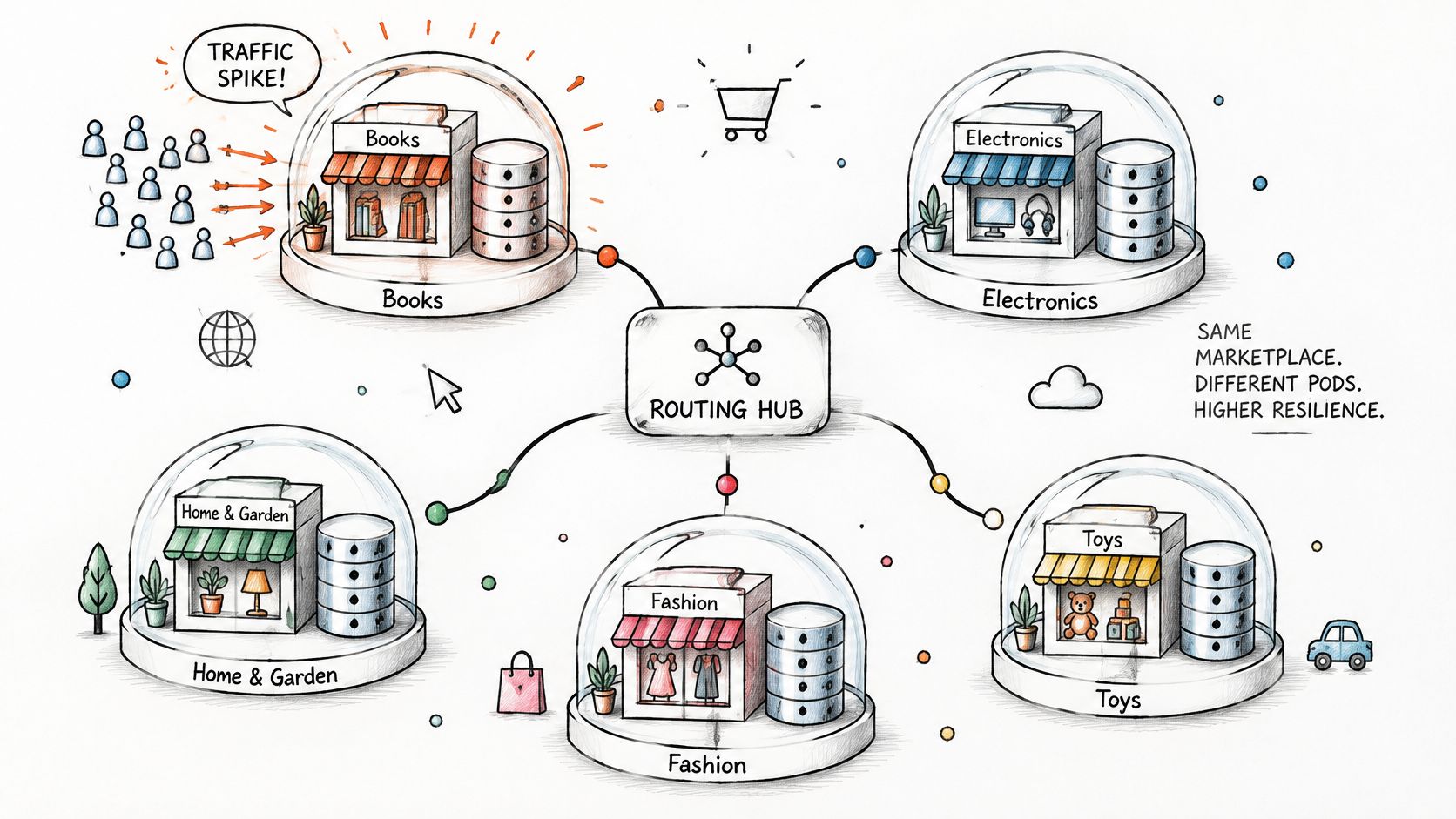
Shopify groups merchant stores into isolated units called pods. Each pod carries its own database and application resources, and every store belongs to exactly one pod. A merchant whose flash sale triples order volume pushes against their own pod's ceiling, not the platform's. Capacity grows by adding pods rather than rebuilding one enormous shared system, which is how the platform absorbs Black Friday and Cyber Monday peaks while serving millions of independent stores.
Where apps break the model
Containment costs nothing until you write a query that spans every shop. A nightly job that loops over all installed stores inside one transaction turns your app into exactly the shared-fate system the pod design avoids.
Say your app imports catalogs. If a 60,000-SKU merchant's import shares a queue and a connection pool with everyone else, that one merchant slows webhook processing for every other store during the busiest week of their year. The fix is structural, not a bigger instance.
- Key every record by shop. Store the shop domain or shop ID as a column on every table and in every job payload, not just in a session variable that disappears at the queue boundary.
- Scope every background job to one shop. A job that processes ten thousand stores should be ten thousand jobs, so one failure retries alone.
- Budget throttling per shop. A shared rate budget lets your loudest merchant starve the quiet ones.
If one merchant's worst day can degrade another merchant's storefront, you don't have a multi-tenant system. You have shared fate with a nice logo.
2. Instagram Postgres Logical Sharding
Instagram split its PostgreSQL data into many logical shards mapped onto a smaller number of physical database servers. Each shard ID lived inside the primary key, so any object's home could be derived from its ID alone. Moving a shard to a new machine became an infrastructure operation instead of an application rewrite, and that's what carried the product through growth to hundreds of millions of users.
Partitioning pays off in maintenance, not just capacity
Netflix rebuilt its time-series storage by distributing data across systems per member, and the results were as much about human cost as machine cost. Netflix's engineering writeup on scaling time-series data storage reports roughly a sixfold reduction in data size, a thirteenfold reduction in time spent on Cassandra maintenance, and a fivefold reduction in average read latency. Fewer bytes also means fewer hours of human attention.
The Shopify version of this is smaller and just as real. Picture an app that stores crawl results or AI outputs per shop. If the job IDs are global autoincrements, every insert lands on the same index tail and every archive job scans the whole table.
- Choose a shard key that matches your hottest query. Shop ID for merchant-facing data, customer ID for order history, never a field you rarely filter on.
- Bake the shard into the ID from day one. A prefixed ULID or composite key costs nothing now and saves a migration later.
- Plan resharding before you need it. Start with more logical shards than servers so you can move them without splitting rows.
The common mistake is copying the shard count and skipping the ID design. Shards you can't locate from a key are just tables with extra steps.
3. Netflix Microservices and Chaos Engineering
Netflix moved from a monolithic Java application to hundreds of independently deployed microservices on AWS. Each service scales against its own demand, and resilience gets tested continuously with tools such as Chaos Monkey, which terminates production instances at random so failure becomes routine rather than novel.
The talk below is the clearest short version of how that migration was framed inside the company.
Scaling out can make a slow path slower
The detail most retellings skip is that adding machines didn't fix the workload. Benchmarking on an Amazon EC2 m5.12xlarge initially showed it wouldn't scale linearly with available CPU. Engineers found false sharing and true sharing, with threads competing over the same cache lines, and removing that contention lifted throughput per CPU by 3.5x while cutting both average and tail latency, which let Netflix consolidate instances and spend less, per Intel's Netflix performance case study.
The trade-off is blunt. Ten more workers on a contended code path buy you the same contention at ten times the bill.
- Measure throughput per core first. Useful work per unit of compute is the only number that tells you whether scale-out will help.
- Find the lock before you rent a bigger instance. Shared counters, synchronized writes and single-row updates are the usual culprits in Shopify webhook workers.
- Split a service when its scaling curve differs. A PDF generator and a webhook receiver shouldn't share a process.
Microservices before a modular monolith is the expensive mistake here. Retries without timeouts are the second one.
4. Shopify Admin API Rate Limits and Bulk Operations
Every scaling failure I've had to unpick in a Shopify app came from the same assumption: that the Admin API behaves like a local database. It doesn't. The GraphQL Admin API uses cost-based throttling, where each query has a calculated cost and the store's bucket refills over time. Ask for too much and you get throttled responses, not slow ones.
Bulk operations are the only honest way to move a catalog
A merchant with 40,000 products and 180,000 variants is a normal Tuesday. Cursor-paginated queries at that size hit the bucket ceiling repeatedly, the sync takes hours, and other jobs starve while it runs. A bulk operation works differently: it runs asynchronously on Shopify's side and hands you a file when it finishes. One request, one completion webhook, then you process the file in chunks at your own pace.
Data that arrives once and changes constantly needs two paths. Bulk for the backfill, webhooks for the delta. Anything else drifts, and the drift is what breaks catalogs, as this guide to syncing Shopify data reliably lays out.
- Request only the fields you store. Query cost scales with fields and nested connections, not with rows.
- Use bulk for backfills and webhooks for changes. Polling burns budget and always lags reality.
- Back off exponentially on throttle responses. Retry storms are how a rate limit becomes an outage.
- Log the throttle headers. They tell you the restore rate before it becomes a page at midnight.
Practical rule: if a job needs more than a few hundred records, it's a bulk operation, not a loop.
5. Horizontal Autoscaling with Kubernetes and Cloud Auto Scaling
AWS turned Amazon's own infrastructure problem into elastic, reusable services, and the result changed what "adding capacity" means. The shape of that moment is worth a look before you wire up a single autoscaler.
Amazon S3 launched on March 14, 2006, EC2 followed months later, and within roughly three years S3 was storing 82 billion objects, as AWS's recap of its first five years records. The object count isn't the point. The point is that capacity became a dial instead of a purchase order.
Scale the worker, not the whole stack
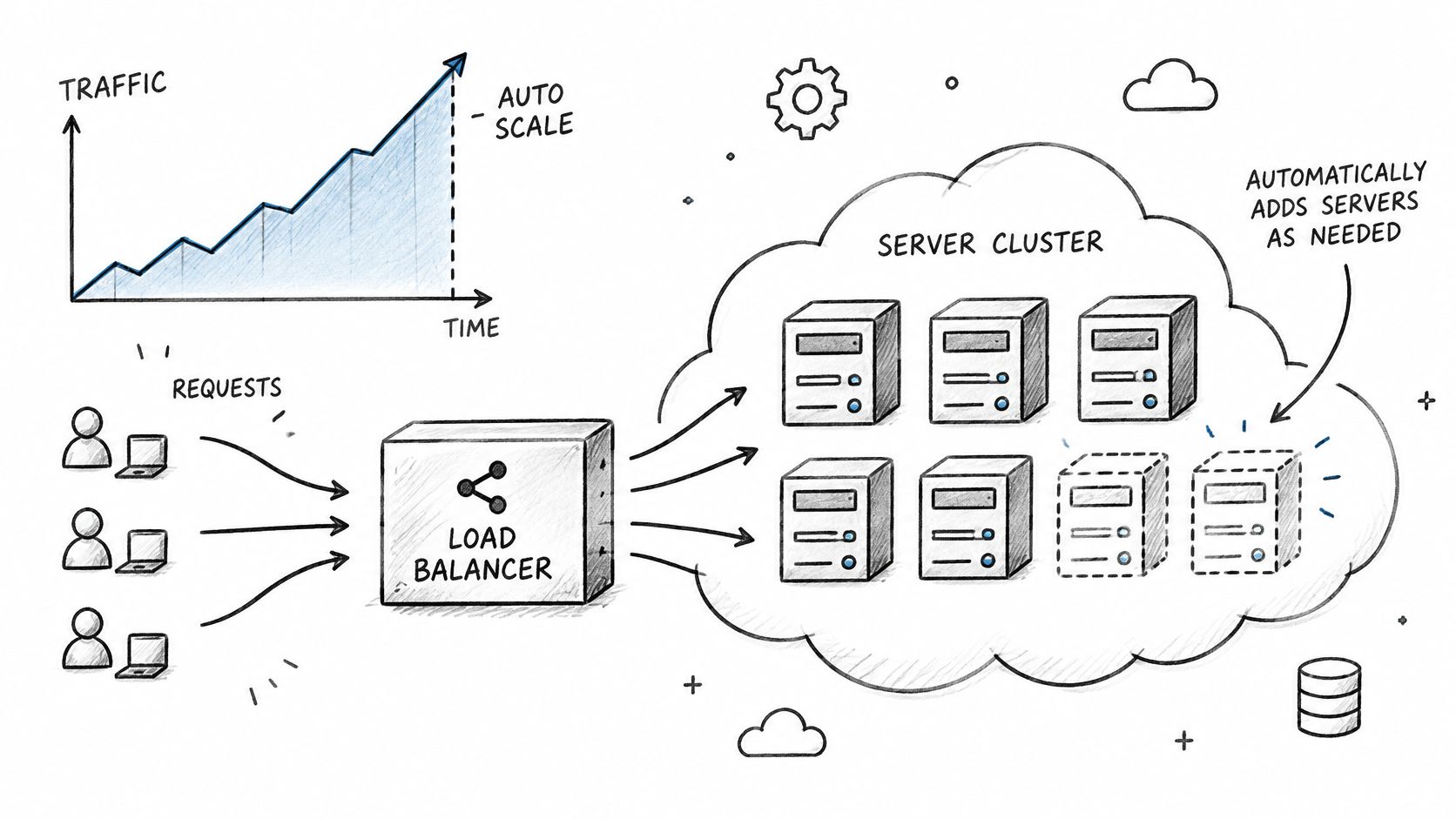
Horizontal autoscaling adds or removes instances based on metrics such as CPU, memory, request rate or queue depth. Kubernetes ships the Horizontal Pod Autoscaler; AWS ships Auto Scaling Groups. Both work, and both get pointed at the wrong metric constantly.
Say an app generates AI content for 300 stores. The load is bursty: merchants dump a catalog in at 9am and expect results by lunch. Scaling the web tier does nothing when the web tier is idle and the queue is 40,000 jobs deep.
- Keep servers stateless. Sessions in Redis, uploads in object storage, nothing on local disk.
- Scale background workers on queue depth. CPU stays flat while a queue grows, so CPU-based scaling reacts late.
- Set minimum replicas above zero. Cold starts are lost minutes on the one day you can't afford them.
- Load test the threshold, not the ceiling. You want to know where scaling starts, not where it breaks.
Autoscaling on CPU while the main constraint is database connections is common. New pods just add connection pressure to a database that was already the bottleneck.
6. Cloudflare Global Edge Network and CDN Caching
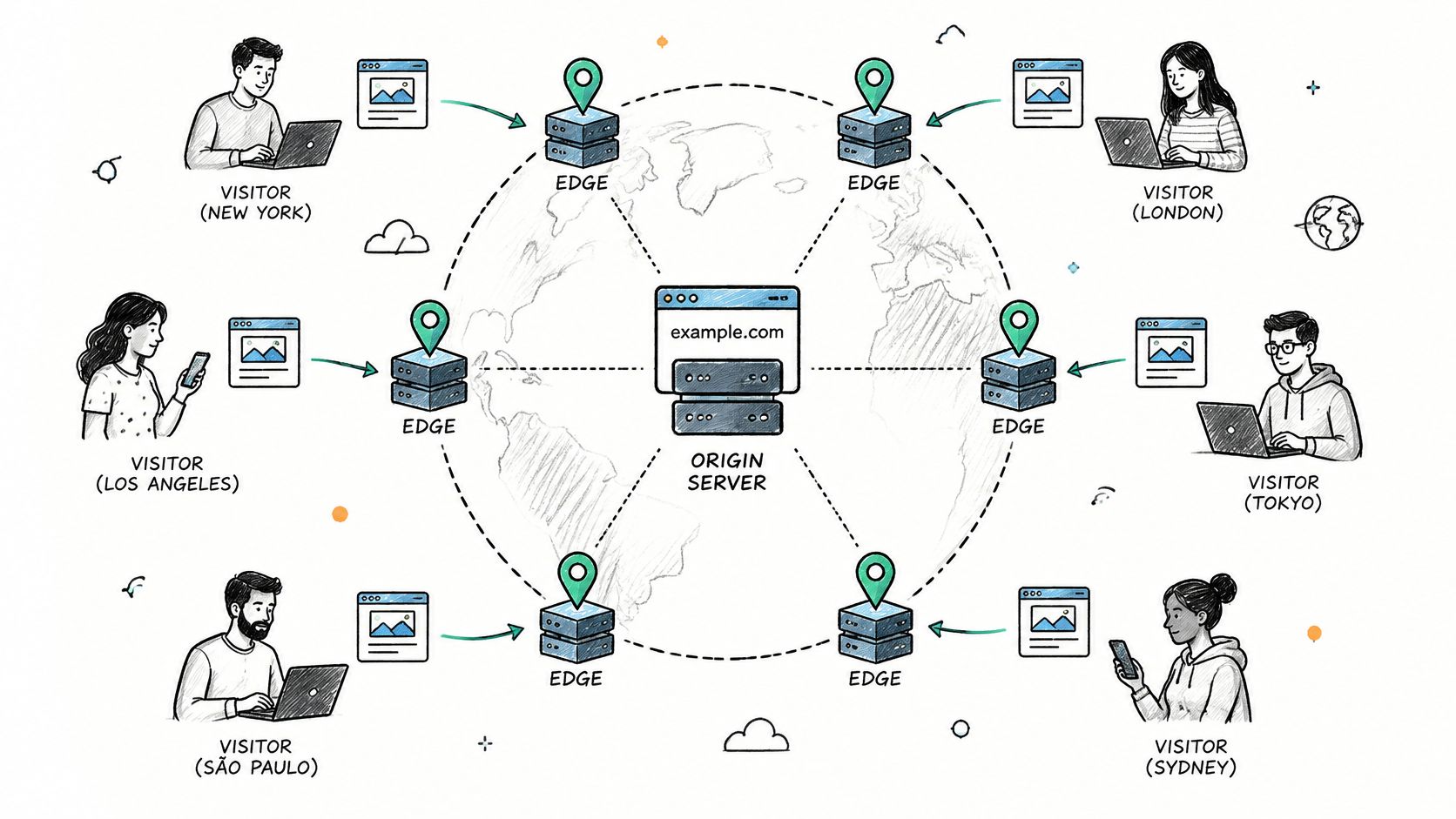
Cloudflare runs a global network of data centers in hundreds of cities. Static assets, cached pages and many dynamic responses get served from whichever location is nearest the visitor, so origin servers see a fraction of total requests. Traffic can grow sharply without matching growth in origin infrastructure.
Cache rules do the work, not the CDN
Take a product launch day. Hero images, theme CSS and JavaScript, and product photos are cacheable for months if the filename changes whenever the file changes. Cart, checkout and customer account pages aren't cacheable at all, and pretending otherwise breaks sessions in ways support tickets can't explain.
- Version filenames and cache for a year.
theme-v3.cssbeats a purge request every single time. - Set cache-control deliberately. Long lifetimes for immutable assets, short ones for anything that references inventory or price.
- Purge by tag, not by everything. A full purge after every catalog update hands your origin the entire traffic spike at once.
- Watch the hit ratio. That single number tells you whether the edge is doing the work.
Page speed and caching are the same conversation, because both decide how much work the origin never has to do. The same reasoning runs through this guide to improving Shopify page speed without hurting SEO.
The fastest origin request is the one that never reaches the origin.
7. Programmatic SEO at Scale with Template Pages
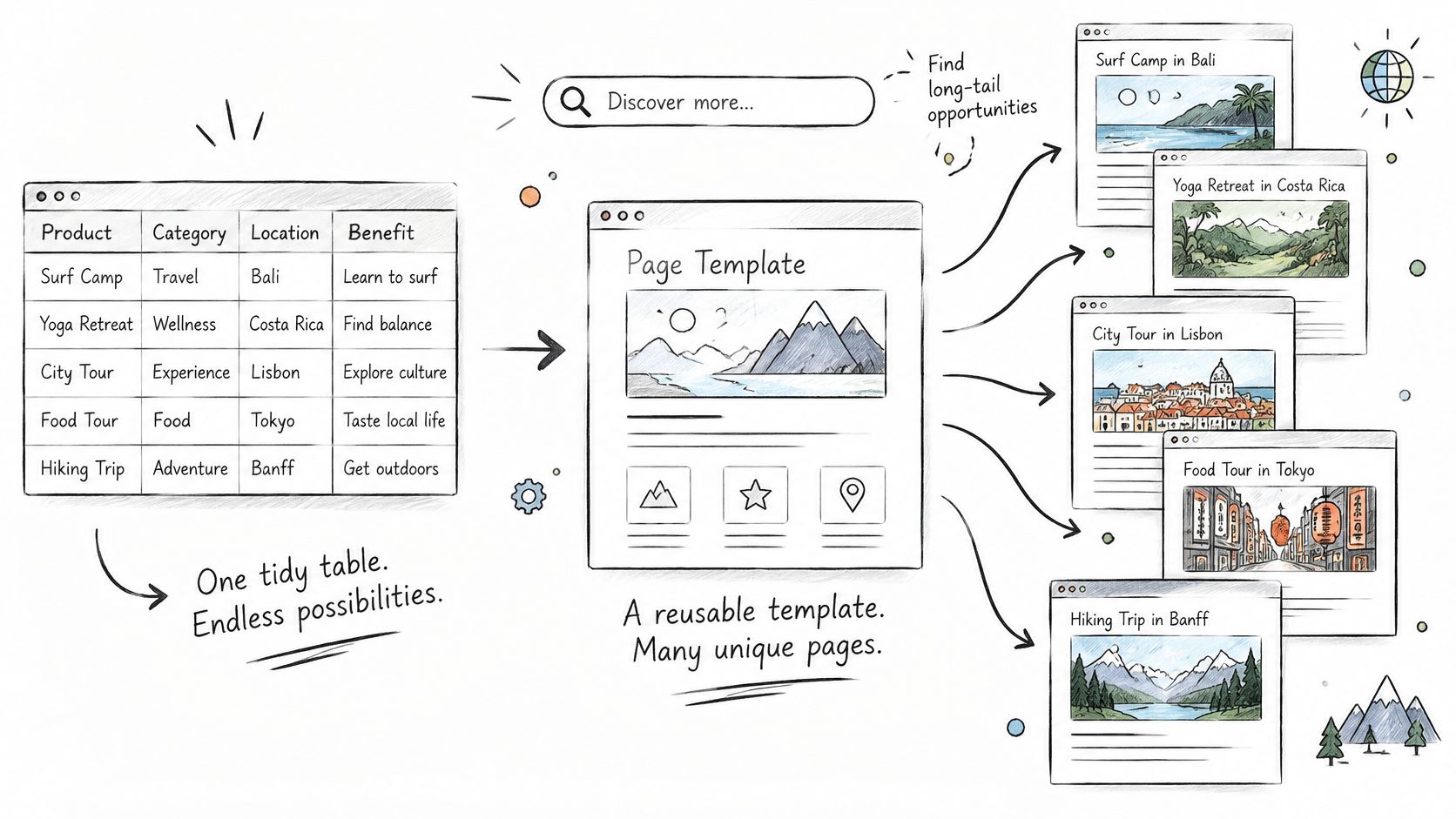
Programmatic SEO generates landing pages from structured data and a reusable template, each page aimed at a distinct query. Zapier popularized it with thousands of integration pages, one for every app-to-app connection somebody might search for. Done well, content scales without a writer touching every page.
The bottleneck is data quality, not word count
Templates inherit every flaw in the feed behind them. Shopify's analysis of digital transformation drivers notes that 32% of enterprises struggle with data quality and availability, while 33% say cybersecurity and privacy risks limit how far they can scale AI. Your version of that problem is a metafield that's empty on 4,000 products.
Picture "best [product] for [use case]" pages built from catalog attributes. If half the catalog lacks the attribute, half the pages are shells with a title and nothing else. Those pages don't rank, and enough of them drag the whole section down.
- Make each page carry unique data. Specs, comparisons, FAQs and pricing pulled from the product record, not synonyms spun from a template.
- Launch twenty pages and measure indexing. If Google ignores twenty, it will ignore two thousand faster.
- Use canonical tags and noindex for thin variants. Combinations that share identical data should point at the strongest version.
- Sync the feed before you regenerate. Stale data at scale is a hundred wrong pages an hour.
Titles and descriptions take the same treatment, which is what optimizing Shopify meta titles and descriptions at scale covers in detail.
8. Vertical Scaling at Stack Overflow
Stack Overflow has served an enormous amount of traffic from a comparatively small number of powerful servers. Instead of spreading load across hundreds of small machines, the team optimized queries, cached aggressively and upgraded hardware when it paid off. Vertical scaling is unfashionable, and it's often the cheapest thing a small team can do.
The database is usually the real constraint
Netflix moved a self-managed, PostgreSQL-compatible distributed database to Amazon Aurora PostgreSQL, and the gains came without touching application logic. AWS's Netflix case study reports up to 75% higher performance and 28% lower costs, with Spinnaker's Front50 average latency falling from 67.57 ms to 41.70 ms. The substrate changed, not the code.
Tail latency matters as much as averages here. A falling mean can hide outliers that every merchant on a busy pod still feels, so track p95 and p99 alongside the average when you compare before and after.
- Profile slow queries before adding servers. One twelve-table join can cost more than the instance it runs on.
- Cache what's read most and changes least. Collections, policies and templates are usually static enough.
- Keep a horizontal path open. Vertical scaling has a ceiling and a single point of failure, so know where you'd shard next.
- Keep backups and failover even on two servers. Efficiency without recovery is a countdown.
Scalability Examples Compared
| Example | Core Pattern | Best For | Main Trade-off |
|---|---|---|---|
| Shopify Pod Architecture | Isolate stores into pods with separate data and compute | Multi-tenant platforms that need contained failures and horizontal growth | Cross-pod operations and rebalancing add complexity |
| Instagram Postgres Logical Sharding | Route data to logical shards using shard-aware IDs | Scaling relational databases while retaining PostgreSQL | Cross-shard queries and resharding are difficult |
| Netflix Microservices and Chaos Engineering | Independently scale services and test resilience through failure injection | Large, global services with mature operations teams | Adds distributed-system complexity and operational overhead |
| Shopify Admin API Rate Limits and Bulk Operations | Use cost-based throttling, asynchronous bulk jobs, and webhooks | Apps syncing large Shopify catalogs or order histories | Requires retry handling and tolerance for asynchronous results |
| Horizontal Autoscaling with Kubernetes and Cloud Auto Scaling | Add or remove instances based on workload metrics | Workloads with variable traffic or queue volumes | Scaling delays and poor configuration can affect performance and cost |
| Cloudflare Global Edge Network and CDN Caching | Serve cached content and logic from global edge locations | Global sites seeking faster delivery and reduced origin load | Cache invalidation and dynamic content are challenging |
| Programmatic SEO at Scale with Template Pages | Generate targeted pages from structured data and reusable templates | Sites with reliable data and many distinct search intents | Thin or duplicate pages can hurt search performance |
| Vertical Scaling at Stack Overflow | Optimize software and increase capacity on fewer powerful servers | Teams prioritizing simplicity and efficient use of hardware | Hardware limits and single points of failure constrain growth |
Which Scalability Pattern Fits Your Store or App?
Match the pattern to your constraint, not to the architecture you find most impressive. The bottleneck tells you which example to copy.
- The database is the constraint. Instagram-style logical sharding, Netflix-style partitioning by tenant, and Stack Overflow-style query tuning all attack the same problem from different angles.
- Traffic spikes are the constraint. Pod isolation contains them, horizontal autoscaling absorbs them, and edge caching prevents most of them from reaching your servers at all.
- Content production is the constraint. Programmatic templates with a data quality gate scale output, and only if the underlying feed is trustworthy.
- Operational complexity is the constraint. This one hides the longest. The State of Commerce Ops 2026 report from Linnworks found that only about one-third of retailers in both the United States and United Kingdom rate inventory visibility across channels and warehouses as excellent, while 88.8% of U.S. and 89.6% of U.K. retailers reported moderate to significant year-over-year growth. Growth without visibility multiplies errors: overselling, late fulfillment, ads promoting stock that isn't there.
Scaling early beats scaling big. Adding a second channel, a second market or a second ad account is cheap. Untangling the data that three channels wrote in three formats is not, and the bill arrives months later.
The same logic shapes how we build. Our apps run tasks in bulk on all products, a single collection or a hand-picked selection, now or on a repeating schedule, and every app has a free plan with all core features so you can test on real products before committing. Start with one collection, check the output, then scale the scope.
Four habits carry across all eight examples. Measure before you scale, because the bottleneck is rarely where the dashboard points. Isolate tenants, so one merchant's spike stays theirs. Cache aggressively, because the cheapest request is the one you never serve. Automate the repetitive work, so headcount grows slower than volume.
Yassine Malti builds SEO-focused Shopify apps and custom automations that take repetitive catalog work off your plate, from image alt text and meta descriptions to product tags, descriptions and blog content, all run in bulk or on a schedule. Each app has a free plan with its core features, so you can run a single collection, check the results against your own data, and scale up only when the output holds. Pick the app that matches your bottleneck and start at Yassine Malti.
Shopify apps by Yassine Malti
Put this into practice
-

Describer · Product descriptions
Product descriptions written from your own product data · Free: 50 descriptions/month
-

LLMs TXT · llms.txt for AI tools
A short llms.txt of your real store links · Free
-

Blogger · SEO blog posts
An AI blog agent that writes and publishes for you · 50 credits/month free