BCG's history of the growth-share matrix reports that the matrix, or approaches based on it, reached approximately half of Fortune 500 companies at its peak influence. The appeal was a clearer way to decide which businesses deserved investment.
A strategic business unit (SBU) is a business inside a larger company with its own market, competitors, accountable leader, and economics you can measure. Size does not make the unit. Separate commercial accountability does, even when legal entities, HR, finance, or engineering stay shared.
That is the standard to apply to GE, P&G, Johnson & Johnson, Amazon, Alphabet, Tata Group, and Berkshire Hathaway. Each strategic business units example here is treated as an operating model: who sets strategy, who controls capital, how money moves between corporate and the unit, and where the boundary creates real trade-offs. I read the lesson for a smaller business the same way: copy the decision rules and measurement discipline before copying the org chart.
Table of Contents
- 1. General Electric (GE) Strategic Business Units and the GE-McKinsey Portfolio Matrix
- 2. Procter & Gamble Category Business Units
- 3. Johnson & Johnson Decentralized Operating Companies
- 4. Amazon Web Services (AWS) as a Standalone Business Unit
- 5. Alphabet's Other Bets as a Separate Business Unit Group
- 6. Tata Group's Multi-Company Business Unit Structure
- 7. Berkshire Hathaway's Decentralized Subsidiary Model
- Strategic Business Unit Examples Compared
- Key Takeaways: How to Structure Your Own Business Units
1. General Electric (GE) Strategic Business Units and the GE-McKinsey Portfolio Matrix
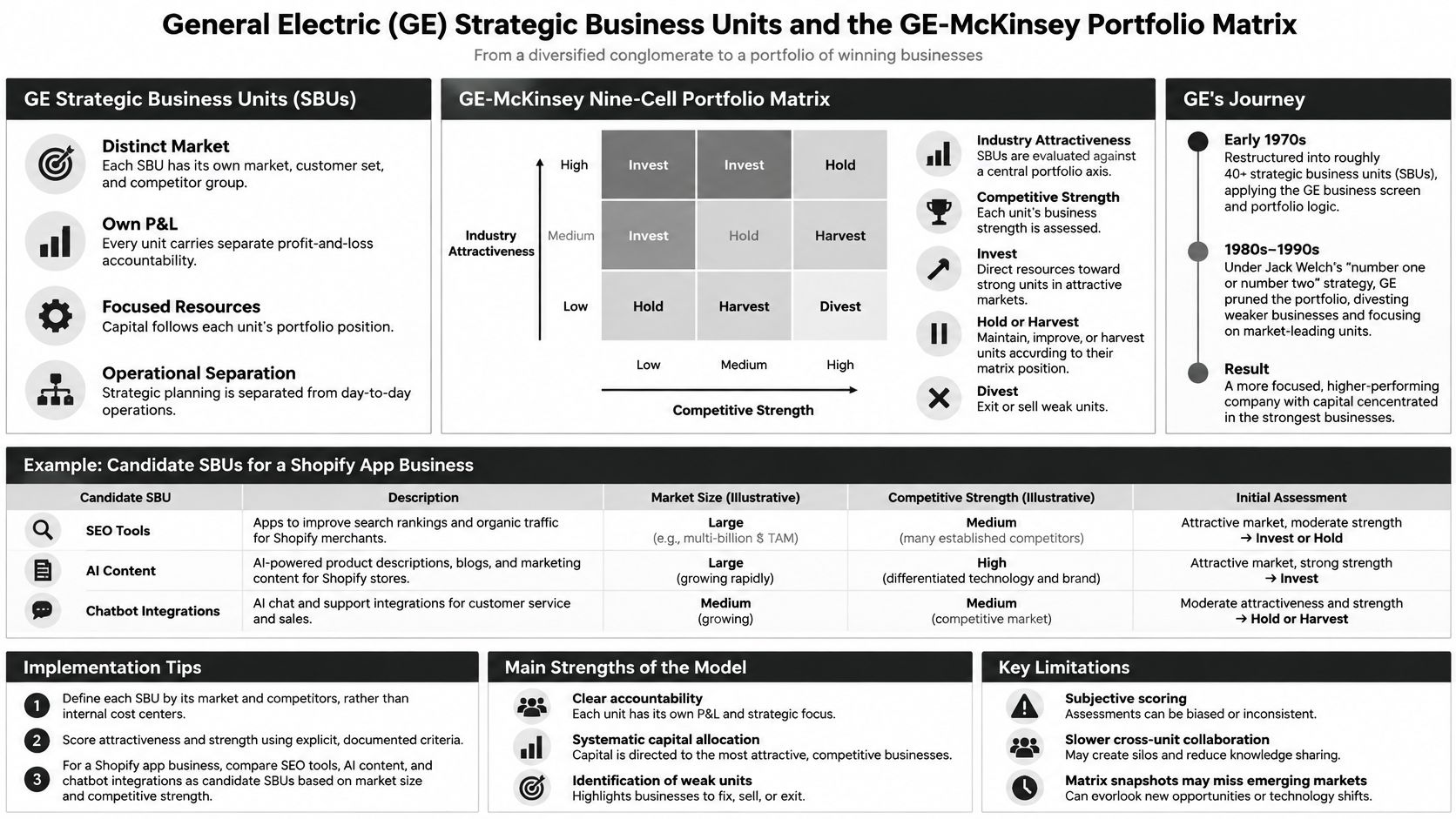
GE drew a sharp line between strategic planning units and operating departments. Its SBUs needed identifiable missions, competitors, external markets, and control over the variables critical to success, while existing organizational layers continued handling operations, according to this historical account of GE's planning structure.
That split is the mechanic worth copying. Unit leaders develop competitive strategies for their own markets; corporate leaders compare investment requests across businesses rather than accepting each department's budget in isolation. Money follows the comparison, not the organization chart.
What to copy
For a Shopify app developer, SEO tools, AI content products, and chatbot integrations are candidate businesses; none of them becomes an SBU automatically. Compare their buyers, the alternatives those buyers already use, acquisition costs, support requirements, and your realistic ability to compete.
- Define the market: Name the customer and the competing solution, not just the software feature.
- Document the assessment: Write down why an opportunity is attractive and what gives you an advantage.
- Allocate deliberately: Fund the strongest opportunity rather than splitting development time evenly across all three.
The main risk is false precision: a polished matrix cannot correct untested assumptions. Record the evidence behind each assessment and revise it when customer behavior changes.
The video below walks through portfolio analysis in more detail.
2. Procter & Gamble Category Business Units
Tide and Pampers solve different customer problems. Treating laundry care and baby care as interchangeable product lines would obscure differences in purchasing behavior, product development, and competition.
P&G's category-based model illustrates specialization within shared infrastructure. Category leaders control their markets, innovation priorities, and commercial choices, while shared capabilities absorb the costs that would be wasteful to duplicate in every category. The transferable principle is to place commercial decisions close to the people who understand the customer problem.

Assign owners where buyers and margins diverge
A Shopify merchant selling skincare and salon supplies has a strong case for two commercial owners if the buyers and margins differ. Retail customers reordering moisturizer and salon owners buying in bulk respond to different pricing, promotions, and sales processes. One owner optimizing both lines would keep compromising one for the other.
Give each owner responsibility for assortment, positioning, promotional choices, and contribution margin. Keep customer-data definitions, core analytics, and technical infrastructure shared unless separation has a clear commercial purpose.
Practical rule: Separate the decisions that require customer expertise. Share the capabilities where duplication adds cost without adding differentiation.
The governance system should also reflect how each unit competes. An Academy of Management Journal study associates different combinations of controls and resource sharing with effectiveness under low-cost and differentiation strategies.
Apply that to your scorecard. A low-cost bulk-optimization product and a consultative automation service win on different terms, so measure them on different terms: processing cost and reliability for the first, customer outcomes and implementation quality for the second.
3. Johnson & Johnson Decentralized Operating Companies
Autonomy needs boundaries, especially when mistakes affect customers' health or safety. Johnson & Johnson's decentralized operating-company model shows the tension between specialist leadership and group-wide standards. Its pharmaceutical and medical-technology businesses are useful reference points for that distinction, without treating its historical consumer-health portfolio as its current structure.
The transferable lesson is a split. Decisions that need specialist judgment sit inside the unit, while standards that must stay consistent sit above it.
Delegate decisions, retain guardrails
Write down what a unit leader can decide independently before you hand over responsibility. Product positioning, customer interviews, and release priorities can sit locally. Privacy requirements, security reviews, and financial reporting definitions should remain shared, because a failure in any of them lands on the whole business rather than on one unit.
- Local ownership: Give the unit a named leader and measurable commercial responsibilities.
- Central standards: Define mandatory checks for data handling, product quality, and customer commitments.
- Escalation rules: Specify when a decision needs approval because it creates exposure beyond the unit.
An agency offering both Shopify theme development and AI chatbot implementation can give each service its own delivery owner, pricing logic, and margin targets. Both still follow the same rules for accessing merchant accounts and handling customer information, since a breach in either service damages the agency's reputation as a whole.
Where does this structure break? At both extremes. If headquarters approves every routine choice, decentralization becomes cosmetic and unit leaders stop owning outcomes. If it reviews nothing, those same leaders can create risks the whole business absorbs.
A one-page authority document covering who decides what captures most of this benefit for a small team, at a fraction of the coordination cost a company of Johnson & Johnson's size carries.
4. Amazon Web Services (AWS) as a Standalone Business Unit
An internal tool becomes a product only after outside customers pay for it without your help. AWS is the clean strategic business unit example of that shift: infrastructure expertise turned into an external offering that buyers compare with rival providers.
The mechanics to copy are separate product ownership, pricing, customer support, and unit economics. An internal team serves colleagues inside existing priorities. A commercial unit has to win demand, answer for churn, and carry the full cost of serving customers who can leave.

Test commercialization before creating a unit
Take a Shopify agency with an internal catalog-cleanup tool. Before it becomes an app, prove that merchants outside the service base will adopt it, pay for it, and keep using it with limited hand-holding.
A documented MKA Insights business-unit launch case describes the move from a commercially validated initiative to a formal business line with dedicated employees and commercialization capabilities. That is the threshold: the offer needs ownership beyond the original project team.
Give one named owner responsibility for onboarding, retention, support cost, and product development. Put hosting, maintenance, and shared engineering time into the unit economics before deciding whether the tool deserves a roadmap.
Judge the tool by external demand. Customers must value the packaged service enough to support its full operating cost.
Each week spent on the packaged tool comes out of the service retainer that pays for it. Keep the first commitment bounded: a defined owner, a narrow release, and a fixed amount of engineering capacity until paid usage justifies more.
5. Alphabet's Other Bets as a Separate Business Unit Group
A mature business and an experimental venture shouldn't have identical funding tests. Alphabet's Other Bets grouping, associated with ventures such as Waymo and Verily, shows why a parent might separate emerging businesses from an established commercial engine.
A reporting group is not an operating SBU. Alphabet reports these ventures together because they sit at a similar stage of maturity. They don't share customers, economics, or a competitive strategy, so each one still needs its own accountable leadership and investment rationale. Copy the separation of accountability, not the grouping itself.
Ring-fence the experiment, not accountability
For a Shopify business, separate a subscription offering from one-off sales with its own budget and owner. The experiment gets defined funding and a single person answerable for its results. The core business keeps responsibility for dependable fulfillment and cash generation, and neither side subsidizes the other invisibly.
Run the venture through explicit gates rather than funding it on enthusiasm:
- Demand gate: Establish that the intended customer has a problem worth paying to solve.
- Usage gate: Check whether customers continue using the offer after initial curiosity.
- Economics gate: Include delivery effort, support, refunds, and ongoing maintenance.
- Exit gate: Define in advance what evidence would trigger closure, redesign, or further investment.
Protection can harden into insulation. A shielded venture escapes the short-term expectations of the core business, which is the point of the structure. The risk is funding that continues because the mission sounds ambitious rather than because the gates are being met.
Allocate money in stages. Give the leader enough room to test the central assumption, then require a clear decision before committing additional resources. Patient funding still needs an evidence standard.
6. Tata Group's Multi-Company Business Unit Structure
Tata Consultancy Services, Tata Motors, and Tata Steel serve markets that demand very different strategies. Shared ownership does not mean a shared operating playbook.
A separately incorporated company is not the same thing as an internal SBU. You can still borrow the portfolio-management logic of a holding group without copying its legal structure.
Share standards where they create value
The practical model pairs local commercial responsibility with group-level expectations for governance, ethics, and brand stewardship. Business leaders need room to pursue their markets. Group leadership needs visibility into capital commitments and risks that could affect the wider organization.
For a Shopify operator running wholesale and direct-to-consumer lines, that means separate sales targets and pricing authority, plus shared inventory definitions, customer-data standards, and automation components. Assign one named owner to each shared standard. If wholesale and direct-to-consumer define "in stock" differently, decide who settles the definition before it turns into a reconciliation problem.
The technology boundary deserves particular care. In PwC's digital trends in operations survey, 27% of operations leaders said AI strategy was fully embedded across business units. Separate commercial ownership will not produce coordinated technology use on its own.
- Keep local: Customer offers, channel strategy, commercial experiments, and budget proposals.
- Keep shared: Access controls, analytics definitions, reusable integrations, and core data standards.
- Price transparently: Make shared-service costs visible when evaluating profitability.
Duplication is the cost to watch. Separate teams don't each need their own chatbot framework or content-generation pipeline. Give leaders control over outcomes without requiring them to rebuild the infrastructure.
7. Berkshire Hathaway's Decentralized Subsidiary Model
A service that brings in attractive invoices can still be the weaker business once senior development time is counted. Berkshire Hathaway runs that discipline at scale: operating managers run subsidiaries, while the parent controls where money is reinvested. GEICO and BNSF are recognizable examples, with distinct customers, assets, and operating economics.
Give unit leaders operating authority, and keep capital allocation with the parent. A leader can own delivery and commercial results while still needing approval for major cash commitments. That separation is the mechanism worth copying.

Judge the business after its real costs
A Shopify app portfolio alongside a custom-development service makes the point. The service may invoice well while consuming scarce senior developers. An app may bring in less revenue while needing little incremental work to maintain.
Compare each line after direct expenses, support, maintenance, and an explicit allocation of shared resources. Judge cash generation, capital requirements, and returns on additional investment. Revenue can hide all three.
Owner's test: If this product line stood alone, would you invest more money and management time in it today?
Decentralization fails when autonomy outruns information. Keep reporting concise, but require visibility into service failures, unresolved liabilities, and deferred maintenance, because a unit can look profitable while postponing necessary work. Copy Berkshire's split clearly: local teams decide how to operate, headquarters decides whether the next dollar belongs there.
Strategic Business Unit Examples Compared
The most useful comparison is who controls the work, who controls the money, and what evidence forces a change. Use the first-test column to try that boundary inside your current organization before creating departments, legal entities, or new reporting lines.
| Example | Unit structure | Who decides what | First test for a small business | Main risk |
|---|---|---|---|---|
| General Electric | Portfolio-managed SBUs | Central leaders compare industry attractiveness and competitive strength, then invest or divest | Rank each product line on market appeal and competitive position before assigning its next budget | Subjective scoring can harden into rigid decisions |
| Procter & Gamble | Product-category units | Category teams manage brands and innovation, while shared services support them | Put one owner over a product category and check whether shared support reduces duplicate work | Duplication and silos across categories |
| Johnson & Johnson | Decentralized operating companies | Local leaders make operating decisions within shared corporate standards | Define the decisions a manager can make without approval, then review the results against common standards | Overlapping efforts and coordination challenges |
| Amazon Web Services | Standalone commercial unit | The unit controls products, pricing, and profit for infrastructure developed internally | Ask an outside customer to pay for an internal capability at a stated price | Platform concentration and parent-company tensions |
| Alphabet's Other Bets | Ring-fenced venture group | Separate leadership manages funding and reporting for experimental ventures | Set the evidence required to continue before funding another experimental product line | Hard to judge when to exit |
| Tata Group | Holding-company portfolio | Independent companies operate under shared brand and governance standards | Run one line with separate reporting while keeping brand and governance rules common | Coordination complexity and group-wide brand exposure |
| Berkshire Hathaway | Autonomous subsidiary portfolio | Local teams run operations while the parent allocates capital | Delegate routine operating decisions while keeping reinvestment approval with the owner | Dependence on local management quality and central capital judgment |
Read the tests as filters. A product line that fails one needs clearer ownership, reporting, pricing, or continuation rules before it needs a formal SBU.
Key Takeaways: How to Structure Your Own Business Units
Choose the smallest structure that makes accountability clearer. You rarely need a separate legal entity, its own technology stack, or a new department to apply SBU thinking. What changes is who decides what and how money reaches each opportunity. The trade-off is real: tighter central control buys comparability across units, while looser structures buy speed and local knowledge.
Draw unit boundaries around markets and accountability. The boxes already on your organizational chart rarely match where customers, competitors, and profit pools actually diverge.
Before splitting a Shopify business, test whether the proposed units have different customers, competitors, profit pools, capital needs, and strategic choices. A subscription variant doesn't automatically deserve its own SBU if the same team makes the same decisions for the same buyers. Two offerings that share one buyer, one price point, and one delivery pipeline belong in a single unit.
A practical action checklist
- Map the businesses: Write down each product line's customer, alternatives, revenue model, and delivery requirements.
- Build separate economics: Track direct costs and allocate shared expenses transparently.
- Name the owner: Assign responsibility for commercial outcomes and specify decision rights.
- Protect shared capabilities: Keep data standards, reusable automation, and security controls consistent.
- Judge incremental returns: Apply Berkshire-style capital discipline by funding the investment with the strongest forward return.
- Bound experiments: Use Alphabet-style funding gates and kill criteria before expanding commitments.
Solo operators can apply the same logic. A Shopify app developer such as Yassine Malti can weigh an app, a service, and an automation opportunity against the same tests: customers, competitors, profit pools, capital needs, and strategic choices. Whichever opportunity clears those tests earns the next hour of development time. The useful output is a better allocation decision; the organization chart can stay exactly as simple as it is now.
Yassine Malti builds SEO-focused, AI-powered Shopify apps and custom automations, including content tools, workflow automation, and chatbot integrations. Visit Yassine Malti to explore ready-made apps or discuss a custom solution for the product line or operational bottleneck you've prioritized.
Shopify apps by Yassine Malti
Put this into practice
-

Describer · Product descriptions
Product descriptions written from your own product data · Free: 50 descriptions/month
-

LLMs TXT · llms.txt for AI tools
A short llms.txt of your real store links · Free
-

Blogger · SEO blog posts
An AI blog agent that writes and publishes for you · 50 credits/month free