If your costs, demand, and competitors change daily, why should your prices stay frozen for months? A fixed price can protect consistency, but it can also leave you selling scarce stock too cheaply or holding aging products at prices shoppers won't accept.
Dynamic pricing strategies replace that frozen price with rules tied to business conditions. On Shopify, that might mean scheduling a promotion, protecting margin after a supplier update, or adjusting selected products when demand outpaces replenishment. You don't need individualized prices or an elaborate prediction model to begin.
The important distinction is between automating a decision and automating every possible price change. A useful workflow names the trigger, defines the adjustment, sets boundaries, and records what happened. Without those controls, a pricing app can execute a bad rule faster than your team can notice it.
- Start with predictable inputs: Time-based and cost-plus rules are easier to validate because you control the schedule or know the underlying cost.
- Add market signals selectively: Demand, inventory, and competitor rules need cleaner data and closer monitoring.
- Judge profit and customer response together: Track conversion, returns, cancellations, and repeat purchases alongside sales.
Treat each play below as logic to adapt, not a store-wide default. Keep the customer-facing explanation simple, preserve accurate prices across your storefront and sales channels, and review legal requirements before using personal data or changing prices during sensitive shortages.
Table of Contents
- 1. Time-Based Dynamic Pricing
- 2. Demand-Based Dynamic Pricing
- 3. Competitive Pricing
- 4. Inventory-Based Dynamic Pricing
- 5. Event and Seasonal Dynamic Pricing
- 6. Segmented Dynamic Pricing
- 7. Personalized and Individualized Dynamic Pricing
- 8. Real-Time Auction and Bidding Pricing
- 9. Cost-Plus and Rule-Based Dynamic Pricing
- 10. Value-Based Dynamic Pricing
- 10 Dynamic Pricing Strategies Compared
- Build Your Pricing Stack One Rule at a Time
1. Time-Based Dynamic Pricing
Time-based pricing works best when you can explain the offer before it begins. A Shopify electronics store might schedule a quieter-period promotion on selected accessories, then restore regular prices automatically when the window closes.
The trigger is the calendar, not a sudden traffic spike. Review Shopify sales and conversion reports by shopping period, separating paid campaigns from ordinary demand. Low sales alone don't prove that a discount will help, especially if you're comparing periods with very different traffic.
Build a schedule customers can understand
- Sample rule: Apply the approved promotional price to a tagged collection during the published offer window, provided it stays above the margin floor. Restore the saved regular price afterward.
- Implementation: Configure the pricing app's timezone, start and end conditions, eligible variants, and discount-stacking exclusions. Preview the scheduled changes before publishing.
- Primary KPI: Compare contribution profit per visitor and conversion with comparable non-promotional periods or an untreated product group.
- Main risk: Shoppers may delay purchases if they learn that the same predictable discount always returns.
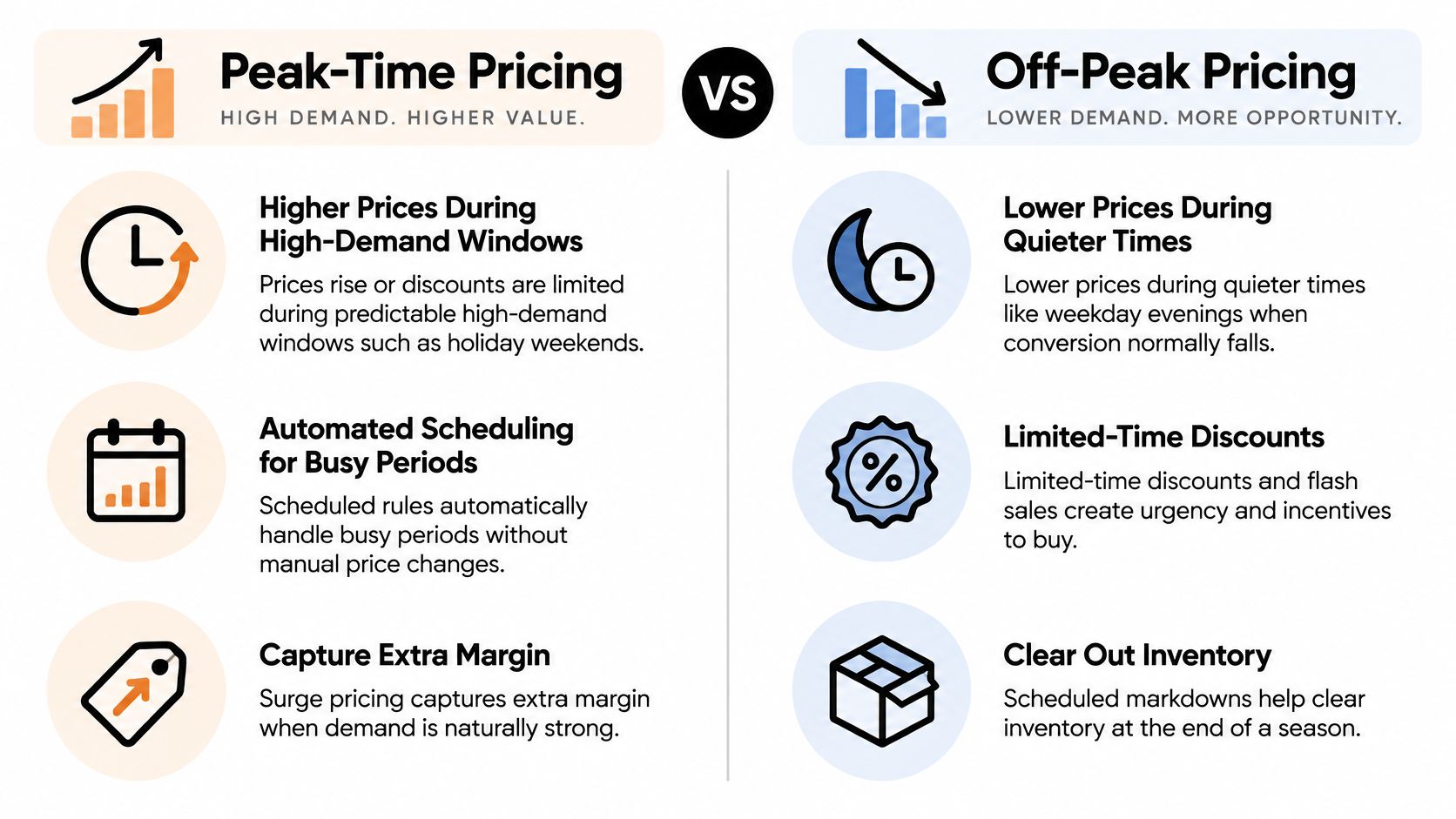
Publish the promotion's end time and conditions clearly. Keep recurring offers on stable, useful landing pages rather than creating disposable URLs for every schedule, and don't assume that approaching a deadline always justifies a lower price.
2. Demand-Based Dynamic Pricing
A viral sneaker video can bring visitors who never intend to buy. Raising prices because page views increased would confuse attention with demand.
Use sales velocity, conversion, and available stock together. For a Shopify footwear store, compare demand at the variant level so strong sales of a popular size don't trigger unnecessary increases across the entire model.

- Trigger: Sales velocity exceeds the product's normal pattern while conversion remains healthy and replenishment is constrained.
- Sample rule: Move eligible variants toward an approved higher price band only when the combined signals persist. Freeze increases when traffic appears abnormal or tracking fails.
- KPI: Monitor contribution profit per visitor, conversion, cart abandonment, and stock availability.
- Risk: A price increase can suppress demand enough to erase the extra margin.
In a ride-hailing field study described in the NBER working paper on surge pricing, bookings in a surging area declined by 7% on average. That's a useful warning about customer response, not an ecommerce performance forecast.
Use AI-powered demand forecasting to distinguish a sustained trend from campaign noise. Keep an unchanged product group where practical, and pause the rule if bot traffic, influencer activity, or a tracking change makes the input unreliable.
3. Competitive Pricing
Match the offer, not just the displayed number. A camera body sold by an authorized retailer isn't automatically comparable with a marketplace listing that has different warranty coverage, delivery terms, or included accessories.
For Shopify merchants selling recognizable products, competitor pricing can inform selected rules. It shouldn't determine the price of your whole catalog.
Create a defensible comparison set
Map exact products using identifiers such as GTINs or manufacturer part numbers. Separate item price, shipping, taxes, membership discounts, and temporary coupons so the repricer compares consistent terms rather than mixing incompatible offers.
- Trigger: A verified, in-stock competitor changes the price of an equivalent product.
- Sample rule: Move toward the approved competitor reference only if the resulting selling price preserves the minimum contribution margin. Otherwise, hold and flag the product for review.
- KPI: Track gross profit, conversion, and paid-shopping profitability, not cheapest-price position alone.
- Risk: Automatic undercutting can produce repeated margin reductions without increasing profitable orders.
A competitor's price is an input. It isn't evidence that the competitor makes money at that price.
Exclude unavailable listings and suspicious outliers. For products where your service or bundle differs, explain that difference instead of chasing a misleading comparison.
Keep feed prices aligned with landing pages through disciplined Google Shopping optimization. A competitive price won't help if shoppers click an advertised offer and encounter a different amount on your storefront.
4. Inventory-Based Dynamic Pricing
A furniture store with discontinued tables needs a different rule from a collectibles store protecting a scarce release. Both use inventory signals, but their business objectives point in opposite directions.
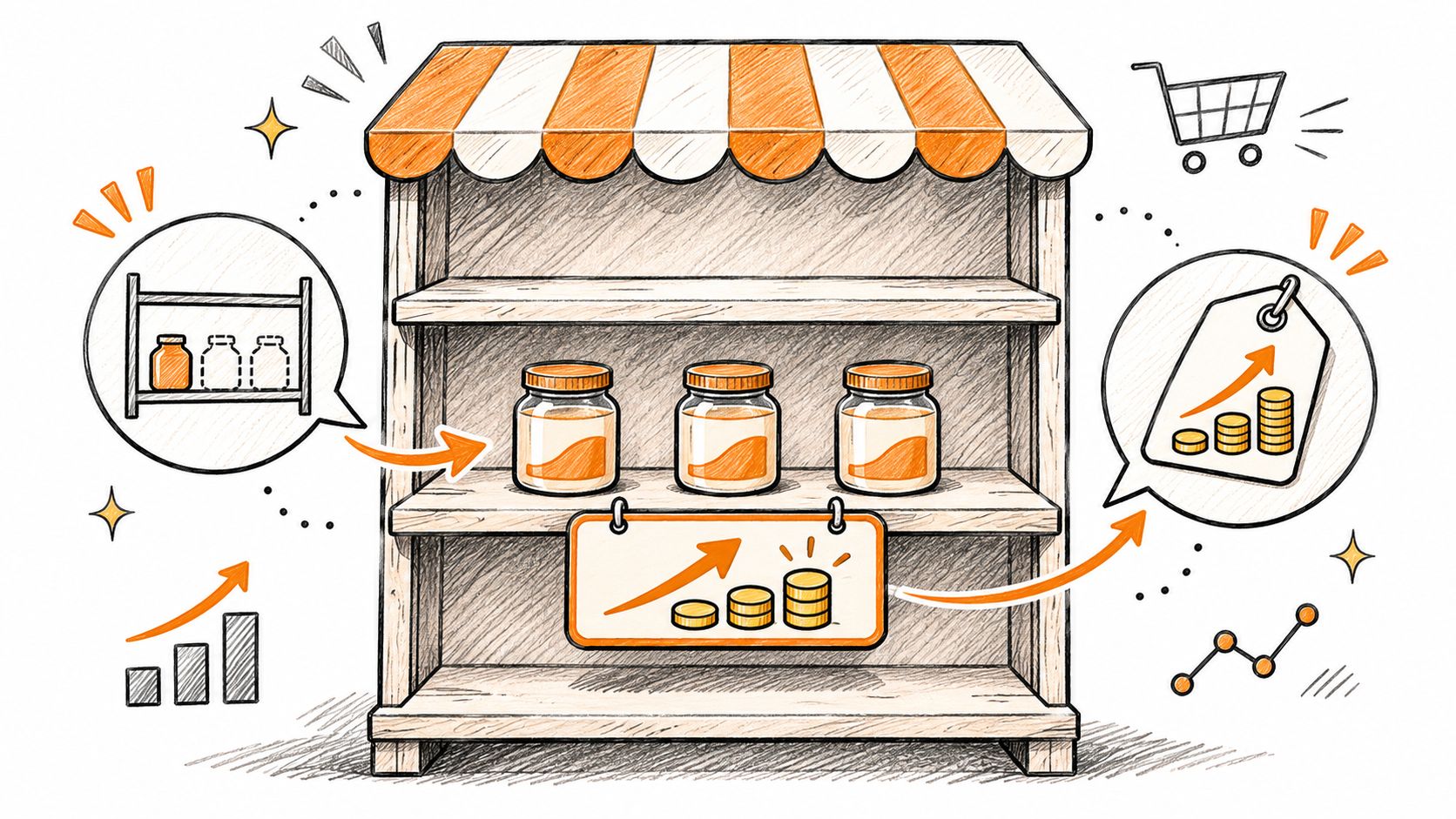
Base decisions on days of supply, not stock count alone. Calculate it from sellable inventory and representative sales velocity, then account for confirmed replenishment and stock reserved for replacements.
Separate clearance from scarcity protection
- Clearance rule: When a discontinued furniture collection exceeds its approved stock-cover target, move it into the next authorized markdown band, stopping at the clearance floor.
- Scarcity rule: When a collectible's sellable stock falls below its protection threshold, remove discretionary discounts before considering a capped price increase.
- KPIs: Measure sell-through, contribution profit, inventory age, and stockouts.
- Risk: Inaccurate inventory can trigger discounts on unavailable products or increases on stock that's plentiful.
Dynamic pricing's inventory logic has roots in aviation: the Amadeus revenue-management paper describes its development after the U.S. Airline Deregulation Act of 1978. For a merchant, the practical lesson is to connect price decisions to the remaining selling opportunity.
Coordinate changes with merchandising, email, and advertising. Don't promote clearance stock after the last sellable variant disappears, and don't display scarcity messages unless your inventory records support them.
5. Event and Seasonal Dynamic Pricing
A gift retailer should price around the deliverable shopping window, not merely the holiday date. Once standard shipping can no longer meet the occasion, the offer may need to shift toward local delivery, pickup, or a different product.
Event pricing combines a calendar with current conditions. Unlike a recurring weekday promotion, it needs explicit rules for the lead-up, peak demand, shipping cutoff, and post-event leftovers.
- Trigger: The store enters an approved campaign phase, with inventory and fulfillment checks satisfied.
- Sample rule: End the early-order incentive when the campaign reaches its peak phase. After the delivery cutoff, discount only eligible seasonal leftovers and clearly exclude unavailable delivery promises.
- Implementation: Tag the campaign collection, save baseline prices, schedule transitions, and assign an owner to approve exceptions.
- KPI: Evaluate campaign contribution profit after advertising, discounts, returns, and shipping subsidies.
- Risk: Last-minute discounts can frustrate early buyers or generate orders you can't fulfill on time.

Prepare inventory and campaign assets before activating the rule. Keep an evergreen seasonal landing page where it remains useful, updating products and delivery information rather than replacing the URL each season.
Avoid treating every weather event or shortage as a price-increase opportunity. Build a manual review requirement for essential goods and emergency-related demand, with jurisdiction-specific legal review before activation.
6. Segmented Dynamic Pricing
A published loyalty benefit is easier to defend than a hidden device-based surcharge. Both distinguish between shoppers, but only the former gives customers a clear explanation and a route to eligibility.
For a Shopify coffee subscription brand, reward a defined group through a disclosed member offer. Don't assume that grouping customers makes every pricing criterion fair or legally appropriate.
Make eligibility visible
- Trigger: A customer qualifies for an explicitly defined membership, subscription, or acquisition offer.
- Sample rule: Apply the published subscriber benefit to eligible coffee products, subject to the offer floor, and prevent stacking with incompatible promotions.
- Implementation: Use supported customer-segment or membership functionality. Define precedence when someone qualifies for overlapping offers, and test the logged-out, logged-in, cart, and checkout experiences.
- KPI: Measure incremental contribution profit, repeat purchases, and retention against comparable eligible customers without the new incentive.
- Risk: Existing customers may feel penalized if acquisition discounts consistently exceed loyalty benefits.
Fairness deserves operational attention: 78% of U.S. adults believe prices should be the same regardless of who buys, according to Ipsos findings reproduced in the Portland council document on pricing practices.
Keep public product prices and structured data consistent with the public offer. Explain restricted discounts separately, minimize personal data, and review segment outcomes for unintended exclusion.
Customer location may affect fulfillment costs or market requirements, but that doesn't make opaque location-based willingness-to-pay pricing a sensible default.
7. Personalized and Individualized Dynamic Pricing
Personalization doesn't have to mean charging a returning shopper more because they appear eager to buy. Personalize the offer before personalizing the base price.
A Shopify skincare brand could offer a relevant routine bundle to an eligible returning customer while keeping the individual products' public prices unchanged. The customer receives a useful choice rather than an unexplained price discrepancy.
- Trigger: A customer meets a disclosed offer criterion using permitted, necessary customer data.
- Sample rule: Present an eligible replenishment bundle with an approved discount, while excluding incompatible offers and preserving the bundle's margin floor.
- Implementation: Establish reliable customer data integration, document each input, and obtain consent where required. Don't infer permission merely because a tracking tool can collect something.
- KPI: Compare incremental profit, conversion, repeat purchases, refunds, and pricing-related complaints.
- Risk: Hidden individualized prices can undermine trust and create privacy or consumer-protection exposure.
Safer default: Use purchase history to improve relevance, not to secretly increase someone's base price.
Keep an audit trail showing the eligibility rule, offer shown, data used, and decision time. Provide a rollback mechanism and review whether different customer groups experience materially different outcomes.
Personal-data pricing needs market-specific legal review before launch. Feed consistency, customer support explanations, and deletion or consent changes also need testing, because a technically functioning personalization rule can still produce an indefensible customer experience.
8. Real-Time Auction and Bidding Pricing
Auctions suit items whose market value is uncertain and whose buyers accept competition. A signed collectible or limited artist collaboration is a better candidate than a routine replenishment product shoppers expect to buy immediately.
Use a Shopify-compatible auction app that handles bidding, inventory, notifications, and the eventual purchase process. Verify those capabilities explicitly rather than assuming an ordinary discount app can manage them.
Define the sale before accepting bids
- Trigger: An approved collectible enters its published auction window.
- Sample rule: Accept valid bids above the reserve using published increments, close under the stated extension rules, and offer the item to the verified winner.
- Implementation: Publish payment deadlines, shipping charges, cancellation terms, refund conditions, and the process for an unpaid winning bid.
- KPI: Track realized contribution profit, completed-payment rate, time to sell, and disputes.
- Risk: Fraudulent bids or unpaid wins can create an impressive displayed price without a completed sale.
The winning bid isn't revenue until the buyer pays and you can fulfill the order.
Test outbid messages, winner notifications, payment verification, and inventory reservation. If you offer a fixed-price purchase option alongside bidding, clearly state when that option disappears.
Auction mechanics are easier to assess when you can see the buyer flow.
Avoid auctions when the extra steps would make an ordinary purchase unnecessarily difficult.
9. Cost-Plus and Rule-Based Dynamic Pricing
Supplier updates are a practical starting point for automation because the trigger is concrete. If an electronics accessory costs more to source and deliver, recalculate the acceptable selling price before the next promotion compounds the margin problem.
Cost-plus automation protects a floor. It doesn't discover what shoppers will pay. Keep those jobs separate.
Build the cost model before the rule
Maintain landed product cost separately from fulfillment, payment fees, shipping subsidies, expected returns, and acquisition expenses. Distinguish fixed per-order costs from expenses that vary with the selling price, or you'll calculate a misleading floor.
- Trigger: An approved supplier, freight, fee, or fulfillment cost changes.
- Sample rule: Recalculate the minimum acceptable price, apply the chosen margin logic, round using the store's pricing convention, and send changes outside the permitted band for approval.
- KPI: Monitor contribution margin, conversion, and the frequency of below-floor transactions.
- Risk: Passing every cost increase directly to customers can make the product uncompetitive.
For a Shopify beauty bundle, calculate the component costs and packaging together rather than adding a markup to an outdated bundle price. Check the result against current market offers and the bundle's conversion history.
Don't confuse markup with margin when configuring the app. Also avoid subtracting advertising expense in the pricing model and then subtracting the same expense again when reporting profitability.
Save the previous price and cost version so your team can explain or reverse each change.
10. Value-Based Dynamic Pricing
A differentiated product shouldn't inherit a commodity pricing rule. A Shopify electronics merchant selling a professionally configured equipment bundle can price the convenience and compatibility of the package, provided the product page explains exactly what's included.
Value-based pricing becomes dynamic when you revise offers or prices in response to observed customer response and changing benefits. It isn't permission to assign an arbitrary premium.
- Trigger: The product gains a meaningful benefit, or controlled testing indicates room for a different price.
- Sample rule: Test an approved premium bundle against the existing offer, preserving the cost floor and holding other merchandising changes steady where practical.
- Implementation: Interview target buyers, document the benefit, and show concrete inclusions such as configuration, accessories, support, or warranty terms.
- KPI: Evaluate contribution profit per visitor, conversion, returns, and subsequent purchases.
- Risk: Raising the price without making the value credible can reduce sales and increase disappointment.
Test the benefit and the price separately
First establish whether customers want the bundle or service. Then test the price without simultaneously rewriting every product page and changing the traffic mix.
The network-pricing study on dynamic policies emphasizes that algorithm performance depends on market structure. For your catalog, that means a differentiated bundle and a widely available replacement cable shouldn't automatically share the same pricing model.
Keep premium claims specific and supportable. Explain the work saved or components included rather than relying on words such as superior, exclusive, or professional without substance.
10 Dynamic Pricing Strategies Compared
| Strategy | Primary Signal | Best For | Implementation Effort | Main Risk |
|---|---|---|---|---|
| Time-Based Dynamic Pricing | Scheduled time periods | Predictable peaks, quiet periods, and seasonal campaigns | Low | Poorly timed changes can frustrate customers or hurt conversion |
| Demand-Based Dynamic Pricing | Sales velocity, traffic, and conversion | Trend-sensitive products and limited inventory | Medium to high | Misread signals can trigger damaging price changes |
| Competitive Pricing | Competitor prices and availability | Price-sensitive, easily compared products | Medium | Price wars can erode margins and brand differentiation |
| Inventory-Based Dynamic Pricing | Stock levels, velocity, and days of supply | Limited, seasonal, aging, or perishable inventory | Medium | Inventory errors or frequent markdowns can undermine trust and margins |
| Event and Seasonal Dynamic Pricing | Holidays, launches, and scheduled events | Coordinated promotional campaigns and seasonal demand | Low to medium | Forecast errors or discount dependency can reduce profitability |
| Segmented Dynamic Pricing | Customer attributes and purchase history | Loyalty, acquisition, and retention offers | Medium | Unfair criteria or overlapping segments can create backlash |
| Personalized and Individualized Dynamic Pricing | Individual behavior and predicted willingness to pay | Tailored offers and high-value customer experiences | High | Privacy concerns and hidden price discrimination can damage trust |
| Real-Time Auction and Bidding Pricing | Customer bids and scarcity | Collectibles, limited releases, and constrained capacity | High | Complexity, fraud, and low buyer participation |
| Cost-Plus and Rule-Based Dynamic Pricing | Product costs, fees, and target margins | Large catalogs needing dependable margin protection | Low to medium | Prices may not reflect market demand or customer willingness to pay |
| Value-Based Dynamic Pricing | Perceived benefits and willingness to pay | Differentiated products and premium offerings | Medium to high | Misjudged value or price sensitivity can reduce conversion |
Build Your Pricing Stack One Rule at a Time
Choose the constraint that most directly limits your catalog's profit. If supplier changes are eroding margin, start with cost-plus rules. If discontinued stock ties up cash, start with inventory markdowns. If your promotion schedule creates repetitive manual work, start with time-based pricing.
Write the rule before choosing the automation. Name the eligible products, trigger, price floor, ceiling, maximum permitted movement, exclusions, and rollback condition. Assign a person who can pause it, and decide what happens when a required input is missing.
Pilot before expanding
- Define the scope: Select a coherent product subset with reliable cost, inventory, and sales records. Save baseline prices and keep a comparable untreated group where feasible.
- Run a representative cycle: Include ordinary demand and the relevant replenishment or promotional pattern. Don't declare success from an unusually strong campaign day.
- Measure the outcome: Compare gross profit and conversion, then calculate contribution profit after relevant variable costs. Review returns, cancellations, stock availability, and customer complaints.
- Inspect the decisions: Check whether the app followed the intended rule, not merely whether total revenue increased.
Customer acceptance belongs in that review: 22% of U.S. consumers said they wouldn't spend money at a business using dynamic pricing in a NerdWallet survey conducted with The Harris Poll, reported by Retail Brew. Clear explanations, consistent eligibility, and restrained changes deserve as much attention as the algorithm.
Automation makes dynamic pricing sustainable on Shopify, but separate price execution from the surrounding catalog work. A dedicated pricing app should enforce price rules and retain decision records. Content workflows can update product explanations, collection copy, tags, and campaign messaging within the scope you approve.
At Yassine Malti, we build focused, AI-powered Shopify apps for SEO, product content, and product visuals, each with a free plan. Our apps can process all products, chosen collections, or hand-picked selections, immediately or on schedules repeating weekly, monthly, or quarterly.
You set content rules once, including keywords, tone, format, and language, and choose which fields may be overwritten. Each app is installed and billed separately, so you only pay for the apps you use; $100 in free AI credits can help you begin pricing-adjacent work such as product content and catalog updates.
Expand only after you can explain why the pilot worked. A modest rule with reliable inputs and a clear customer explanation is a stronger foundation than store-wide repricing nobody can audit.
Visit Yassine Malti to explore focused Shopify apps for product content, SEO, and catalog automation, each with a free plan. Use the free AI credits to prepare the product information and campaign content around your pricing pilot, or discuss a custom automation that fits your existing workflow.
Shopify apps by Yassine Malti
Put this into practice
-

Describer · Product descriptions
Product descriptions written from your own product data · Free: 50 descriptions/month
-

LLMs TXT · llms.txt for AI tools
A short llms.txt of your real store links · Free
-

Blogger · SEO blog posts
An AI blog agent that writes and publishes for you · 50 credits/month free