A Shopify store can have satisfied customers, steady repeat orders, and a referral app installed, yet still lose margin on every successful referral. The trouble often isn't the share button. It's a discount that stacks with a sale, a reward sent before a return is resolved, or a code that's easy to pass around.
A referral program works when its rules fit the products and the store's margins. Set those rules first, then make sharing easy. That gives customers a clear offer and gives you a way to tell whether the program is bringing in worthwhile orders.
Table of Contents
- Reward Models That Fit a Shopify Catalog
- Launch and Wire the Program in Eight Moves
- Metrics That Show a Healthy Referral Mix
- Fixes When Referrals Stall or Leak Margin
- Pilot One Collection Then Widen the Offer
Reward Models That Fit a Shopify Catalog
For a brand with repeat purchases, start with store credit for the advocate and a smaller discount for the friend. The advocate earns credit only after the friend's order qualifies, so the reward encourages another purchase without paying out for an order that may be returned. This model is especially useful for replenishment products, where a returning customer has a natural reason to spend the credit.
| Model | Advocate gets | Friend gets | Use when | Margin rule |
|---|---|---|---|---|
| Two-sided percent | A percentage off or matching store credit | A percentage off the first order | A percentage reward fits the catalog's typical order value | Don't combine with sale prices |
| Credit plus friend discount | Store credit after the order qualifies and returns are resolved | A smaller percentage off | Supplements, skincare, and replenishment products | Issue credit only after the return period closes |
| Flat pair | A fixed-value discount or credit | A matching fixed-value discount | Higher-value orders where a fixed offer is easy to understand | Set a minimum subtotal above the reward |
| Tiered credit | Credit for each successful referral, with milestones for active advocates | The standard friend offer | Repeat buyers and products with low return risk | Cap monthly rewards per advocate |
Pick the reward that matches the next purchase
A two-sided percentage discount is easy to explain and works well when the friend is likely to buy a first order at full price. Its weakness is that the same percentage costs more on a larger basket. Set a minimum subtotal, limit the friend's offer to a first purchase, and exclude items that are already discounted.
A credit-plus-discount model puts a stronger emphasis on retention. The friend receives a clear reason to try the product; the advocate gets value they can use at your store. Make the credit a separate reward, not a coupon that can be redeemed before the referred order is settled.
Practical rule: A reward is not earned when someone shares a link. It's earned when the referred purchase meets the terms you've published.
A flat-value pair is often easier for customers to compare at a glance. It can also protect margin better than a percentage on higher-priced products, provided the minimum subtotal prevents the reward from consuming too much of a small order. Store credit can replace the advocate's discount when you want their next purchase to happen at your store.
Use tiers to reward sustained advocacy
Tiered credit gives repeat customers a reason to keep sharing without making the first referral unusually expensive. Set milestones around successful orders, not clicks or sign-ups, and define what happens if a referred order is refunded. Keep the friend's offer consistent while the advocate's reward increases.
Whatever model you choose, define the minimum purchase, whether the reward applies to sale items, whether it can combine with other discounts, and when it expires. Make codes single-use where practical, and avoid open-ended percentage codes if your catalog is nearly always on sale or your wholesale margins are thin. For customer retention ideas that complement repeat-purchase rewards, see these customer retention strategies.
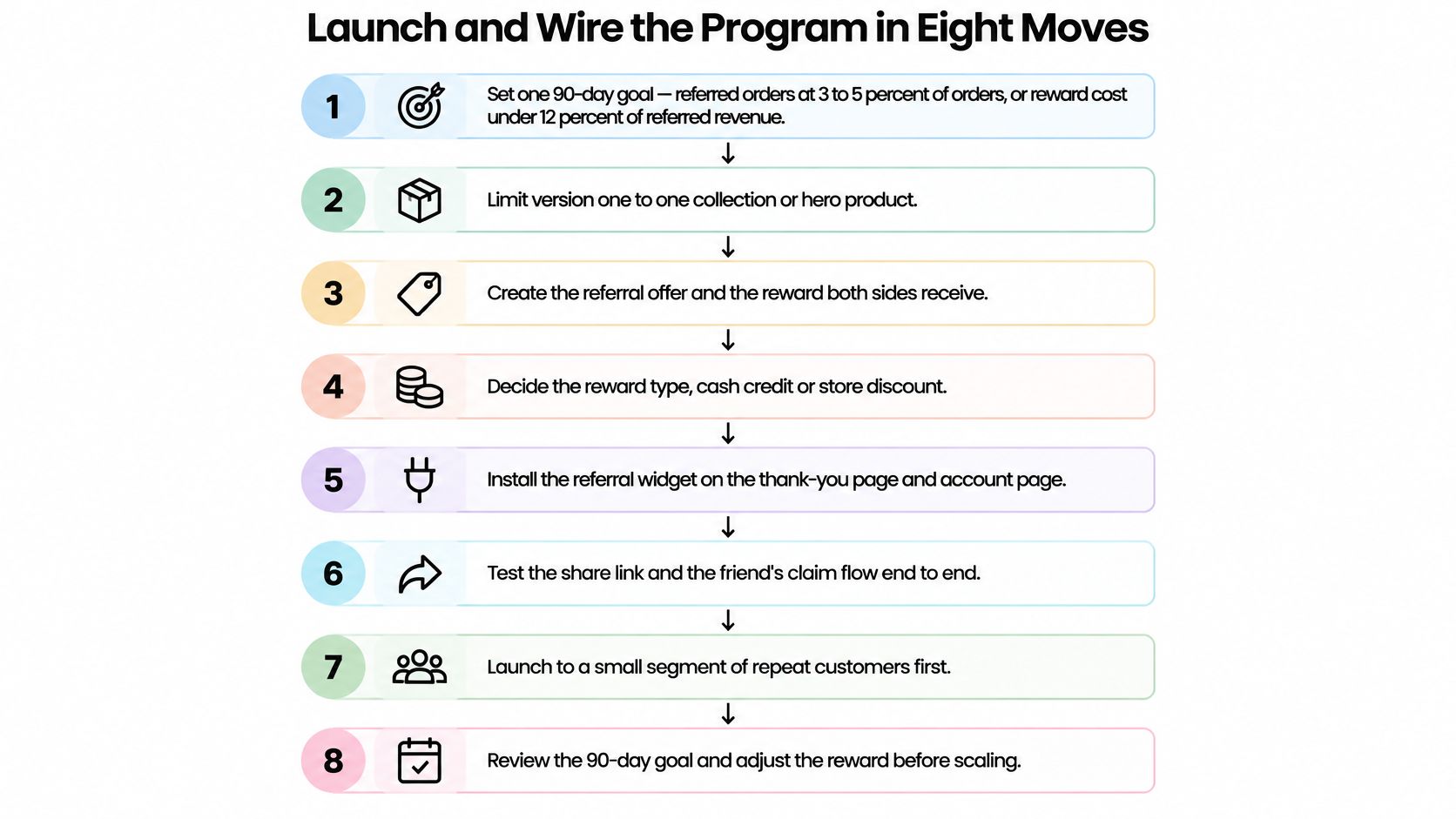
Launch and Wire the Program in Eight Moves
A referral setup is a group of connected rules, not a widget on a product page. The discount, reward trigger, tracking method, and fraud checks all need to agree. Start with a narrow program that you can audit by hand before you automate more of it.
Choose one goal. Decide whether the pilot should bring in a meaningful share of orders or keep reward costs within the margin earned on referred sales. Pick one primary measure, write down how you'll calculate it, and give the pilot a defined review date. A goal that mixes acquisition, retention, and revenue without prioritising any of them is hard to act on.
Limit the first version to a collection or hero product. Choose products with reliable fulfilment, clear margins, and a purchase experience you're comfortable recommending. A narrow launch makes it easier to spot whether the offer works for those products. It also limits the damage if an exclusion or discount setting is wrong.
Build the friend offer as a Shopify discount. Use a code or automatic discount restricted to the eligible collection. Add a minimum subtotal, limit redemption per customer, and prevent the offer from combining with other discounts or sale prices. If sale products shouldn't qualify, exclude those products or collections directly rather than relying on customers to notice fine print.
Set the advocate reward to follow a qualified purchase. Don't create store credit as soon as a friend clicks, signs up, or places an order. Wait until payment is confirmed and the applicable return period has passed. Then issue credit or a unique code, with a clear expiry and rules for refunds, cancellations, and partial returns. An app should handle this automatically when its reward settings support your terms.
Track the advocate without corrupting other attribution. Give each advocate a unique link or code and check that the referral app records the relationship against the resulting order. If you use UTM parameters, add them in a way that preserves existing campaign tags. Keep a fallback record in the order notes or your reporting system so you can investigate an order when app attribution is missing.
Put the invitation where customers are ready to share. Add the referral prompt to the thank-you page and order status page. Send a follow-up through Klaviyo or Shopify Email after fulfilment, when the customer has had a chance to receive the product. Don't send the request to someone who abandoned checkout; they haven't yet become a customer with an experience worth recommending. For related workflow ideas, see this guide to marketing automation for ecommerce.
Publish eligibility and fraud rules. Explain how self-referrals, staff purchases, returns, and cancelled orders are handled. Before issuing a reward, flag matching customer emails, shipping addresses, or staff accounts for review. These checks won't catch every form of abuse, but they prevent obvious cases from turning into automatic payouts.
Test the whole path before announcing the program. Place a test order and verify that the friend receives the intended offer, the order is attributed to the correct advocate, and no reward is created before the purchase qualifies. Then invite past buyers first and review early referred orders for shared addresses or payment details. Hold paid promotion until the offer, tracking, and redemption flow behave as intended.
Buy an app for standard rules, build for unusual ones
A standard referral app is usually enough for a straightforward percentage discount or store-credit program. It can generate links and codes, attribute orders, and issue rewards according to its built-in settings. Don't commission custom software just to reproduce features the app already handles.
Custom development becomes relevant when the rule is central to your economics and the app can't represent it. Examples include different rewards by product margin, credit that must wait for returns to clear and then sync with a separate loyalty balance, or an eligibility workflow tied to your existing systems. In those cases, a generic app may record referrals but still leave someone manually reconciling the money.
Metrics That Show a Healthy Referral Mix
A referral dashboard can make a program look busy without showing whether it's profitable. Track orders, clicks, rewards, and refunds together. Pull order and revenue information from Shopify, then match it to the advocate and click records in your referral app.
| Metric | How to calculate | Early healthy band | Stop or fix if |
|---|---|---|---|
| Referral share of orders | Referred orders divided by all orders | A visible, steady contribution after existing customers are invited | Few or no referred orders after the program has been promoted |
| Friend conversion | Referred orders divided by referral-link clicks | A consistent share of clicks turning into purchases | Many clicks but very few completed orders |
| Reward cost ratio | Discount and credit value divided by referred revenue | Below the gross margin on referred orders | Reward cost exceeds the gross margin |
| Fraud rate | Suspected self-referrals divided by referred orders | Isolated cases that can be reviewed and blocked | A sudden cluster of suspicious orders, especially after a code becomes public |
| Refund drag | Referred-order refund rate compared with the store baseline | Close to the store's usual refund pattern | Referred orders are refunded well above the baseline during the reward-eligibility period |
Read the numbers in context
Referral share tells you whether the program is contributing orders, but a low share alone isn't a reason to shut it down. Customers may not have seen the offer, or the placement may be easy to miss. Friend conversion helps separate that problem from a weak offer or landing page: clicks with no purchases suggest the friend's path needs attention.
Reward cost is the clearest financial guardrail. Include both the advocate's credit and the friend's discount, and compare the total with the gross margin from referred orders. If rewards consume more than the margin, pause new payouts or revise the offer before you scale.
Check suspicious referrals and refunds weekly, since they can create immediate losses. Review referral share and reward cost monthly, when there's enough activity to judge whether the channel is contributing sustainably. For broader measurement practices, use a consistent approach to Google Analytics setup, and keep the referral app's order-level records available for reconciliation.
Fixes When Referrals Stall or Leak Margin
Almost no one shares the offer. The referral prompt may be buried in a post-purchase email that customers don't notice, or the reward may not feel useful for the product they bought. Move the invitation to the thank-you page and test a clearer fixed-value offer. Leave paid ads off; more traffic won't fix an offer that existing customers ignore.
Clicks arrive, but friends don't order. Check the landing page as a new customer would. If it advertises one discount while the storefront displays a different sale, or the code is hard to find, the friend has to work too hard to understand the offer. Put the benefit near the top of the landing page and show the redemption instructions in the cart. Leave the advocate's reward alone until the friend's purchase path is clear.
Rewards go out, then refunds arrive. Don't shorten the time before the reward is issued to improve participation. Instead, make the eligibility rule explicit and delay the credit until the order has passed the return period. Review whether the app can enforce that rule before changing the amount of the reward.
Codes cut into margin during sitewide sales. Turn off discount combination and exclude sale collections. Leave the reward amount unchanged until you can see the cost of the code by product and order type. A code that looks harmless on a full-price order can be unprofitable when it stacks with a promotion.
A public post brings a suspicious wave of referrals. Pause the public code, return to unique codes or links, and reject matches that indicate a self-referral. Check whether the suspicious orders share customer details, addresses, or payment information. Don't change a private program for every customer based on a code that has escaped its intended audience.
Advocates refer once and then stop. Add a milestone reward for repeat successful referrals rather than making the first reward larger for everyone. Keep the friend offer stable so you can tell whether the milestone is motivating advocates. Paid acquisition should remain off until friends who click are completing purchases reliably.
Pilot One Collection Then Widen the Offer
Widen the program only when the pilot's orders show that friends are converting, suspicious referrals remain controlled, and reward costs fit within gross margin. Those conditions matter together. Strong conversion can't rescue a program that loses money, and low fraud doesn't prove the offer is attractive.
If the pilot clears those gates, add the next suitable bestseller and consider a tier for advocates who have already referred successfully. For consumables, a reminder in the replenishment email can reach customers when the product is naturally due for another order. A post-purchase SMS is appropriate only where the customer has already given the required consent.
If a gate fails, change one variable at a time, such as the offer placement or the reward size, then let the revised version run long enough to evaluate. Don't add a new channel while you're still unsure whether the current offer works. Keep homepage popups and blanket influencer codes off until you can attribute orders cleanly; otherwise, the program may claim sales it didn't generate.
A standard app remains the right choice when its settings can enforce your rules. Commission a custom Shopify app only when you need a rule the standard setup can't reliably run, such as margin-based rewards or credit that must wait for returns to clear and then sync to an existing loyalty balance. We build custom apps for brands, white-label apps for agencies, and public App Store apps for SaaS companies, and we also take over existing apps.
This week, launch the pilot on one collection and test the entire purchase and reward path before inviting customers. That gives you real order behaviour to assess without exposing the full catalog to an untested discount.
Yassine Malti builds Shopify apps and custom automations, including referral workflows designed for cases where standard apps can't enforce the reward rules your store needs. If you're planning a referral pilot or need to connect rewards with an existing system, visit Yassine Malti to discuss the right fit.
Shopify apps by Yassine Malti
Put this into practice
-

PROMPTit · AI photo editing
Five AI image tools for your product photos · 5 images/month free
-

REMOVEit · Background removal
Clean, consistent product backgrounds in bulk · 5 images/month free
-

VEOit · Product videos
AI product videos made from your product images · 5 credits/month free