Average order value went up last month and the payout barely moved. Refunds took a slice. A discount code took another. Two customers wrote in to ask why a cleanser they never picked had been sitting in their cart.
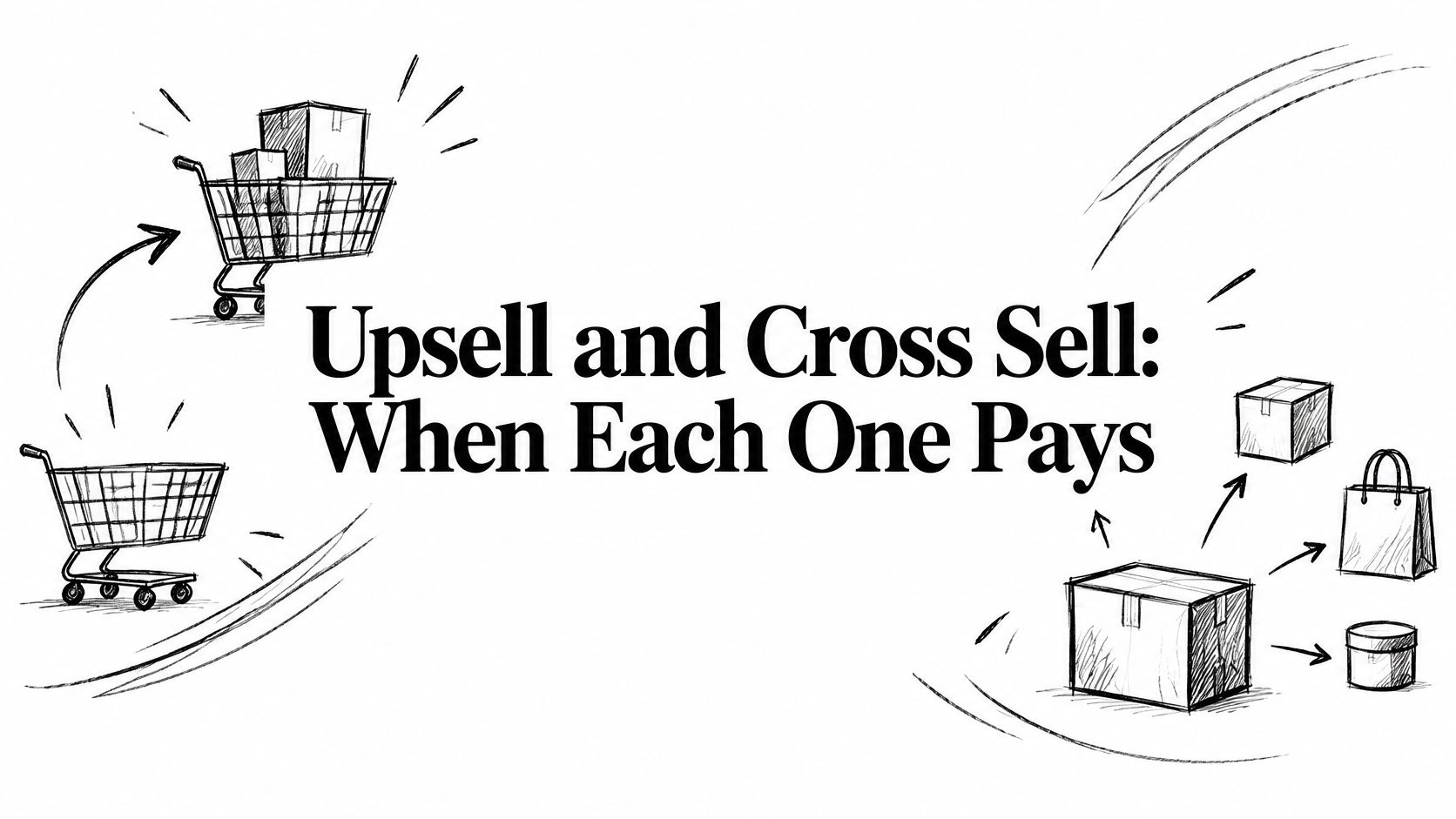
Upsell and cross sell programs get built in the theme editor and judged in the payout report, and those two places disagree more often than merchants expect. An upsell and a cross sell do different work on a basket, they attract different buyers, and they pay back on different timelines. Treat them as one tactic with two names and the store ends up with a fatter order and a thinner margin.
The discipline that fixes it is a merchandiser's habit: name the job each offer does at the cart, then judge it on incremental contribution margin and the quality of the customer it brings in, never on clicks or average order value alone.
Table of Contents
- Upsell and Cross Sell Side by Side
- Why a Bigger Basket Can Still Lose Money
- When to Upsell, Cross Sell or Stay Quiet
- Messages That Explain Why This Item
- Automate the Offer and Measure the Margin
- Three Shopify Baskets Worked Through
- Ship One Offer and Check the Margin
Upsell and Cross Sell Side by Side
Picture a cart holding a $48 serum. The shopper picked it, read the ingredient list, decided.
An upsell replaces that choice with a higher-value version of the same product: the $72 size, a refill bundle, or a kit built from the same formula. Nothing new enters the routine. The shopper just spends more on the thing already in the basket.
A cross sell adds a different item that finishes the job, like a $16 cleanser the serum is meant to follow. The second product only makes sense because the first one is there.
A downsell waits for the decline, then offers a smaller size or a lower-priced variant so the original sale doesn't walk out with the upgrade. The order stays, only the quantity changes.
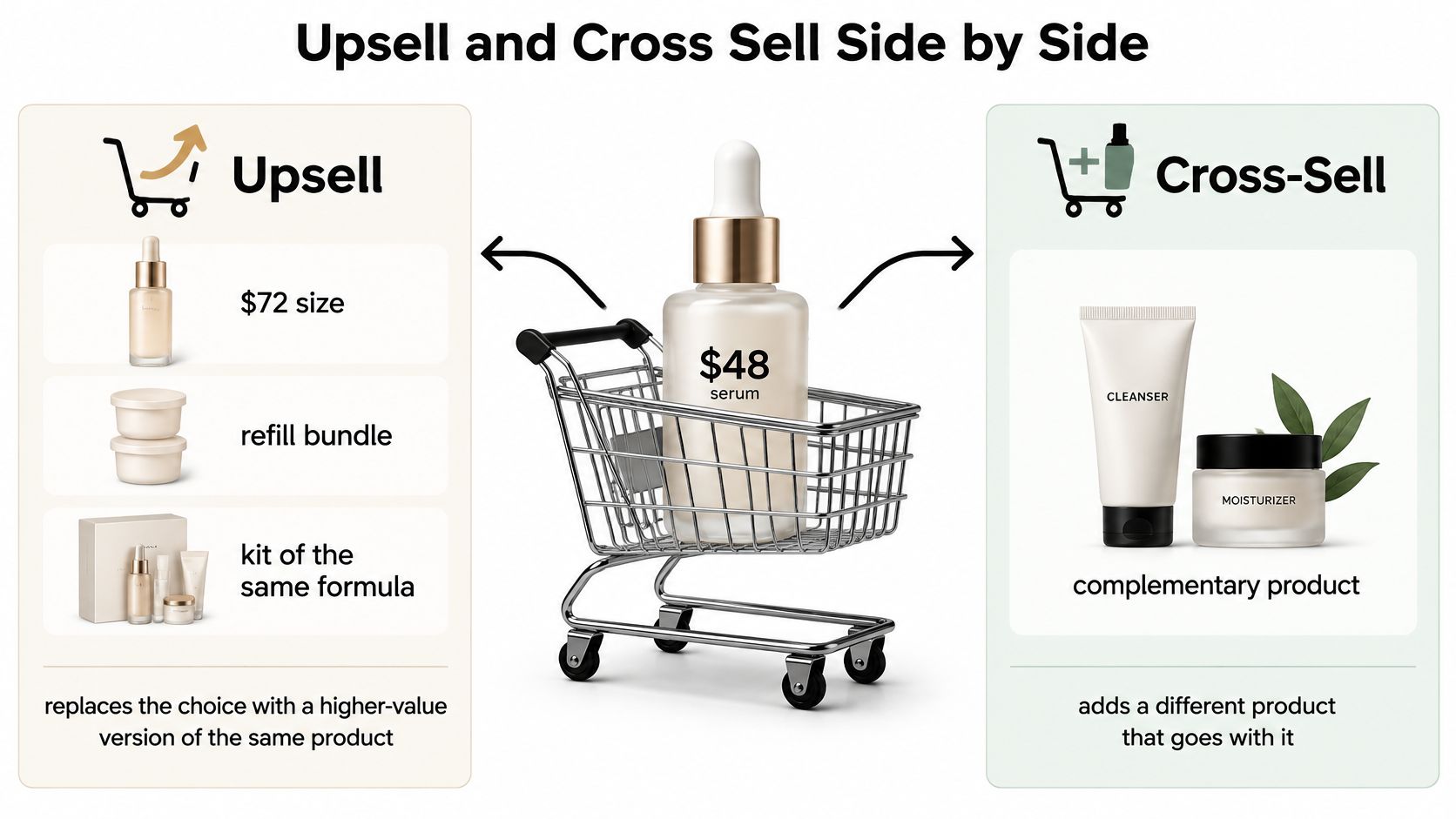
Most stores collapse all three into one recommendation widget and hope the cart grows. The evidence says they run on different mechanics. A systematic literature review from researchers at the Stockholm School of Economics, covering 147 academic papers published between 2000 and 2024, found an overall positive relationship between cross-selling, upselling and add-on selling and outcomes such as sales, revenue and profitability, but the mechanisms work through different pathways. Cross-selling performed best when supported by targeted promotions. Upselling responded more to personalized, emotionally resonant messaging. Add-on selling produced stronger returns when directed at loyal customers and adapted to product complexity.
That is the practical split. An upsell needs a personal reason to trade up, and "you deserve the best" isn't one. A cross-sell needs a targeted reason the two items belong together, which is a claim about the products rather than about the shopper.
| Offer | Basket change | Best moment | Message style | Main risk | Prove it with |
|---|---|---|---|---|---|
| Upsell | Higher-priced version of the same product | Product page or cart when a real premium exists | Personal reason to trade up | Crediting a sale that would have happened anyway | Incremental contribution margin |
| Cross-sell | A different complementary product | Cart, post-purchase or replenishment | Targeted reason the items belong together | Bigger basket, worse profit from returns or support | Margin after refunds and support cost |
| Downsell | Smaller or cheaper alternative after a no | Only after an upsell is declined | Honest price alternative, not a fake discount | Training buyers to wait for the cheaper option | Saved orders that still clear a margin floor |
Default rule: one offer type per moment, matched to the job the shopper is already trying to finish. A screen that offers all three at once makes the shopper compare instead of clicking.
Why a Bigger Basket Can Still Lose Money
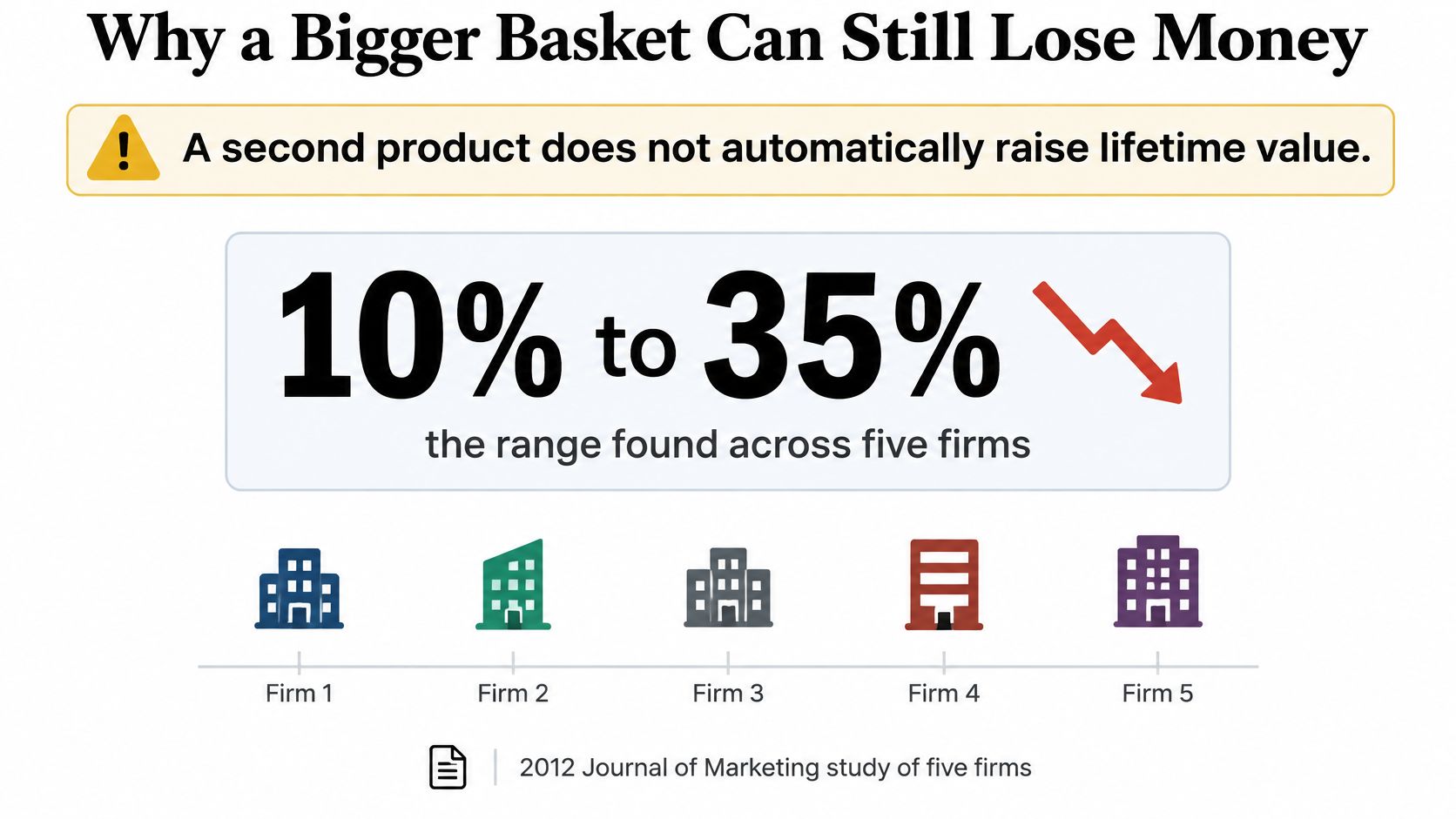
Selling a second product to a customer who already bought doesn't automatically raise lifetime value. It can lower it.
A 2012 study in the Journal of Marketing analyzed customer databases from five firms and found that between 10% and 35% of customers who purchased across multiple product categories were unprofitable. Those cross-buyers generated between 39% and 88% of each firm's total customer-related losses. The study named the behaviors behind the losses: low spending, frequent revenue reversals, excessive service requests, and repeat purchases driven by promotion.
Read that list as a store owner and it starts to look familiar. Those are the exact behaviors an offer engine rewards when it optimizes for conversion. A shopper who adds a third item because a code appeared will convert beautifully and cost money for a year: two support tickets, one return, and a discount dependency that never breaks.
The three-line check before an offer goes live
- Contribution margin on the added item: selling price minus landed cost minus the discount that made it move. If the number is under a few dollars, the offer is buying revenue with cash.
- Refund risk for that exact SKU: pull your own returns from the last two quarters, not the category average. A $16 cleanser that arrives leaking turns a $64 order into a loss.
- Support load: sizing questions, compatibility confusion, and anything that needs an instruction card. Each contact has a cost, and it lands on the same order.
Then split the audience. A loyal full-price repeat buyer can take a complementary offer because the relationship already survives small mistakes. A promotion-sensitive one-time buyer should see fewer, stricter offers, or none at all. Same product, different answer, because the buyer is the variable.
Practical filter: if you can't name the margin, the return risk, and the kind of customer who'll see the offer, don't automate it yet.
There's a second question worth asking before you touch the recommendation logic: is the price doing the work, or the offer? A product priced below its own margin will stay there no matter how clever the bundle. If that's the issue, the groundwork is in these notes on dynamic pricing strategies, and the offer can wait a month.
When to Upsell, Cross Sell or Stay Quiet
The question isn't which tactic is strongest. It's which moment you're standing in, and what the shopper is already trying to finish.
| Situation | Use this | Stay quiet or switch when |
|---|---|---|
| Product page, clear premium version | Upsell | Price gap is large and the extra value is not explained |
| Cart, item needed to use the main product | Cross-sell | The add-on has a high return rate or thin margin |
| Loyal repeat buyer, complex product | Add-on | The buyer only purchases when a promotion is attached |
| Just after checkout | One accessory or a replenishment note | The same item was already offered before payment |
| Consumable running out | Post-purchase replenishment cross-sell | The last order was returned or heavily discounted |
| Only a single product view, no stated need | Nothing, or one quiz question | A carousel would be the only personalization signal |
Read a row as a hypothesis about your catalog, not a lever with a known payout. A percentage another brand published describes that brand's products, prices and customer mix, and it won't reproduce in your cart. Run the row against a control for two weeks, then keep it only if the margin holds after refunds.
How to pick the one row worth testing
Start with the product that pays the bills. If it has a genuine premium version and the price difference is small enough to explain in a sentence, the product page upsell is the cheapest test you'll run all quarter.
If the hero product only works with a second item, such as a device that needs filters or a serum that needs a cleanser, the cart cross-sell is the natural second test. Check its return rate first.
For a store whose catalog is complex and whose buyers come back, an add-on aimed at repeat customers tends to earn more than a new-customer pitch, because the shopper already knows how the product behaves.
Practical rule: one row, one test, one result. The other five rows wait for the answer.
What you shouldn't do is copy a competitor's arrangement because it looks tidy. Their checkout flow, discount policy and return handling are different, so the same offer lands differently. Test it or skip it.
Messages That Explain Why This Item
A shopper buys the $48 serum, and forty minutes later an email arrives about the store's new candle line. Nothing in that message connects to the serum, her skin type, or the season. She doesn't unsubscribe. She just stops opening.
Relevance is the scarce resource here, not data. In Constructor's state of ecommerce research, a 2025 survey of more than 1,500 consumers in the United States and Europe found that only 15% considered product-recommendation emails extremely relevant, while nearly two-thirds rated them merely somewhat relevant or neutral. That result is a warning about weak logic, not a reason to add more recommendation blocks. A relevant offer behaves like a good shop assistant: it appears because something in the basket or the shopper's stated need gave it a reason to appear.
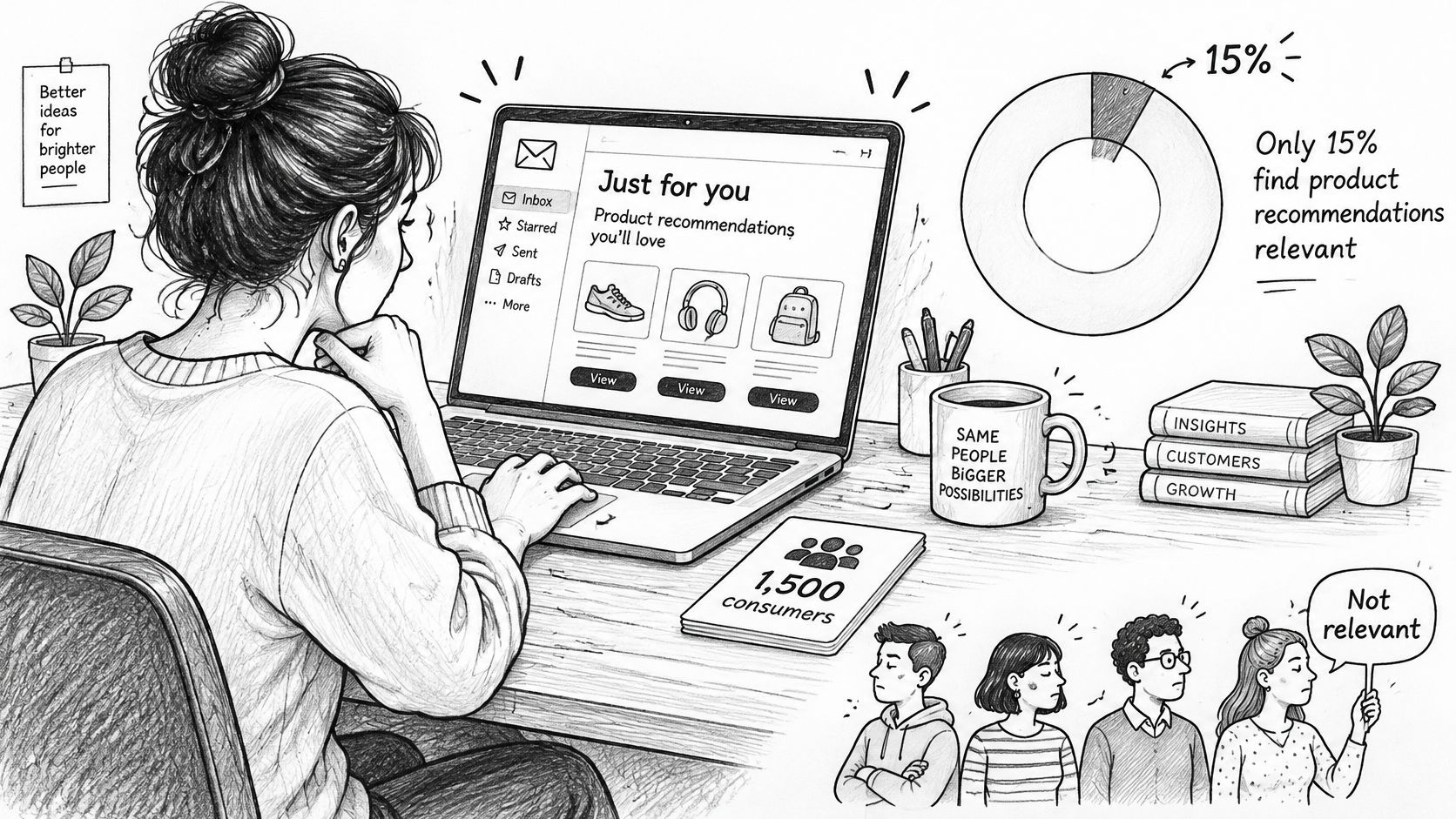
The safest rule is simple: attach one stated reason to one specific item, show the price, and make refusal easy. That reason also protects margin. A generic carousel may produce a click, but a clear offer tells the shopper what job the extra item does, so the merchant can judge whether that job adds contribution after cost, discount and refund risk.
Three signal levels, strongest first
Explicit zero-party signals. A quiz answer, a stated use case, a budget, a compatibility requirement. The shopper told you, so act on it without hesitation.
Repeat purchase of a consumable. A fair replenishment signal. If she bought the same cleanser twice, a refill reminder is service, not selling.
One viewed product. Too weak. A single page view says she clicked a link, not that she has a need. Ask one question, or show nothing.
Placement follows the same logic. A bundle on the product page can help a shopper still choosing between options. A single cart line can complete a kit that's almost done. A post-purchase message can suggest one accessory or a refill, which is far less disruptive than a second storefront appearing on the thank-you page.
Shopify apps by Yassine Malti
Put this into practice
-

Describer · Product descriptions
Product descriptions written from your own product data · Free: 50 descriptions/month
-

LLMs TXT · llms.txt for AI tools
A short llms.txt of your real store links · Free
-

Blogger · SEO blog posts
An AI blog agent that writes and publishes for you · 50 credits/month free