Between 1 November and 31 December 2024, traffic arriving at U.S. retail websites from generative AI sources grew 1,300% year over year, and Cyber Monday alone recorded a 1,950% increase, according to Adobe Analytics, which measured the change across more than a trillion visits to U.S. retail sites.
The shoppers behind those sessions don't behave like ordinary referral traffic either. Adobe found that AI-referred visitors showed 8% higher engagement, viewed 12% more pages per visit, and had a 23% lower bounce rate than visitors from non-AI sources.
So the channel is real, and the people arriving through it read more than average. The awkward part is that a standard Shopify report can't see most of it. When an assistant names your store and the shopper never clicks, sessions stay flat, conversion rate stays flat, and the only trace of the event is a branded search three days later. Making that trace visible takes a different set of numbers than the ones in your SEO dashboard.
Table of Contents
- What AI Search Visibility Actually Measures
- Does AI Visibility Cost You Clicks?
- Measuring AI Visibility Step by Step
- Tracking Store Listings Across AI Search With Synup
- Making Shopify Pages Easier to Cite
- Why AI Answers Leave Out Good Stores
- Your First Month of AI Visibility Work
What AI Search Visibility Actually Measures
AI search visibility is how often your store, its products and its pages turn up inside the answers that AI assistants and AI search features generate, whether or not anyone clicks through to your site. It counts a named recommendation, a linked citation, a passing mention of your brand, and a summary that repeats your return policy without crediting you anywhere.
The closest analogy is a shop window versus a knowledgeable friend. Traditional SEO is the window on a busy street: a passer-by sees the sign, likes the display, and walks in, and you can count everyone who crosses the threshold. AI visibility is closer to being named by that friend when somebody asks for a recommendation. The friend names you from what they already know and have read about you, and you never hear the question or the answer.
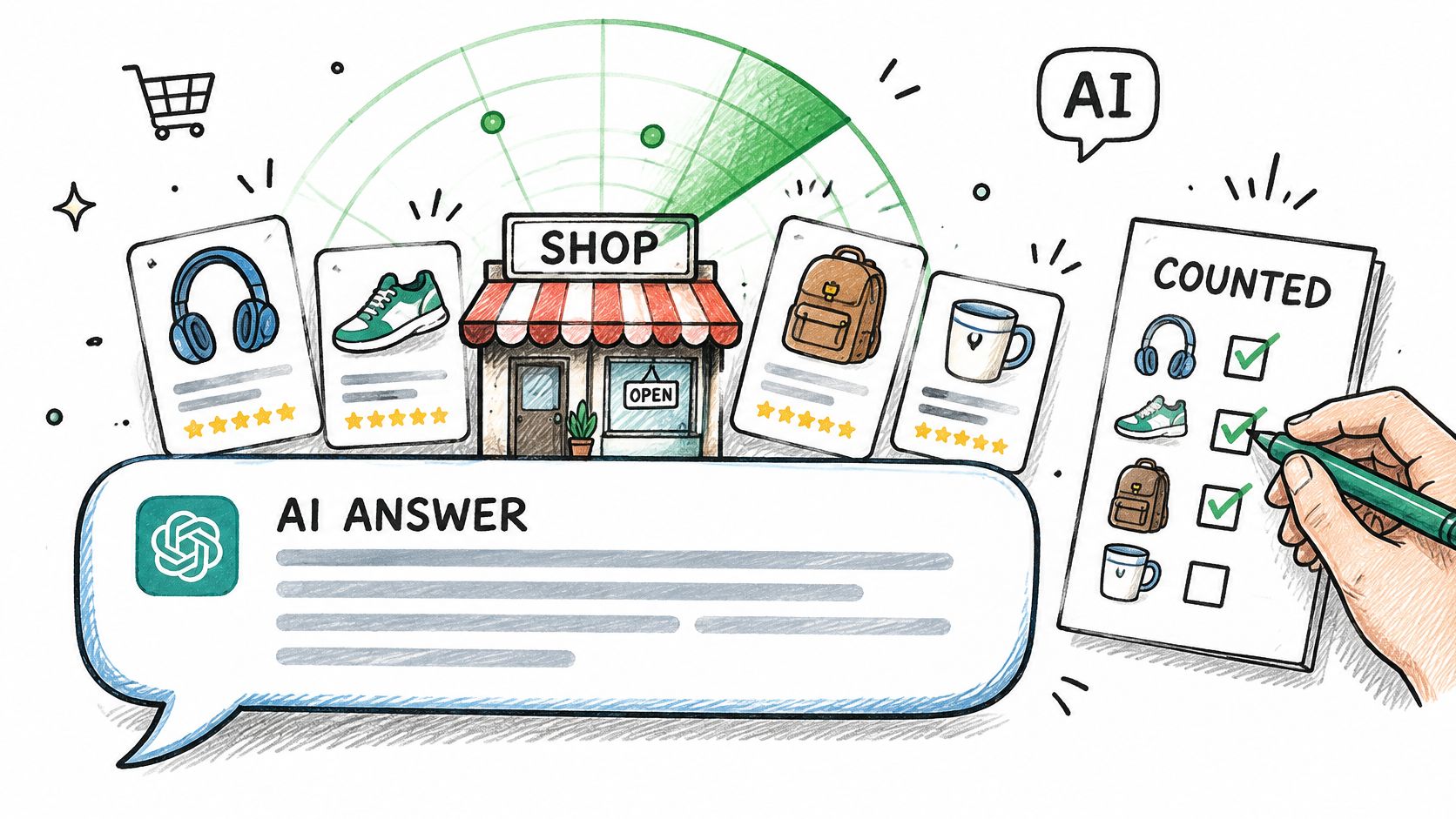
Underneath, the process runs in three steps a merchant can influence.
Retrieval. The system pulls candidate pages for the question, usually from an index it has already crawled. A product stuck behind a JavaScript-only gallery, or a variant page folded into a canonical, never gets pulled.
Selection. From those candidates it chooses the passages that appear to answer the question. A title echoing the shopper's wording beats one written for a mood board.
Citation. It writes the answer and links to some of the sources it used. That last step covers a small subset of what was retrieved, so a page can be used and still never be shown.
Adobe's retail dataset recorded AI-driven traffic to U.S. retail websites growing 12-fold between July 2024 and February 2025 (Adobe research). That makes the channel fast-growing and, for now, a slice of retail visits rather than a replacement for search.
Working rule: a page that can't be crawled can't be retrieved, a page that can't be retrieved can't be cited, and a page that isn't cited sends nobody anywhere.
Work the chain in order. Retrievable first, selectable second, quotable third, and only then argue about rankings.
Does AI Visibility Cost You Clicks?
Google results with AI summaries can lead to fewer clicks on traditional links. In its analysis of Google searches from March 2025, Pew Research Center found that users clicked a traditional result in 8% of visits when an AI summary appeared, compared with 15% when it did not. A link inside the summary received a click in 1% of visits. (Pew Research Center's analysis of Google users' clicks)
Pew also found that 26% of visits with an AI summary ended without a click to another site, compared with 16% of visits without one. These figures describe browsing behavior, not sales.
Click rates with and without AI answers
| Measure | Without AI summary or Overview | With AI summary or Overview |
|---|---|---|
| Traditional link clicked per visit (Pew, March 2025) | 15% | 8% |
| Link inside the AI summary clicked (Pew, March 2025) | Not applicable | 1% |
| Visits that ended without reaching another site (Pew, March 2025) | 16% | 26% |
A short overview of how answers reach shoppers:
Fewer clicks do not necessarily mean less influence. A shopper might read an AI-generated comparison, remember a store's name, and search for it later. A report based only on sessions or last-click attribution may record the later visit without showing that an AI answer helped prompt it.
Clicks and presence therefore answer different questions. Clicks show visits that reached the site; presence shows whether the store appeared in an answer. Neither alone shows whether that exposure contributed to a purchase.
What to watch instead: AI-referred sessions, branded search volume, and orders from visitors who arrived without a tracked campaign. Read the three together, rather than treating any one as a complete measure.
Measuring AI Visibility Step by Step
A single figure labelled "AI visibility" hides the only thing worth knowing. A citation inside an answer that compares four brands is worth more than a mention at the bottom of a list of thirty, and both are worth less than a shopper who reads your name and comes back on Saturday. Split the idea into six signals and measure them separately.
Two of them, inclusion and citation, take an afternoon to collect. Assisted revenue takes months, because you're waiting for people to return. Don't let the slow signal hold up the fast ones.
| Signal | What It Shows | How to Check It | How to Read It |
|---|---|---|---|
| Answer inclusion | Store appears in the generated answer at all | Run the prompt set and log yes or no | Basic presence; the base for every other signal |
| Citation frequency | Share of prompts where your domain is linked | Linked prompts divided by total prompts | Trust and reuse across related questions |
| Citation position | Where your link sits in the source list | Note whether the link is first, second or lower | Higher positions get more attention in the answer |
| Brand mentions | Your name appears without a link | Log name mentions in each saved answer | Awareness that can lead to later branded search |
| AI referral traffic | Visits arriving from AI tools | Filter analytics by AI referrer sources | Direct click volume; undercounts influence |
| Assisted revenue | Orders that followed an AI-era visit | Compare branded search and direct sessions after exposure | Commercial influence; hardest to prove |
Build the prompt set
- Write 20 to 30 prompts in shopper language. Mix product questions ("does this fit a 15 inch laptop"), comparisons ("X vs Y for a small kitchen"), and problem-led questions ("how do I stop a mattress topper sliding"). Keep the list fixed, because a set you rewrite every month can't be compared with itself.
- Run each prompt in a clean session. Log out, clear memory or history, and use at least three assistants plus Google's AI Overviews. Systems retrieve different candidates, so the platform that skips your store may be the one that cites it elsewhere. Save the full answer text rather than a screenshot of the first line.
- Log presence, link and position. Four fields per answer: does the store appear, is it linked, where does the link sit among the sources, and which competitors show up. The common slip is treating a mention as a citation. They're separate outcomes that respond to different fixes.
Connect the answers to revenue
The fourth step is a comparison, not a snapshot. Pull sessions from AI referrers for the last four weeks and set them against the same weeks a year earlier, since a month-on-month retail comparison mostly measures the calendar.
Fifth, open Search Console and plot branded search volume beside the prompt log. Google Search Console is the closest thing to a free read on demand you can't see in a referral report. A lift in people typing your store name in the days after an answer appears is the footprint of a mention nobody clicked.
Sixth, repeat the whole set monthly and change one page at a time. Rewrite six pages at once and a rise in citations teaches you nothing about which edit worked.
A healthy baseline rarely looks impressive. A handful of inclusions, two or three citations, and a long list of prompts where a competitor appears and you don't. The gap list is the useful output.
Sort that gap list by what the question is worth. A prompt about a £400 product that decides a purchase belongs at the top; a definitional question at the bottom.
Tracking Store Listings Across AI Search With Synup
A Shopify brand with physical locations, pickup points or a dealer network has a second content problem. Much of what an answer says about that brand comes from directory records and review platforms rather than from the store's own pages, and stale opening hours or a wrong address copied across five sites will outlive any rewrite of the homepage.
Synup is a local marketing platform built around that layer. It pairs an AI agent, Sydekick, with listings management, reputation tools and an answer engine optimization module. Its listings sync pushes business data to Google Business Profile, Apple Business Connect, Bing, Facebook and a long tail of directories, then audits and corrects the records when they drift.
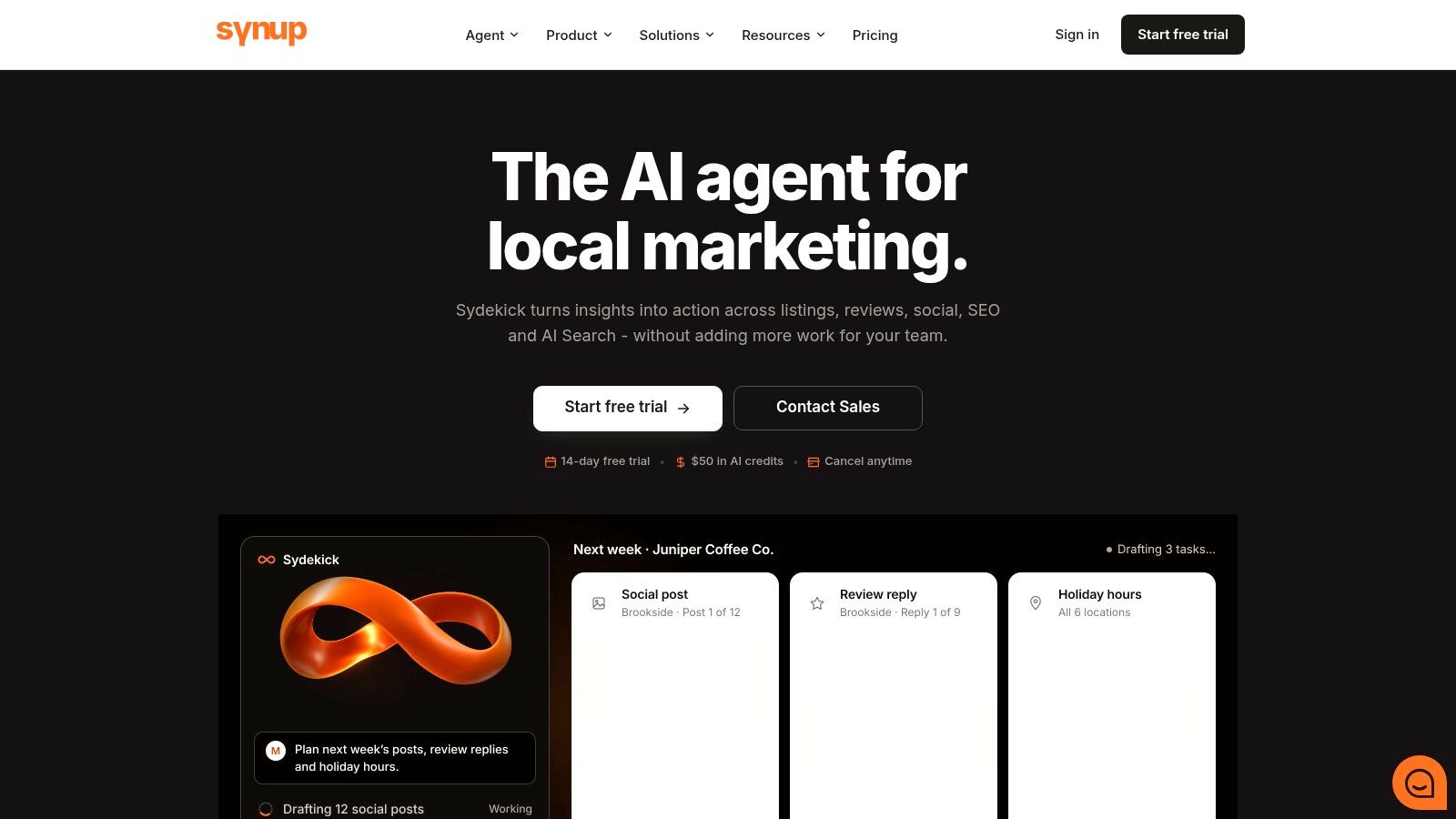
The parts that matter for this topic are the ones that touch citation rather than ranking. Synup's answer engine optimization module tracks AI search visibility across ChatGPT, Gemini and Perplexity, shows which prompts a location is missing from, and points at the citation gaps to fix. Around that sit review monitoring with drafted replies and approval, review request campaigns, social publishing per location, local pack rank tracking, and store locator pages generated from the same records.
Where it earns its keep is scale and mess. A franchise with forty locations, an agency running client stores, or a brand whose hours and addresses disagree across platforms will get value from the sync and the audit trail, and the white-label client portal is designed for partners. For a single-location store with clean data, the directory engine is more tool than you need, and the AEO diagnostics are the useful part. Either way, it doesn't write your product pages. That work stays with you.
Making Shopify Pages Easier to Cite
The comfortable assumption is that the most thorough page wins. A controlled test says otherwise.
Researchers ran 252,000 paired trials across six language models, changing one content factor at a time and recording which source received the first citation. Topical relevance and list position were the biggest drivers. Explicit prices and recent timestamps produced consistent gains, while completeness and trust signals had smaller effects (ACM study on citation selection).
What that means in practice is narrower than most advice suggests. Match the wording of the question in your title and opening paragraph, put the verifiable facts in plain text, and place the decision-relevant evidence early. A long, careful, beautifully written page that answers a question obliquely loses to a shorter page that answers it in the first sentence.
Google's own documentation is blunt about the plumbing. Sites don't need special AI files, AI-only markup or new schema to appear in AI features, and the company describes those features as using core Search ranking systems to retrieve current pages before generating an answer with links to sources (Google Search Central documentation on AI features). The weight falls on fundamentals: renderable HTML, one clear topic per URL, stable canonicals, and internal links that connect a product to the guide that explains it.
There's an entity layer worth getting right too. Organization schema tells a crawler which company owns the site, its logo, its support contacts and its social profiles, so a store name resolves to one entity instead of four half-built ones.
Brand mentions elsewhere correlate with what shows up in answers. An Ahrefs analysis of 75,000 brands found that brand web mentions had a 0.664 correlation with visibility in Google AI Overviews in 2025 (Ahrefs). That's a correlation, not a cause. Mentions may lift visibility, or prominent brands may earn both mentions and citations. Either way, outside coverage counts toward the work.
What to change, page by page
Take a sleeping bag. The product page should state weight in kilograms, temperature rating, fill material, packed size, shipping time and stock status in text. A spec chart baked into an image is invisible to retrieval and useless to a screen reader. Put the price near the title, since explicit prices produced consistent gains in that study.
On a collection page, add three or four sentences of buyer guidance above the grid explaining how to choose by season or use. Category-level questions get answered at category level as often as at product level, and an empty grid of thumbnails gives a retrieval system nothing to quote.
For a guide, put the answer in the first two sentences, use question-style subheadings, and show an updated date that changes only when facts change. A date that refreshes on every save teaches the model that the page is unstable.
Policy pages do more work than merchants expect. Write the return window, shipping windows and warranty in plain sentences that match the checkout figures exactly. "See terms" answers nothing for a buyer who asked an assistant whether you accept returns on opened items.
| Page Type | Add or Fix | Why It Helps | Check Before Publishing |
|---|---|---|---|
| Product page | Plain-text price, dimensions, materials, shipping time and stock status | Gives answer engines verifiable facts to quote | Price and specs are readable without opening images |
| Collection page | Short buyer guide above the product grid explaining how to choose | Matches category-level questions buyers ask | The main question is answered in the first paragraph |
| Guide or blog post | Direct answer in the opening paragraph and question-style subheadings | Passages can stand alone inside a generated answer | Update date shown and revised only when facts change |
| Policy page | Returns, shipping windows and warranty terms in plain sentences | Answers decision questions buyers put to AI | Figures match the product and checkout pages |
Test one page before you rewrite forty
Keep paragraphs short. Two or three sentences per block makes a passage easy to lift intact, and a wall of text tends to get skipped in favour of a cleaner competitor.
Then fix one product page and compare against the prompt set after four weeks. That single test tells you whether the diagnosis was right before you spend a month rewriting a catalogue.
Change one page, wait four weeks, run the same prompts, compare. Anything faster is guessing with extra steps.
Why AI Answers Leave Out Good Stores
Research on how generative search picks its sources reports a citation bias. Longer documents and Wikipedia are over-represented, while social-media sources and negatively framed content are under-represented (research on generative-search source selection). A related synthesis finds third-party earned media can be favoured over brand-owned content, and that the source sets behind Google Search, AI Overviews and Gemini differ from one another.
The consequence for a young store is uncomfortable. An accurate, well-structured product page can lose to a competitor's review, a marketplace listing or a trade article, because the system is drawing on evidence you don't control.
Structure gets you eligible. Evidence from elsewhere gets you chosen.
When a summary misstates your store, correct the sources it read, not only your own page: the review platform, the marketplace listing, the directory record. Then make sure the accurate version exists on your site in plain text, so at least one source says something checkable. Reviews, marketplace presence, press mentions and expert coverage are the corroboration an assistant weighs, and they sit squarely inside the E-E-A-T framework that governs how a brand's credibility is assessed.
Be honest about the limit. That research describes patterns in source selection. It guarantees no fix, and it doesn't tell you which independent mention will move a specific answer for your category. Judge every change by the prompt results from your own baseline.
Your First Month of AI Visibility Work
Every new page should pass one test. Does it answer one exact question with a checkable fact? A guide that describes a category in glowing terms and never says whether the product ships to Canada, fits a 60cm desk or contains nuts fails that test no matter how well it reads. Publish one page per exact question rather than ten generic pieces.
The month's sequence is short enough to finish.
- Run the prompt set this week. Twenty to thirty questions, three assistants, clean sessions. Record the baseline for inclusion and citations, and keep the saved answers.
- Pick two pages. One product page with thin specs and one guide that buries its answer.
- Make the edits. Plain-text specifications on the product page. An answer-first opening paragraph and a visible date on the guide.
- Repeat the same prompts in four weeks. Compare against the baseline, then choose the next fix from whatever gap remains.
Technical housekeeping usually runs alongside this, because it's fast and the gaps are common. Missing alt text on product images and weak meta titles and descriptions appear on most stores and can be fixed in bulk. ALT SEO generates AI alt text for every product image, and RANKit generates AI meta titles and descriptions sized for Google, which clears the two cheapest items on the list so your attention can go to content.
Let the baseline decide the order, though. If the prompts show you're absent whenever a shopper asks for a comparison, meta descriptions won't close that gap, and a rewritten product page will.
Start with the baseline, not the rewrite. Twenty questions, three assistants, one afternoon, and a written record you can measure against in four weeks. Pick the fix that matches the gap the test exposed, whether that's a product page missing plain-text specs, a guide that hides its answer, or the alt text and meta tags nobody has touched since launch. If you'd rather clear the bulk items first, ALT SEO and RANKit run inside Shopify with a free plan, and the site carries $100 in free AI credits across the apps.
Shopify apps by Yassine Malti
Put this into practice
-

ALT SEO · Image alt text
AI alt text for every product image · 100 images/month free
-

RANKit · Meta titles & descriptions
AI meta titles and descriptions, sized for Google · 50 meta tags/month free
-

TAGit · Product tags
SEO-friendly product tags, generated in bulk · 50 tags/month free