Keyword density is the share of a page's total words taken up by a target keyword or phrase, calculated as (keyword occurrences ÷ total words) × 100. A 1,000-word product guide that mentions "Shopify SEO" 10 times lands at exactly 1%.
Now the part most guides skip. Search what is keyword density in SEO and you'll meet the same advice in a dozen fonts: stay between 1% and 2%, never cross 3%, add the phrase two more times to reach the target. That advice treats the number as a destination. It isn't one. It's a reading, closer to a thermometer than a thermostat. It tells you the temperature of the page, not what the temperature ought to be, and Google publishes no density target at all. Stores that chase a percentage usually make their pages worse in the process.
What the number is useful for is editing. It shows you where a product page repeats itself into nonsense, and where a collection description says so little that a shopper learns nothing. Here's the path: how the formula works, how to measure it by hand, where the number came from historically, why it stopped deciding rankings, and how to use it on real Shopify pages without slipping into mechanical repetition.
Table of Contents
- What Keyword Density Measures and How to Calculate It
- How to Measure Keyword Density by Hand
- When Keyword Density Decided Rankings
- Why Keyword Density Matters Less Today
- Tools That Measure Density and Their Limits
- Keyword Density Examples on Shopify Product Pages
- Audit Your Shopify Pages Without Chasing a Percentage
What Keyword Density Measures and How to Calculate It
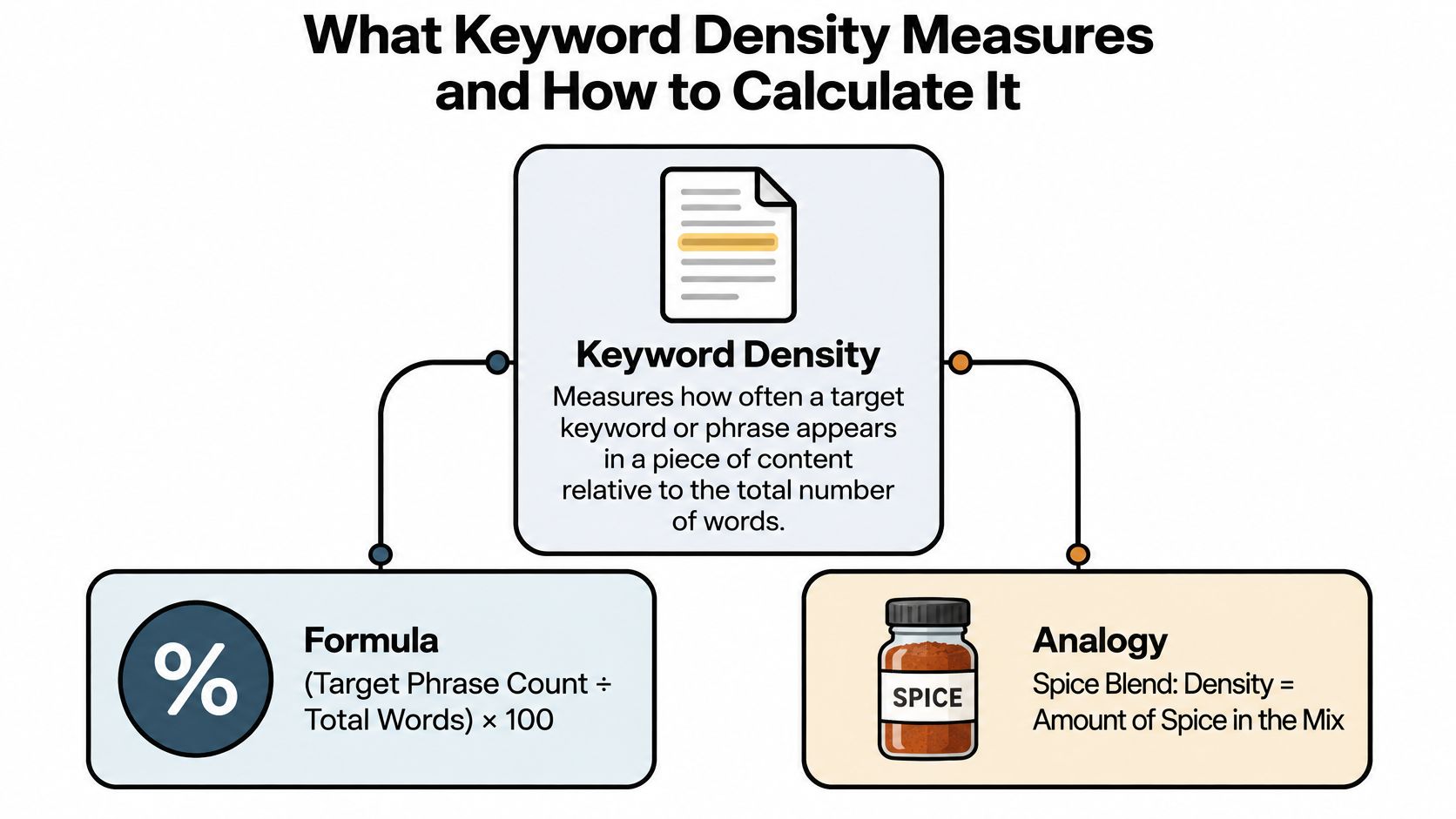
Keyword density is the share of a page's words taken up by a target phrase, expressed as a percentage. A spice blend gives you the right mental model. Density tells you how much of the mix is cumin. It says nothing about whether the dish tastes good, whether a guest would order it twice, or whether the recipe was worth writing down in the first place.
The formula is short enough to keep in your head: keyword density = (keyword occurrences ÷ total words) × 100. A 1,000-word product guide that mentions "Shopify SEO" 10 times works out to 10 ÷ 1,000 × 100, which is 1%. The same arithmetic, documented in the reference entry on keyword density, applies to a 40-word collection blurb and a 3,000-word buying guide without changing a single step.
Four Worked Examples
Read down the rows and the arithmetic starts to teach.
| Page | Total words | Keyword occurrences | Exact-match density |
|---|---|---|---|
| 1,000-word product guide | 1,000 | 10 | 1.0% |
| 500-word collection description | 500 | 5 | 1.0% |
| 1,500-word buying guide | 1,500 | 6 | 0.4% |
| 300-word product description | 300 | 9 | 3.0% |
- 1,000-word product guide, 10 mentions: one mention per hundred words, roughly once every two or three sentences.
- 500-word collection description, 5 mentions: halve the page and halve the mentions and the ratio holds flat.
- 1,500-word buying guide, 6 mentions: a longer page dilutes each mention even when it answers more of the shopper's question.
- 300-word product description, 9 mentions: short copy swings hardest. Nine mentions in 300 words is a phrase every 33 words, which reads like a slogan on repeat.
That last row is where most store owners get caught, because product descriptions are short by nature. One extra mention on a 300-word page moves the number by a third of a point, so the temptation to keep adding is strong and the damage is immediate.
What the Number Cannot Tell You
Density is a descriptive text metric. It reports repetition and nothing else. It cannot establish topical depth, whether the page satisfies search intent, whether the merchant knows the product, or whether a shopper converts at the end of it. A page can sit at a perfect 1% and still fail every one of those tests, and a page at 0.2% can answer the question better than its competitor.
You can now compute the figure for any product, collection or blog page in under a minute. Keep this in view as you do: the number only means something when it's read beside the page's purpose. A specification table and a gift guide answer different questions, and they earn different densities.
How to Measure Keyword Density by Hand
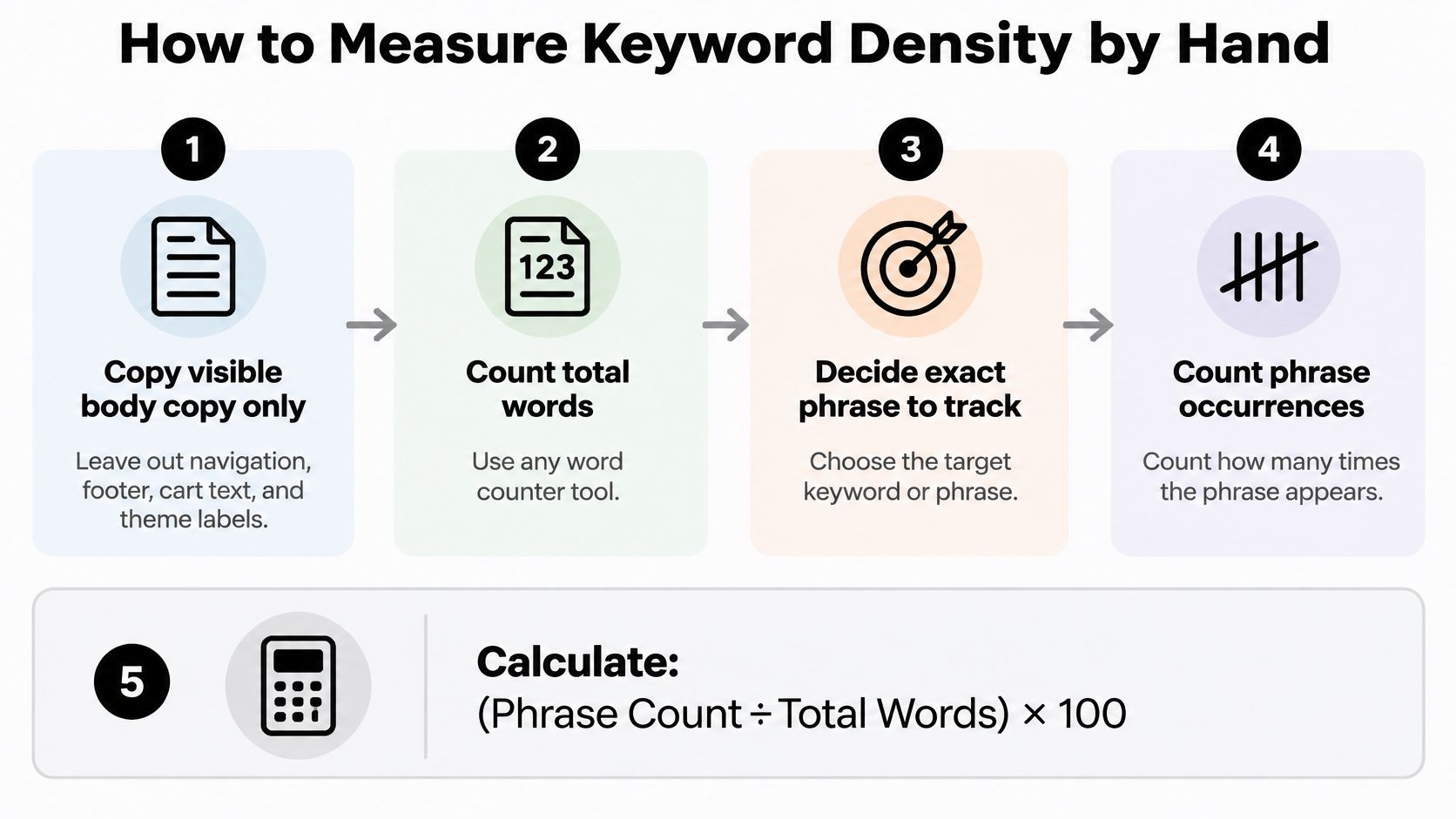
Do this once and you'll never need a calculator site again. The steps take about five minutes on a normal product page.
- Copy only the visible body copy. Leave out navigation, footer links, cart text and theme labels. Those strings inflate the word total and drag the percentage down, so a page can look under-optimized when the body copy is perfectly fine.
- Count the total words. Any word counter works. Write the number down, because you'll want to compare it after the rewrite.
- Decide the exact phrase you're tracking. Record the variants you'll count separately, such as plurals or reordered words. "Pour-over coffee set" and "coffee pour-over set" are two different counts unless you say otherwise, and most tools count them separately by default.
- Count exact occurrences in the body copy, and declare whether headings count. Consistency matters more than the choice. If one page includes H2s in the count, every page you compare must.
- Divide and multiply. Occurrences divided by total words, times 100. Then run the same count with one synonym to see how far the page leans on the exact phrase versus related language.
Edge Cases That Skew the Result
A phrase split across a line break often escapes a search box, so count those by eye. Short descriptions move in big jumps: one mention in 100 words equals 1%, which means a single sentence can shift a short product page by several points. Stopwords like "the" and "and" pad the total, so two tools that treat them differently will disagree about the same page.
The more important number is what you do with the result. Google's SEO Starter Guide describes excessive repetition as keyword stuffing and tells publishers not to focus on it, and it gives no recommended percentage to aim for. Google classifies stuffing by intent and reading experience, meaning unnatural, out-of-context repetition used to manipulate rankings, not by any published cutoff.
Editing rule: if a product page comes in below 1%, don't add repetitions automatically. Add the missing dimensions, materials, use cases, comparisons, shipping details or FAQs instead. The density will usually fix itself on the way.
That answers the question store owners ask most often. A low reading isn't the problem. A thin page is, and the percentage is just the first place the thinness shows up.
When Keyword Density Decided Rankings
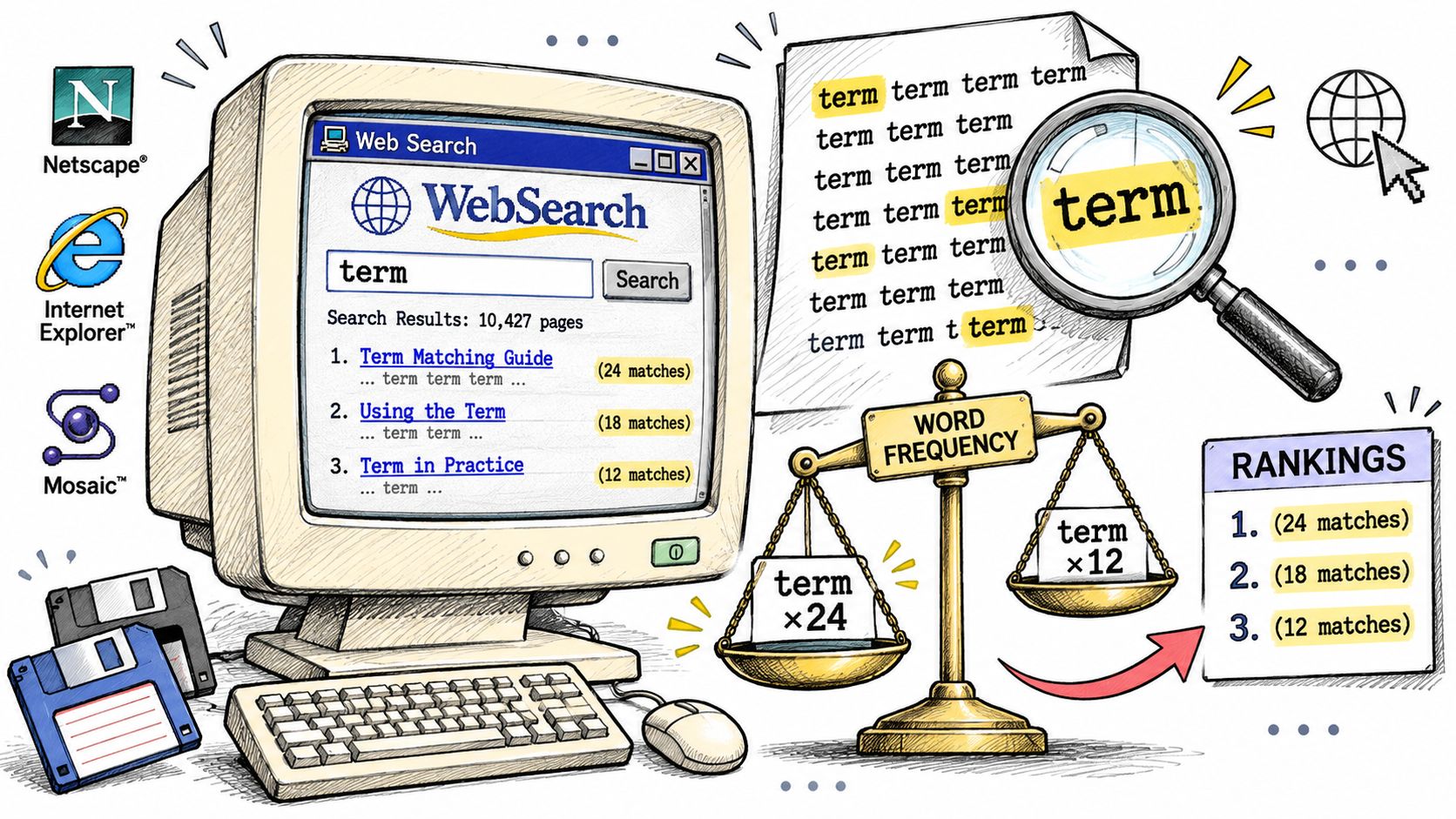
Early search engines were literal machines. They read a page's subject by counting how often a query term appeared in it, so a page that said "running shoes" twelve times looked more relevant than a page that said it twice and described the shoes properly. Term frequency worked because there was nothing better available.
The analogy that holds up is a card catalogue that ranks books by counting words instead of reading them. A shoddy pamphlet shouting "cheap shoes" forty times outranks a careful buying guide that mentions the phrase twice. The catalogue isn't wrong about the data it has. It's blind to the thing you wanted, which is which book helps the reader.
The Chain of Events That Retired the Count
Link analysis changed the equation. When search engines began weighing how many other sites linked to a page, they gained a second opinion, one that a merchant couldn't manufacture by editing their own copy. A page mentioned by ten independent sites carried evidence that a page shouting a phrase forty times did not.
Language understanding finished the job. As engines got better at inferring meaning from context, synonyms and phrase variants, the literal count lost its authority. A page that mentions "kitchen tap" once, "the tap" four times and "this fitting" twice is obviously about taps to a reader, and increasingly obvious to a search engine.
Except the old habit survived. Plenty of store owners learned SEO when density ranges were standard advice, and percentage calculators keep the numerical routine alive long after the systems it was built for changed. The tool is free, the output looks scientific, and the number has three decimal places, so it feels like measurement. A teacher's job here is to say plainly that the instrument is reading the wrong thing.
The video above shows how frequency and placement interact in practice, which is more useful than any single percentage.
Why Keyword Density Matters Less Today
Here's the verdict up front: density is not a ranking target, and no percentage will move a page up the results on its own. Google's spam policies define keyword stuffing as filling a page with keywords or numbers to manipulate Search rankings, including unnatural repetition or lists of terms. Its title-link guidance adds that repeating the same words or phrases multiple times provides no benefit and can make a result look spammy. There's no approved figure, no 1%, no 2%, no 3%.
The evidence points the same way, and it's worth looking at closely because both findings are easy to misread.
| Finding | What it measured | What it means for a store owner |
|---|---|---|
| A 2024 Procrustes analysis of high-ranking articles from large websites found an average of 14 exact keyword mentions and a keyword density of 1.8% | The shape of pages that already rank | Describes those pages, it doesn't prescribe a number for yours |
| A 2024 GEO study by Aggarwal and colleagues tested nine content-optimization methods across roughly 10,000 queries and found keyword density had minimal influence on whether a source was cited | Which methods get a source quoted in AI answers | Repetition isn't what earns the citation |
That 1.8% average is the number most likely to be screenshotted and turned into a target. Don't. It's a correlation inside one sample of large publishers, and it says nothing about what a 300-word product description should contain. It cannot tell you which sentence to change, which detail is missing, or why a competitor outsells you on the same product.
What to Do Instead
Write the primary phrase where it accurately describes the page: the title, the main heading, the opening paragraph, the product details, and the internal links that point at related products. Then let synonyms and related terminology carry the rest of the page, because that's how a knowledgeable person writes about a product they stock.
Rewriting a sentence purely to lift a percentage lowers readability and starts producing the exact signals the spam policy describes. Density tools are better used to catch accidental under-description or conspicuous repetition than to push every page toward a benchmark. If you want a lever that does move rankings, spend the effort on long-tail keyword research and build pages around the specific questions shoppers type.
A page with low exact-match density can beat a high-density page whenever it answers the shopper's problem in the words the shopper would use.
Tools That Measure Density and Their Limits
The choice in front of you is less about which tool is best and more about which job you're doing. A single page during an edit needs a different instrument than 200 product pages during a migration.
| Method | Best for | Main limitation |
|---|---|---|
| Browser keyword density checker | A quick check of one page | Ignores intent, context and synonyms |
| Spreadsheet count with cleaned text | Comparing many drafts at once | Needs manual cleaning of HTML and punctuation |
| Word processor find function | Checking one draft during editing | Counts exact phrase only, no page-level view |
| SEO site crawler with density reports | Flagging outliers across a catalogue | Definitions of words and occurrences vary by tool |
Browser checkers give you a fast reading and a false sense of precision. They paste your URL, strip the page however their parser happens to strip it, and hand back a percentage with no awareness of whether the copy sells anything. Useful as a smoke test, useless as a verdict.
Spreadsheets earn their place when you're comparing twenty product descriptions in one category. Sort the column, find the three outliers at the top, read them. The catch is cleaning: strip the HTML, normalise the punctuation, decide how you handle hyphenated phrases, or the sorting is meaningless.
Why Two Tools Disagree About the Same Page
They count different things. One includes headings, another doesn't. One treats alt text as body copy, another ignores it. One strips stopwords before dividing, which raises every percentage it reports. None of them is lying. They're answering slightly different questions.
Practical check: when a result matters, run the same page through two tools and look at the gap. A wide gap tells you the page is sitting near a boundary the tools handle differently, so read the copy instead of trusting either number.
The word processor's find function is the honest one in the set. It counts exact matches in the text you're editing, which is what you control. A site crawler is the only option when you need to flag outliers across a whole catalogue, and its job is triage rather than scoring: it points you at pages worth reading.
Whatever you use, the output is a flag for review, not a score to optimise. A tool's number becomes useful the moment you pair it with a reading of the page, and worthless the moment you don't.
Keyword Density Examples on Shopify Product Pages
Say you sell a ceramic pour-over coffee set. The description runs 120 words and repeats "pour-over coffee set" six times: in the title, in the first line, and in nearly every sentence after. Six divided by 120, times 100, gives 5.0%.
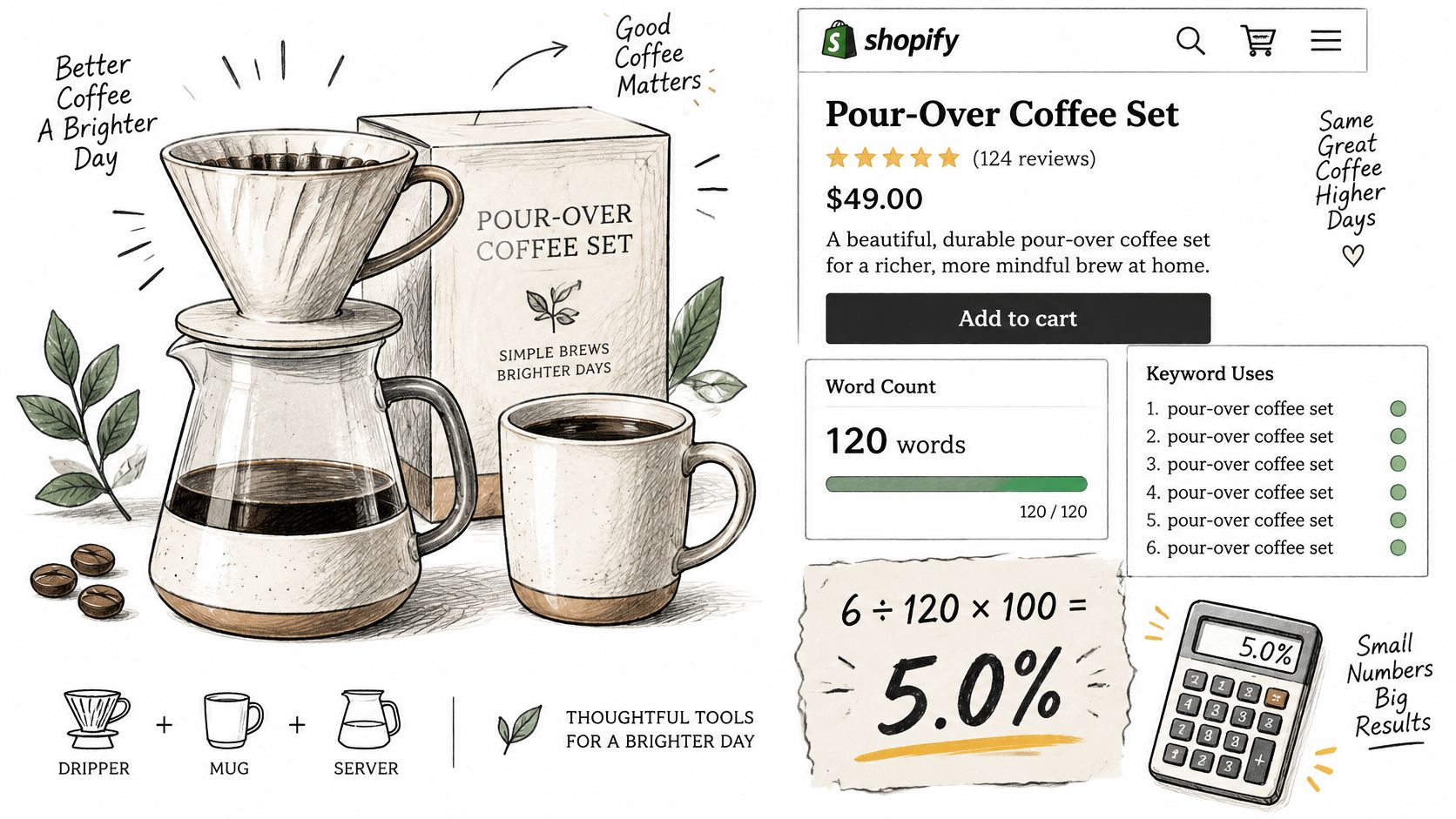
Nothing in those six mentions tells a shopper that the carafe holds 600 ml, that the dripper takes a standard 02 paper filter, whether the ceramic is dishwasher safe, how to keep the glaze even, or how long shipping takes. The page repeats its own headline and calls it copy.
The Rewrite
The better version keeps the phrase in the title and in the opening sentence, then gets on with the information. It runs to 240 words and uses "pour-over coffee set" three times, which is 1.25%. The density fell by three quarters and the page got more useful in every other direction.
A section of it might read:
Ceramic pour-over coffee set, glazed stoneware. The 600 ml carafe brews two generous cups, and the cone dripper takes a standard 02 paper filter, so filters stay easy to find. Both pieces are dishwasher safe, though hand washing keeps the glaze even over time. Ships within two business days.
Two mentions live in that paragraph, one in the heading and one in the body, and the shopper learns capacity, filter size, care and shipping. That's the trade the density number was hiding.
The Opposite Failure
Now look at a collection page that runs 40 words and lists product types: mugs, tumblers, carafes, filters. The target phrase appears once. One divided by 40, times 100, gives 2.5%, which sounds healthy and means nothing. The page has a high reading because it's short, and it's short because it has no descriptive copy at all.
| Version | Words | Mentions | Exact-match density |
|---|---|---|---|
| Original 120-word description | 120 | 6 | 5.0% |
| Rewritten product description | 240 | 3 | 1.25% |
| Collection page with no descriptive copy | 40 | 1 | 2.5% |
The fix here isn't fewer repeats, it's buying guidance: who the carafe suits, how it compares to the larger size, what to pair it with. If you're rewriting product copy across a catalogue, the product description guide walks through the structure that works.
Two pages, one lesson from opposite directions. Density can run too high on short copy that repeats itself, and it can look healthy on a page that says nothing. In both cases the fix is more useful information, never a percentage.
Audit Your Shopify Pages Without Chasing a Percentage
Start where the cost is highest: your top product pages, your main collection pages, and the two or three blog posts that already pull search traffic. Thin copy on a page nobody visits costs you little. Thin copy on your best seller costs you every day.
- Pull the queries. Open Google Search Console and list the top search queries for each page. You want the phrases shoppers already use, not the ones you wish they used.
- Run the density check on the body copy only. Flag any page that repeats the target phrase in most sentences. Flag the very short pages too, the ones with a high reading and nothing to say.
- Read the page aloud. Mark every repetition that adds no information. Your ear catches what the spreadsheet can't, especially in the opening two sentences where the pressure to repeat is strongest.
- Replace the dead repetitions with distinctions. Materials, dimensions, compatibility, use cases, a short comparison against a sibling product. Each replacement should teach a shopper something they'd otherwise have to email you about.
- Check structure. Titles and headings should describe the page accurately, alt text should describe each image in plain words, and internal links should point to related products rather than every page in the catalogue. The on-page SEO checklist covers the remaining structural items worth confirming while you're in there.
Where AI-Generated Pages Raise the Risk
This is the part that changed recently, and it cuts against the old density workflow. Google warns that generating many pages with generative AI without adding value can violate its scaled content abuse policy. Combine that with the stuffing definition and the risk becomes concrete: AI can produce hundreds of collection, product and variant pages that each repeat the same commercial phrase, and every one of them can hit a tool's suggested percentage while offering a shopper nothing new.
Mechanical repetition is not the safety test. The test is whether each page has a legitimate user purpose and materially useful information. Consolidate overlapping collection pages rather than publishing five near-duplicates, and add merchant-specific detail, the thing only you know, before anything goes live.
Audit rule: a page that passes the density check and fails the read-aloud test is the page most likely to hurt you.
On the mechanical side of the same audit, missing alt text and weak meta tags are among the most common gaps on Shopify stores, and fixing them in bulk is quick. That's where ALT SEO and RANKit do most of their work, generating image alt text and product-level meta titles and descriptions at catalogue scale rather than page by page.
Next step, this week: pick five pages, record their current density in a spreadsheet, and make one round of edits focused entirely on missing information. Don't touch a percentage. Recheck search performance after a month and compare.
If you'd rather spend your time on products than on word counts, Yassine Malti builds Shopify apps that handle the mechanical side of on-page SEO, from AI-generated alt text and meta tags to blog automation that links back to your products. The density check stays your job, because it needs a human reading the page. Get the plumbing handled in bulk, then use the saved hours on the five-page audit above.
Shopify apps by Yassine Malti
Put this into practice
-

ALT SEO · Image alt text
AI alt text for every product image · 100 images/month free
-

RANKit · Meta titles & descriptions
AI meta titles and descriptions, sized for Google · 50 meta tags/month free
-

TAGit · Product tags
SEO-friendly product tags, generated in bulk · 50 tags/month free