E-E-A-T means Experience, Expertise, Authoritativeness, and Trustworthiness, Google's framework for judging whether content deserves to rank and be cited. Google added the extra “Experience” dimension on December 15, 2022, evolving the earlier E-A-T framework into E-E-A-T. Google's helpful content guidance explains that these qualities help automated systems identify content that appears useful, while human quality raters use the framework to evaluate search results.
You've probably seen the problem in your Shopify store. You publish a polished comparison of ecommerce tools, optimize the title, add internal links, and watch the page appear in search. A few weeks later, it slips. Meanwhile, a competitor with a simpler design keeps attracting attention because its author explains what they tested, shows original screenshots, names limitations, and gives readers a clear reason to trust the recommendation.
The issue usually isn't the acronym itself. It's whether your content gives people, and increasingly AI systems, enough evidence to believe that your business understands the subject and has earned the right to discuss it. For Shopify merchants, that evidence can come from product testing, merchant experience, accurate policies, qualified authorship, customer reviews, and independent recognition.
Table of Contents
- A Quick Story Before the Definition
- How E-A-T Became E-E-A-T
- The Four Pillars Explained for Store Owners
- On-Page and Technical Signals You Control
- Why E-E-A-T Matters Even When No One Clicks
- Strong Versus Weak E-E-A-T in the Wild
- Your 30-Day E-E-A-T Implementation Plan
A Quick Story Before the Definition
A Shopify merchant selling home fitness equipment publishes a guide comparing adjustable dumbbells. The article looks professional. It uses manufacturer specifications, summarizes popular models, and includes a neat comparison table. The page initially performs well because it matches the search query and covers the expected keywords.
A competing article looks less polished. Its author names the exact products tested, explains how the locking mechanisms behaved during repeated workouts, includes photographs from the test setup, and describes which models felt awkward in a small apartment. The comparison also separates personal observations from specifications supplied by manufacturers. That page gives the reader something the first article can't provide, direct evidence.
E-E-A-T means Experience, Expertise, Authoritativeness, and Trustworthiness. It's Google's framework for assessing whether content demonstrates useful first-hand involvement, sound knowledge, a credible reputation, and reliable information. Google says E-E-A-T isn't a single standalone ranking factor, but its systems use a combination of signals that identify content appearing helpful and aligned with these qualities. Google's guidance on AI-generated content and E-E-A-T also identifies trust as the most important element.
For a merchant, the distinction is practical. A product comparison built from copied descriptions may be relevant, but it offers little evidence of experience. An article written by someone who has handled the products, interpreted the results accurately, disclosed limitations, and linked the business to a real team gives users more reasons to trust it.
Practical rule: Don't ask whether a page “has E-E-A-T.” Ask whether a careful shopper can see who created it, what they know, what they actually did, and why the claims should be believed.
The rest of the work follows that question. You need to understand the change from E-A-T to E-E-A-T, distinguish lived experience from formal expertise, inspect the trust signals across your Shopify store, and prioritize fixes that make your content easier for both shoppers and search systems to verify.
How E-A-T Became E-E-A-T
A Shopify merchant tests a product, answers compatibility questions, and fixes an app conflict before a customer ever sees the result. That practical work was always useful. Google's earlier E-A-T framework, however, grouped its evaluation around Expertise, Authoritativeness, and Trustworthiness, leaving first-hand involvement less visible as a distinct quality.
Human search-quality raters use these ideas to assess page quality and the reliability of search results. Raters do not set rankings directly, and the guidelines are not a checklist that automatically moves a page upward. They help Google evaluate whether content appears useful, accurate, and dependable.
On December 15, 2022, Google announced an update to its Search Quality Rater Guidelines that added Experience as a separate dimension. The change recognized that direct involvement can matter independently from formal knowledge. Google's explanation gives examples such as using a product, visiting a place, or describing what someone personally experienced. Google's explanation of the E-E-A-T update
That distinction suits ecommerce. A merchant may understand a product category without holding a formal qualification in every technical area. Their practical knowledge can come from handling inventory, configuring Shopify apps, resolving compatibility problems, answering customer questions, and observing products in real use.
Experience is not a replacement for expertise
First-hand observation still needs careful interpretation. A merchant who tests an app can describe the setup process, interface, and workflow. Expertise helps explain what the result means, identify configuration limits, and avoid presenting one store's experience as a universal conclusion.
The added “E” gives product-led businesses a way to show evidence they already possess. Support conversations, internal notes, demonstrations, and customer feedback can become clear, accountable content instead of remaining hidden from shoppers and search systems.
What the framework does not mean
E-E-A-T is not a score created by adding an author box or repeating trust-related phrases. It reflects qualities that appear through different signals. An author page can improve transparency, but it cannot correct inaccurate product information or unsupported claims.
Credentials are not the only proof. A qualified professional can demonstrate expertise, while an experienced user can provide valuable practical knowledge. Strong ecommerce content often combines both: direct product experience explains what happened, and suitable knowledge interprets it responsibly. That combination also gives AI-mediated search more reliable material to summarize when a customer sees an answer without clicking through to the store.
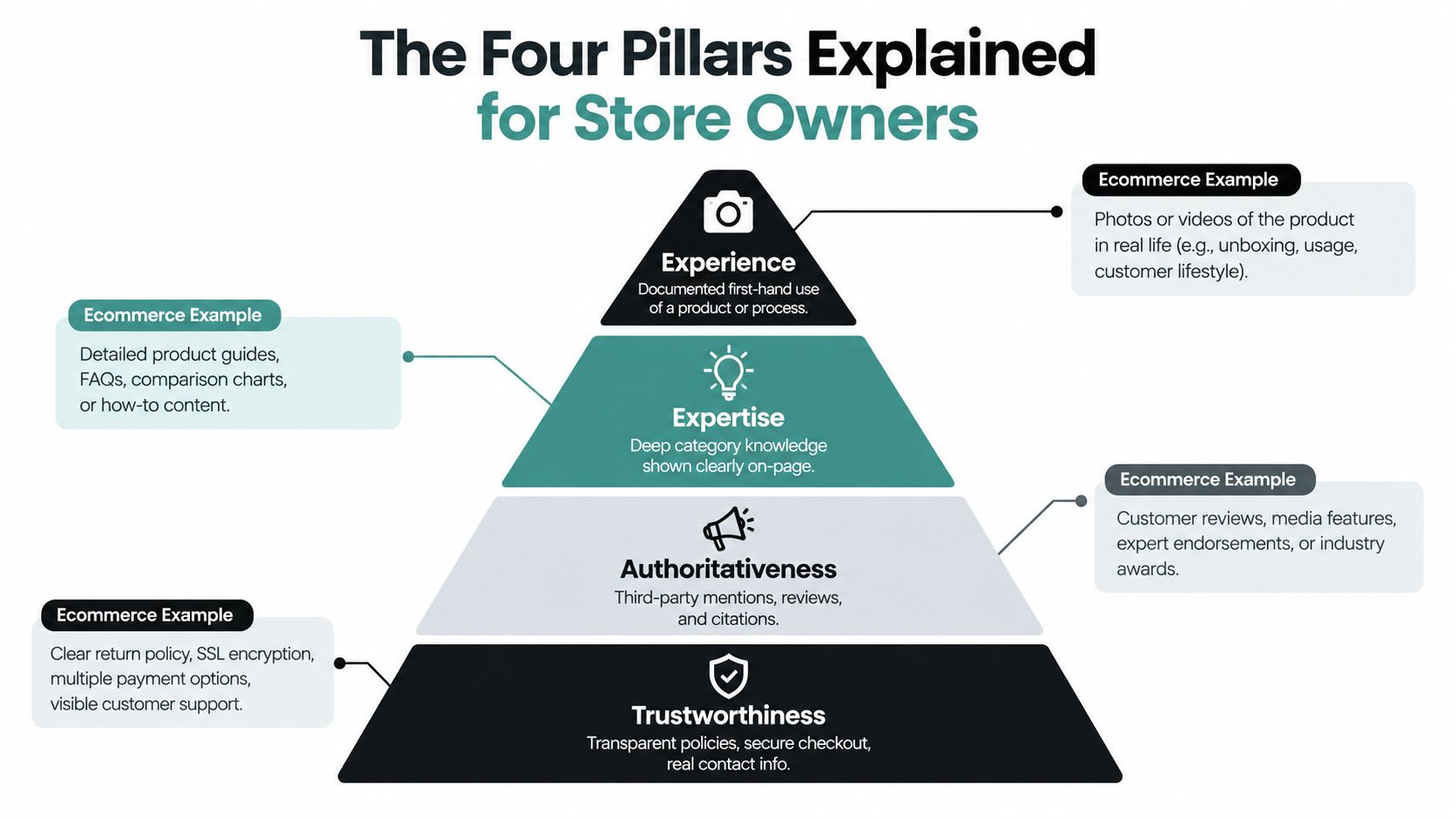
The Four Pillars Explained for Store Owners
Experience
Experience is first-hand involvement. For a Shopify merchant, it might mean using a product, installing an app, testing a theme feature, processing a return, or answering recurring customer questions. The useful evidence is specific, observable, and connected to the subject of the page.
A product guide could include original photographs, notes from a real installation, compatibility checks, or a description of what happened under the stated test conditions. A merchant writing about shipping software could explain the workflow they configured, the carrier rules they used, and where the setup required manual intervention.
Self-audit: Can a reader tell what you personally used, tested, observed, or handled?
Expertise
Expertise is the quality of your understanding. It's not identical to experience. Someone may use a product without understanding its technical limitations, while a qualified specialist may understand the category without having tested every item personally.
On a Shopify page, expertise appears in accurate explanations, appropriate terminology, useful context, and responsible boundaries. If you compare SEO apps, explain how their features relate to indexing, metadata, or catalog management. If you discuss a product's performance, distinguish your observation from the manufacturer's specification.
For help with the writing layer, how to write product descriptions offers a practical reference for making catalog copy clearer and more useful.
Self-audit: Does the page interpret evidence correctly, or does it merely repeat information supplied elsewhere?
Authoritativeness
Authoritativeness extends beyond the named writer. Google's framework considers the creator, the content, and the website's broader reputation. Independent reviews, relevant editorial mentions, genuine partnerships, customer references, and citations from credible sources can all help establish that others recognize your business or knowledge.
This doesn't mean collecting links indiscriminately. A relevant mention from a respected industry publication can be more meaningful than a large set of unrelated pages. Thought leadership can help a specialist brand explain its point of view and earn UK buyer trust with thought leadership when the content is grounded in useful knowledge rather than self-praise.
A structured collaboration workflow such as Backlinker SEO Auto Pilot Backlinks Posts can help merchants discover potential partner stores by niche, language, and location, submit backlink-ready drafts, and manage approval or edit requests. The value depends on the relevance and quality of the partnerships, not on producing links for their own sake.
Self-audit: Would people outside your own website recognize your business as a credible source?
Trustworthiness
Trust is the center of the framework. Google describes it as the most important element because experience, expertise, and authority only help when the page is accurate, honest, safe, and reliable.
For a store, trust includes more than editorial content. Customers need clear shipping and returns information, accessible contact details, accurate product facts, transparent commercial disclosures, and a secure checkout. A review page should make it easy to understand who supplied the feedback and should not hide relevant negative experiences.
Self-audit: Can a shopper verify who operates the store, what they're buying, what it costs, what happens after purchase, and how to get help?
On-Page and Technical Signals You Control
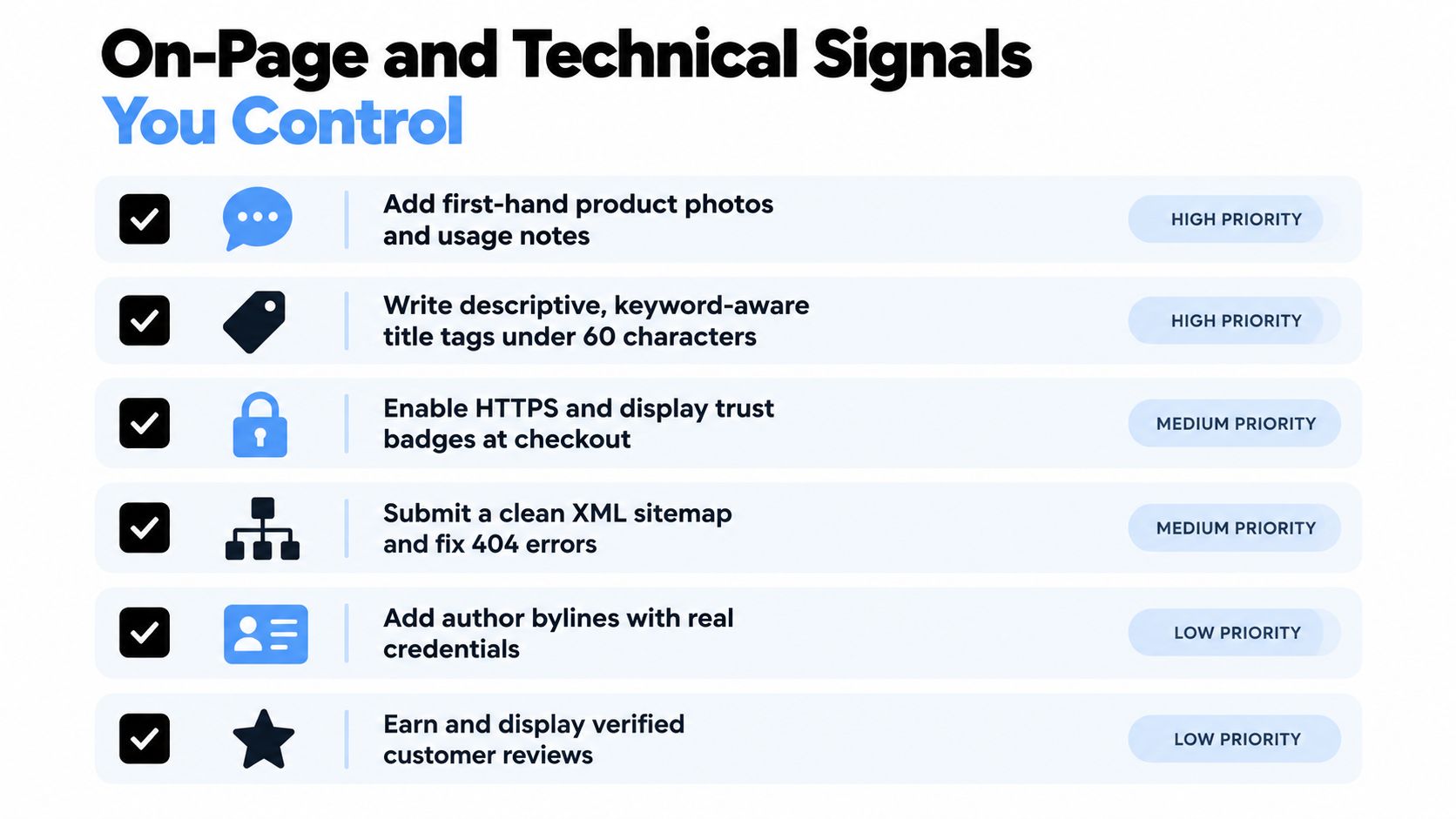
Start with accountability. Add a byline to educational content and link it to an author profile describing the person's relevant experience, training, responsibilities, or testing role. If another specialist reviewed the page, name that reviewer and explain the contribution. A clear owner gives shoppers and AI systems a way to assess who stands behind the information.
Make the business easy to verify. Keep About, Contact, shipping, returns, privacy, and terms pages easy to find. Their details should match the information shown at checkout. Replace vague promises with specific policies, delivery conditions, product specifications, and support options. Update these pages when the business changes.
Make the evidence visible
Product and editorial pages should show how claims were produced. Add original photographs, usage notes, test conditions, compatibility details, and relevant limitations. For example, a merchant selling a phone case could list the tested device models, materials, fit restrictions, and charging limitations instead of repeating a supplier's description. Avoid calling a product “the best” when the page offers no evidence beyond promotional copy.
Customer reviews can support experience and trust. Display verified feedback where possible, leave legitimate criticism visible, and respond with useful information rather than removing every unfavorable comment. Product questions also expose missing details. If shoppers repeatedly ask whether an item fits a particular model, add a direct answer to the product page.
Help systems interpret the page
Use structured data that matches the visible content. Depending on the page, relevant types may include Product, Review, Article, and Organization markup. Structured data doesn't turn weak content into trustworthy content, but it can help search systems interpret products, authors, organizations, and reviews when the implementation is accurate.
Technical basics still matter. Use HTTPS, make checkout security clear, remove broken links, maintain a clean XML sitemap, and fix error pages when a useful replacement exists. Review these foundations with a practical Shopify SEO checklist, alongside content and metadata.
For large catalogs, TAGit AI Product Tag Generator for Shopify can generate product tags from images, titles, and descriptions. It supports bulk processing, multiple languages, customized prompts, and automatic processing of new products. Review tags manually. Automation can organize catalog information, but it cannot provide first-hand evidence or verify a product claim.
Implementation test: Every important claim should have a visible owner, an evidence trail, or a dependable reference. If it has none of these, rewrite it or remove it.
Why E-E-A-T Matters Even When No One Clicks
SEO teams often measure success through rankings and visits. AI-mediated search complicates that model because a customer may see a summary, product explanation, or recommendation without opening the cited website.
A July 2025 Pew-based study reported that users clicked a traditional website result in 8% of searches when an AI Overview appeared, compared with 15% when no overview appeared. It also reported that 1% clicked a cited source inside the summary. The study coverage and its reported findings should be treated as directional, not universal, because Google disputed the methodology and said it hadn't observed significant aggregate traffic declines.
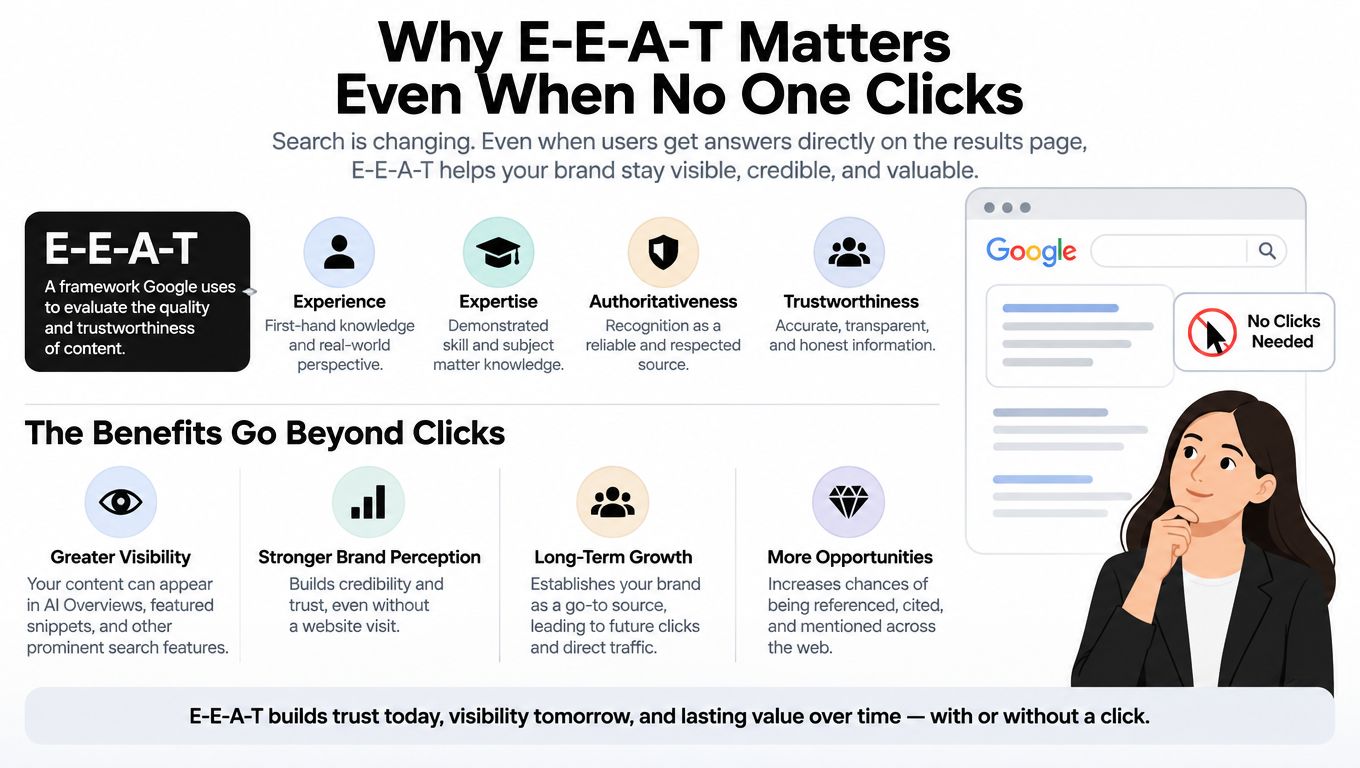
The strategic implication is more important than any single click figure. Your store increasingly needs to be understandable and attributable before a shopper reaches it. If an AI system summarizes your comparison, it needs clear product facts, identifiable sources, consistent terminology, and evidence that can support the summary.
Build for citation-worthiness
A citation-worthy Shopify page answers practical questions directly:
- Who created this content? Show the author, reviewer, or business responsible.
- What was tested? Describe the product, workflow, configuration, or conditions.
- Which claims come from elsewhere? Separate first-hand observations from manufacturer specifications and external references.
- What are the limits? State when a result may depend on a theme, app setup, market, device, or product version.
- Can the facts be reconciled? Keep prices, specifications, policies, and product descriptions consistent across your store.
This changes the publishing objective. You're not only trying to win a position and receive a visit. You're building a source that a search system can summarize accurately and a shopper can recognize later through branded search, direct visits, product engagement, or a recommendation.
A zero-click result can still create demand, but only if the customer can remember and trust the source behind the answer.
Strong Versus Weak E-E-A-T in the Wild
Consider two Shopify blog posts targeting the same product comparison query. The weak page uses a generic author name, copies manufacturer descriptions, includes stock imagery, and gives a confident recommendation without explaining how the products were assessed. Its layout is clean, but the reader has no way to distinguish research from firsthand testing.
The stronger page identifies the writer and reviewer, includes original photographs, records the test setup, separates supplied specifications from personal observations, and adds an update note when product details change. It doesn't claim universal results. Instead, it explains who the recommendation suits and where another option may be more appropriate.
| Signal | Weak Page | Strong Page |
|---|---|---|
| Experience | Generic summaries with no documented use | Original photos, usage notes, and described test conditions |
| Expertise | Repeated product features with little interpretation | Accurate explanation of trade-offs and limitations |
| Authoritativeness | No author profile or external recognition | Named contributor with relevant profile and independent references |
| Trustworthiness | Unclear commercial intent and unsupported conclusions | Clear disclosures, accurate facts, policies, and update information |
The same contrast applies to product pages. A weak page may copy a supplier's title, description, and images while leaving compatibility questions unanswered. A stronger page adds merchant observations, answers common customer objections, displays credible reviews, and links to delivery and returns information where shoppers need it.
The difference isn't visual polish. It's accountability and evidence. A page becomes more useful when the reader can understand who made the recommendation, what information supports it, and how much confidence to place in the conclusion.
Your 30-Day E-E-A-T Implementation Plan
A store that appears in AI summaries while competing pages disappear usually earns that visibility through deliberate improvements to its evidence, ownership, and accuracy. Use the next four weeks to make those signals clearer for shoppers, search systems, and zero-click results.
Week one establishes ownership and transparency
Review your highest-value product, comparison, and blog pages. Add accountable author or reviewer details, connect educational content to relevant profiles, and make the About and Contact pages specific enough to identify the people and business behind the store.
Check shipping, returns, privacy, and terms pages as well. Remove outdated promises, reconcile conflicting information, and place customer-support paths where shoppers can find them before purchase. Clear policies help an AI system describe your business accurately, even when its answer sends no visit to your site.
Week two adds first-hand evidence
Choose pages where your team has real product or merchant experience. Add original photographs, installation notes, compatibility checks, customer questions, troubleshooting steps, and clearly labeled observations. A merchant selling espresso equipment, for example, can document setup time, machine fit, cleaning requirements, and problems discovered during use.
Google distinguishes first-hand experience and formal expertise. Its rater guidance considers whether a creator has used a product or directly experienced a subject, separately from theoretical knowledge or credentials. Google's explanation of experience and expertise supports building both types of evidence where they apply.
Week three validates markup and feedback
Check that Product, Review, Article, and Organization structured data matches visible page content. Review author fields, dates, product identifiers, and review details. Do not add markup for information shoppers cannot see.
Invite genuine customers to share useful feedback about setup, fit, delivery, or use. Turn recurring questions into product copy and support content. If your team uses content automation, assign a human reviewer to verify factual claims and first-hand descriptions before publication.
Week four measures recognition, not only sessions
Track branded searches, direct traffic, product-page engagement, assisted conversions, and mentions in AI-generated answers alongside organic sessions. These measures cannot prove that every change came from E-E-A-T, but they can show whether customers and search systems recognize your store more easily.
A publishing system can help maintain author accountability and update routines. Backlinker can organize relevant guest-post collaborations and approval steps. Use tools to reduce administration, not to manufacture experience or reputation.
Avoid three mistakes:
- Treating E-E-A-T as a checklist: A byline, badge, or schema field cannot compensate for weak evidence.
- Leaving pages untouched: Product specifications, policies, app features, and compatibility details change.
- Confusing authority with self-promotion: Independent references and useful contributions carry more weight than repeated claims about your own expertise.
Start with one important comparison page and one product page. Add the accountable author, document evidence behind the main claims, check purchase-related trust information, and record your current metrics. Repeat the process across the pages that influence customer decisions and the answers AI systems may generate.
Yassine Malti helps Shopify merchants improve SEO workflows through AI-powered apps, custom automations, content generation, on-page optimization, and chatbot integrations. Visit Yassine Malti to explore practical Shopify tools and discuss a custom solution for making your store's content clearer, more trustworthy, and easier to scale.
Shopify apps by Yassine Malti
Put this into practice
-

Backlinker · Backlinks & guest posts
Guest post backlinks from real Shopify stores · 30 credits/month free
-

TAGit · Product tags
SEO-friendly product tags, generated in bulk · 50 tags/month free
-

ALT SEO · Image alt text
AI alt text for every product image · 100 images/month free