The popular advice is simple: get cited by AI answers and traffic follows. That advice gets the mechanism backward. AI citations don't prove an answer is true, and they don't add a fresh stream of clicks on top of search. They redistribute a smaller pool of clicks toward the few sources an engine chooses to name, while making answers feel trustworthy even when the named source doesn't support the sentence. For Shopify merchants, the useful question isn't how to collect citations. It's which store pages own a fact worth citing, whether the cited passage directly supports the claim, and whether the remaining click is worth the work.
Table of Contents
- What an AI Citation Is
- What AI Citations Do to Clicks
- How Answer Engines Choose Sources
- Drafting Store Articles That Answer Buying Questions With Outrank
- When a Citation Only Looks Trustworthy
- Pages Shopify Brands Get Cited For
- How to Make Store Content Citable
- Decide Which Pages Deserve the Work
What an AI Citation Is
A shopper asks a question. The system retrieves passages from indexed pages, writes an answer from that material, and attaches sources to parts of what it wrote. Each attached source is a citation, and it works like a receipt: it should show which page each line came from.
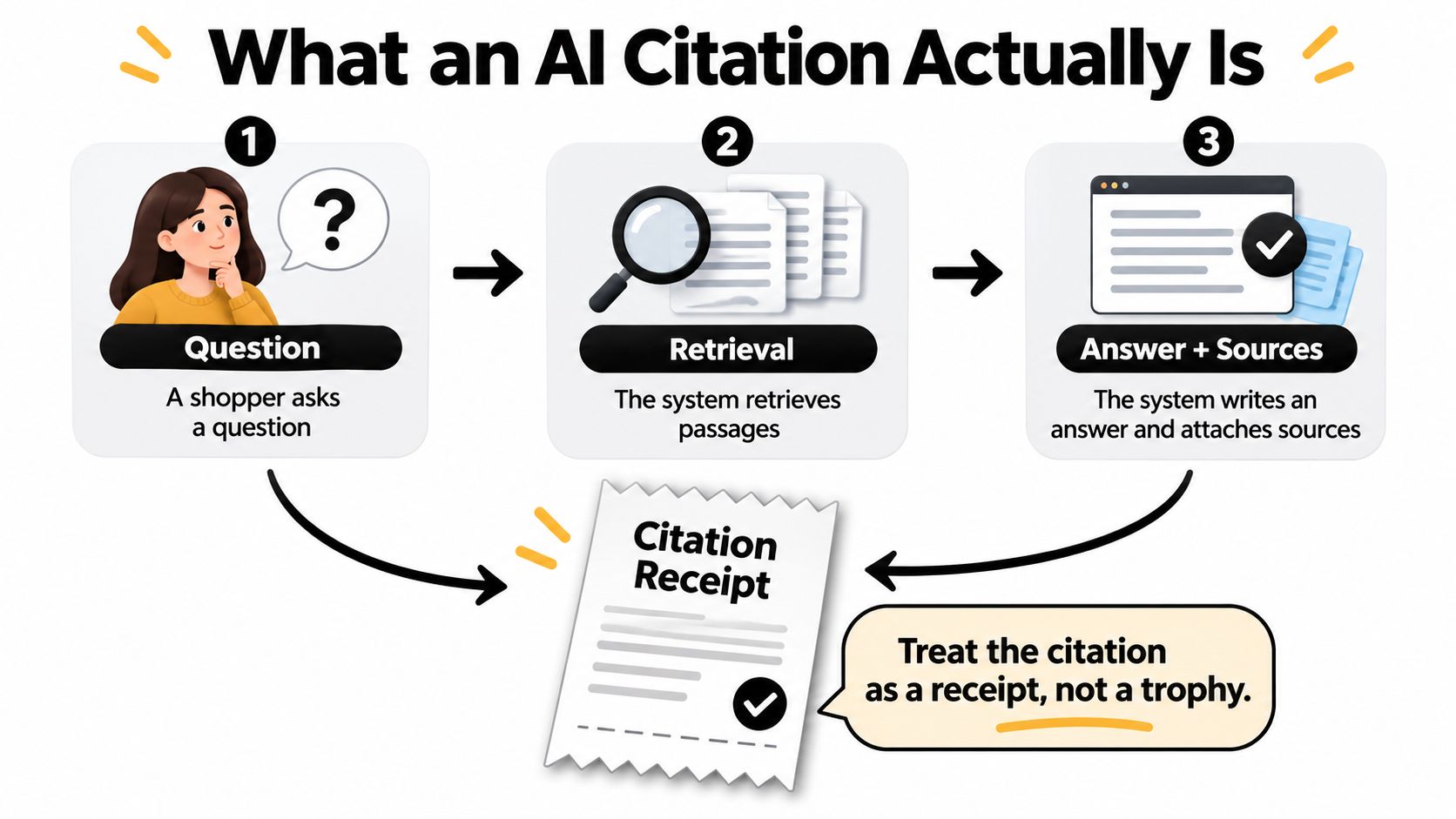
Three Lines on the Receipt
Coverage asks whether each factual sentence has a source. Precision asks whether the attached passage supports that sentence. Recall asks whether the important supporting sources were retrieved at all.
Those three checks fail independently. An answer can post high coverage, with a link after nearly every sentence, and still score low on precision because the linked pages are only loosely related. It can also skip your primary product page entirely, a recall failure, and cite a reseller's older description instead.
Retrieval matters because it constrains what the model can say. A benchmark of retrieval-augmented systems reported that content-level hallucination fell from 42% to 4% when retrieval and verification were evaluated together, while accuracy increased by a pooled 0.64 points with a 95% confidence interval of 0.47 to 0.80. After adjusting for response length, the gain was 0.48 points with a 95% confidence interval of 0.22 to 0.73.
The mechanism behind that gap is plain. Without retrieval, the model answers from what it absorbed in training, which can include outdated or half-remembered product details. With retrieval, it answers from a fetched passage. Verification then checks whether that fetched passage supports the sentence it sits next to.
That distinction matters because fluent formatting has never guaranteed existence. A 2023 JAMA Ophthalmology evaluation found roughly 3 out of every 10 AI-generated citations were nonverifiable or hallucinated. A 2024 analysis of 471 references found hallucination rates of 28.6% for GPT-4 and 91.4% for Bard for systematic-review prompts.
For merchants, the mechanism sets the work. Retrieval performs best when sources are ranked, fresh pages are preferred, and duplicates are dropped before the model writes. After writing, someone or something has to test sentence-level support. A precise citation can still be stale if last year's size chart is the passage retrieved.
Two checks carry through everything that follows. First, does the passage exist at the linked URL. Second, does that passage entail the sentence it's attached to, meaning a reader who accepts the passage would have to accept the sentence. Related isn't enough.
What AI Citations Do to Clicks
Start with the split, because it changes how you budget. A Seer Interactive analysis of more than 3,100 queries observed a 61% decline in organic click-through rate and a 68% decline in paid click-through rate when AI Overviews appeared, while sites cited inside those Overviews experienced 35% higher organic CTR and 91% higher paid CTR.
| Situation | Organic CTR change | Paid CTR change |
|---|---|---|
| Queries where an AI Overview appeared | -61% | -68% |
| Sites cited inside the AI Overview | +35% | +91% |
Read those four numbers together. The Overview shrinks total clicking. Citation concentrates a larger share of what remains. That's redistribution of demand, not a new channel stacked on top of rankings. A merchant who treats AI citations as extra traffic will overinvest. A merchant who ignores them may lose the discovery that still happens.
Definition matters here only as far as measurement does. An AI citation is a source the answer names, links, or quotes as support for its text. It isn't a blue-link ranking. It isn't a casual brand mention in prose with no source attached. Counting mentions as citations inflates your report and hides whether shoppers could reach you.
What to Log Instead of Rankings
For the same priority queries, track these separately:
- AI-answer impressions: How often an answer appears for the query at all
- Citation frequency: How often your page is among the named sources
- Cited position: Whether your source sits where a shopper can see it without expanding a panel
- Later branded searches: Whether exposure shows up as people searching your name afterward
- Assisted conversions: Whether AI-referred sessions contribute before a later purchase
- Revenue per AI-referred session: Whether cited traffic is more qualified, not just more numerous
- Zero-click outcomes: Queries where the answer satisfies the shopper and no visit follows
Check comparisons first. Then check category explainers and product pages that answer a specification in one or two sentences. Those pages can win the concentrated click because the engine needs a compact claim with compact support.
Keep the scope honest. Those percentages come from Google AI Overviews. Other engines may behave differently, so treat any transfer to them as a hypothesis until your own analytics repeat the pattern. The cited evidence also doesn't measure citations as a ranking or backlink signal. The measurable value so far is clicks, branded searches, and assisted conversions, so treat citations as a visibility and conversion lever rather than a rank factor. If a cited page gets traffic that doesn't view a product, save to cart, or return through branded search, the citation is a reporting win and a commercial neutral.
How Answer Engines Choose Sources
Selection looks less mysterious when you see how often engines feel obliged to show sources at all. A 2025 cross-country analysis of Google AI Overviews reported that references or citations appeared in 92% of AI answers to non-Covid queries, compared with 50% of answers to Covid-related queries.
Ordinary product and how-to questions usually expect a source. Sensitive topics receive fewer citations, which suggests engines apply different handling when the cost of a wrong source rises. For a Shopify brand selling non-regulated goods, assume the shopper's answer will try to show receipts. Your job is to be the clearest receipt available.
Evidence Matching, Not a Mystery Score
An engine attaches a source when one passage can carry one claim. It doesn't need your whole page to be brilliant. It needs a block where the answer sentence and its supporting fact sit close enough that extraction doesn't require inference across three paragraphs. A sizing claim buried under brand storytelling gives the system nothing clean to attach. A heading that names the question, followed by a direct answer and the measurement table, gives it a complete unit.
Display format changes what you should check, even though the underlying need for a supportable passage stays constant.
| Engine | How sources appear | Merchant check |
|---|---|---|
| Google AI Overviews | Source chips under the answer | One passage on the page supports one claim |
| Perplexity | Numbered sources beside the answer | The numbered passage matches the sentence it supports |
| ChatGPT search | Inline links and a source panel | The linked URL is canonical and still resolves to the fact |
With Google, the chip rewards a passage that stands alone. With Perplexity, the number creates a visible claim-to-source pairing, so a mismatch is easier for a careful reader to spot. With ChatGPT search, the inline link plus panel makes URL hygiene matter, because a redirect chain, a filtered variant URL, or a page that no longer contains the quoted fact breaks the receipt.
Don't chase keyword density or extra footer links. Neither gives a model a passage that entails a sentence. Density repeats a term. Footer links point elsewhere. The engine still has to find a sentence you'd be willing to defend if a shopper clicked through and read only that block.
Consistency helps for a simpler reason. If your product has three names across collection, product, and blog pages, the system has to decide whether they're the same item before it can cite any of them confidently. Consistent naming, consistent units, and one canonical page per fact remove that extra decision. The signal checklist comes later. The selection logic is already clear: make one passage the obvious support for one claim, and make sure the display format of each engine can surface it without the shopper hunting.
Drafting Store Articles That Answer Buying Questions With Outrank
The assumption worth challenging is that more store articles mean more citations. They don't. A page becomes citable when it answers one buying question with facts the store owns, arranged so an engine can lift a block without inventing context. Volume adds inventory. Structure creates evidence.
Use Outrank for the blank-page problem; keep judgment with the merchant. In an AI citations workflow its role is speed: turn a chosen question, a product fact sheet, and a direct answer into a draft a small team can edit. The merchant still selects the question, confirms measurements and policy wording, and removes claims that cannot be traced to a real detail.
Build the draft around a decision path. Lead with the answer, then state the conditions that change it: size range, materials, fit notes, care limits, shipping cutoff, return window. Keep paragraphs short enough to be lifted cleanly. For comparisons, name the rule before the adjectives. "Choose the insulated version for stationary wear in cold weather. Choose the lighter knit for layering under a shell" gives an engine a clean claim. "Both are premium" gives it tone without proof.
Click math matters. A citation can pull attention out of the results list, but the link remains a trust cue until the page proves the sentence. Audit generated copy line by line. Delete unnamed studies, unopened statistics, expert-sounding filler, and any phrase your product page would not support. If two pages state the same policy differently, pick one wording and reuse it. Replace generic buying advice with the specifics only your store can certify.
The fit is a team with drafting backlog and review discipline. It is a poor fit for a team hoping generation will do the checking. A faster first draft helps only when a person decides which sentence deserves to be cited.
When a Citation Only Looks Trustworthy
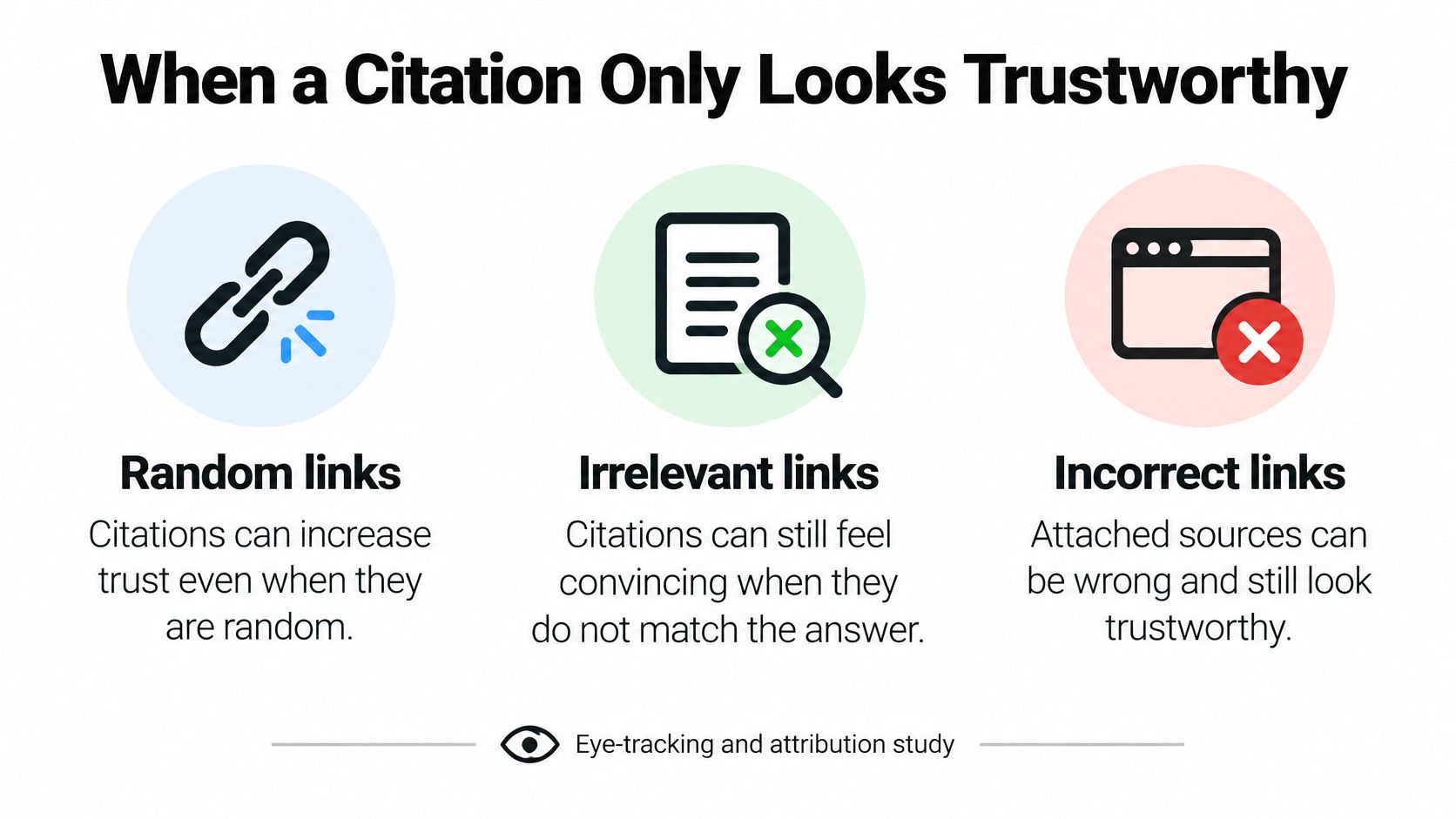
Counting links as proof is the habit to break. An eye-tracking and attribution study reports that citations can increase trust even when they are randomly selected, irrelevant, or attached to incorrect information, that users tended to inspect only about two sources per session, and that a separate audit of deep-research systems found citation accuracy ranging from 40% to 68%, with frequent cases where a relevant source existed but the model cited an irrelevant one.
| Check | What people assume | What the research found |
|---|---|---|
| A citation is visible | The answer was verified | Random or irrelevant citations can still raise trust |
| Sources opened | Readers inspect the evidence | About two sources inspected per session |
| Cited source is accurate | The link supports the sentence | Deep-research citation accuracy ranged from 40% to 68% |
| A relevant source exists | The model will cite that source | Models often cited an irrelevant source instead |
More citations can make a weak answer harder to question.
The same logic applies to how shoppers judge expertise and trust signals on a page, the territory covered in this explanation of E-E-A-T in SEO. A trust signal tells the shopper where to look, not whether the claim holds. A citation nobody opens still does its job for the answer engine, which is why a link can redistribute a click, or absorb it entirely, without ever being tested against the page behind it.
Run a Claim-Level Audit on Your Own Brand
- Sample ten priority queries across Google AI Overviews, Perplexity, and ChatGPT search, using the exact phrasing shoppers use.
- Write down each factual sentence about your product, price, policy, or comparison, one row per sentence.
- Open the cited passage and mark whether it entails that sentence, is only related to it, or contradicts it.
- Mark freshness and source type. Note whether the source is your primary page or a third party repeating older information.
- Track the unsupported-claim rate by engine and by page type, so you fix the worst category first.
Say an answer claims your jacket is waterproof and cites your product page. Your page says water-resistant with a treatment that handles light rain. The model upgraded the claim on its own, and your page now stands as the apparent evidence for a claim you'd never publish. The fix is rewriting your opening block so the limit sits in the same passage as the benefit, making the overclaim harder to extract.
The operational rule is strict. Don't publish AI-written statistics, studies, or expert claims until a person confirms the source exists and supports the sentence. If nobody has time to confirm it, cut it.
Pages Shopify Brands Get Cited For
Citation share goes to whichever page pairs an answer with its proof, and that is rarely the homepage. The visual below shows how that pairing appears inside AI-generated results for product comparisons.
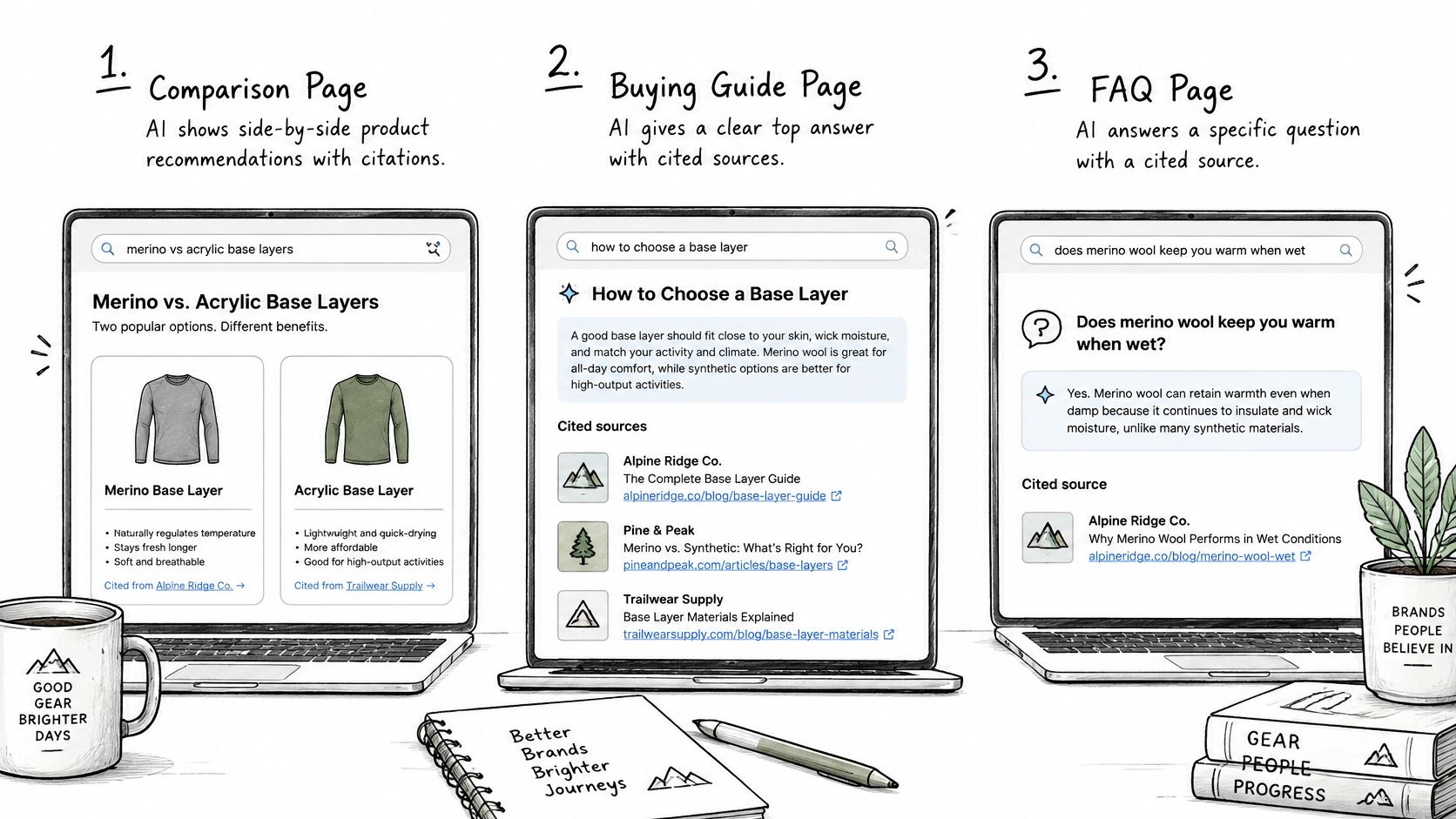
A base layer store builds a merino versus acrylic comparison. The page leads with a one-sentence verdict, follows with a table covering warmth, wash care, and price band, and ends with a dated author note. When a shopper asks which fabric pills less, the engine can cite the cell and the verdict together. The click that used to go to a publisher's fabric guide now goes to the store.
A coffee grinder collection works the same way. Separate headings answer grind size for espresso, filter, and French press, each using the brand's own tested range rather than text copied from a brewing blog. A product page for a 30 ml serum states concentration, scent, and who it isn't for in the opening block, with the ingredient list directly below as the supporting passage. That discipline around how to write product descriptions is what turns a sales page into a citable source, because the first screen already contains the answer block.
Policy pages earn citations too. A shipping page that states cutoff time, served regions, and delivery window in one quotable paragraph answers questions shoppers ask constantly, and it beats the same policy scattered across a FAQ accordion, a footer note, and a checkout banner.
The video below shows the result from the shopper's side: how a cited answer presents a product page's facts, and why the quoted passage has to stand on its own once it leaves your site.
Publishers do not hold this space by default, so a clear product page can still win product-specific queries. A 2025 analysis of AI Search Arena data examined more than 24,000 conversations and 65,000 responses from OpenAI, Perplexity, and Google, containing over 366,000 citations, and the study authors reported that only 9% of citations referenced news sources, meaning 91% pointed at every other kind of page. The redistribution is real. Whether your store collects it depends on whether a passage on your page answers the query more directly than anyone else's.
Housekeeping supports these pages without becoming the strategy. Tools such as TAGit AI Product Tag Generator for Shopify generate SEO-friendly product tags in bulk. Clean tags help shoppers and crawlers reach the right product set. The citable passage still has to come from the page's own content.
Skip thin tag pages, duplicate collection descriptions, and posts that restate a manufacturer claim without your own specifications. They contain nothing an engine needs from you specifically.
How to Make Store Content Citable
Run one pass on a priority URL. Don't start with the whole catalog.
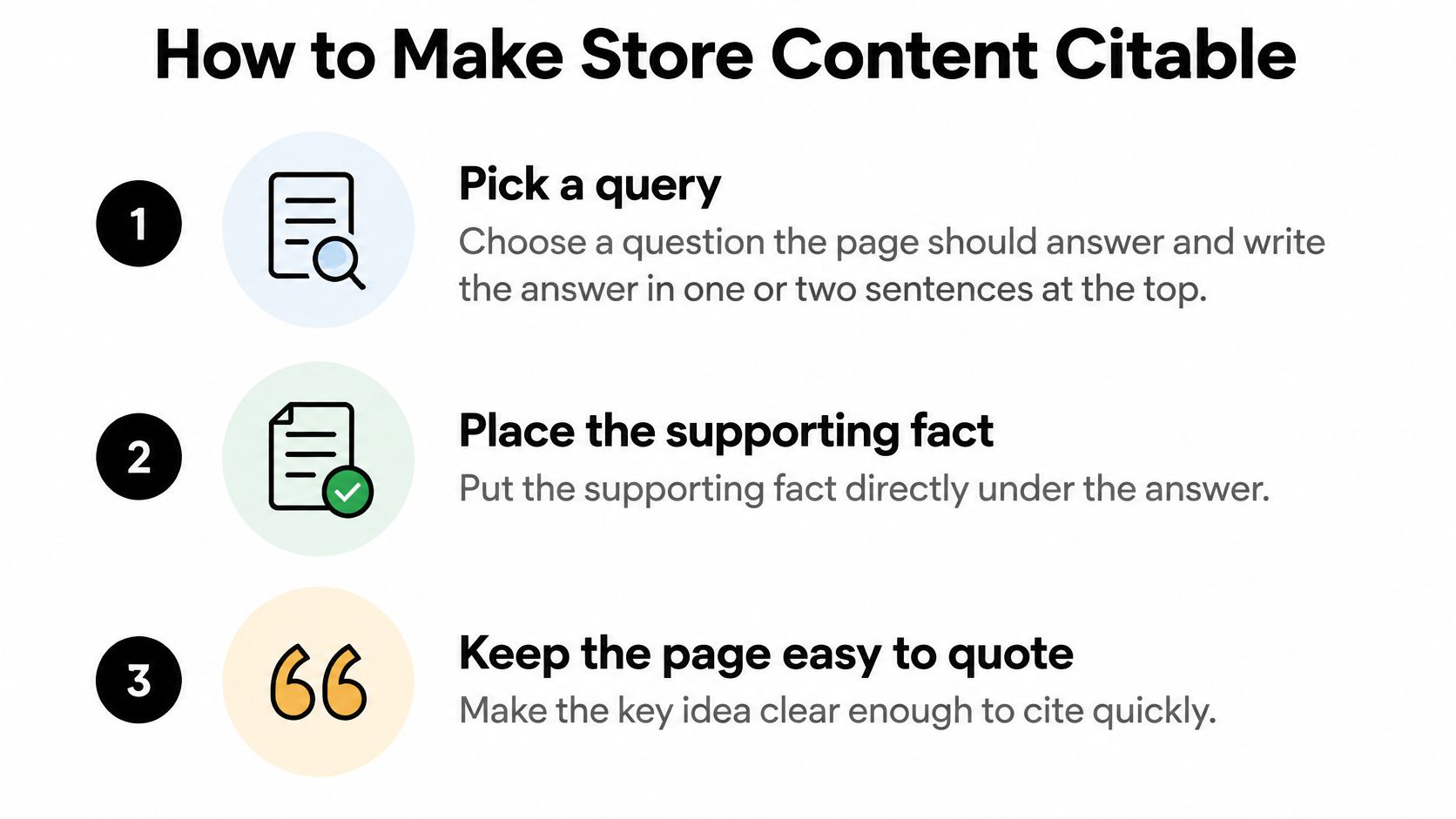
- Pick one query the page should answer and write the answer in one or two sentences at the top. If you can't write that answer, the page doesn't have a citable unit yet.
- Place the supporting fact directly under it, using your own spec, measurement, policy, or comparison cell. Borrowed authority doesn't entail your claim.
- Add the date of the last factual update and the role of the person responsible, even if the byline is the brand. Freshness a reader can't see doesn't reassure anyone.
- Turn repeated shopper questions into short headings whose first sentence answers the question. Put elaboration after the answer, not before it.
- Make image and video context explicit with the product name, variant, and the attribute that matters, so a system isn't inventing what a picture shows. Accurate alt text does the same job for shoppers using assistive technology.
- Remove claims that have no supporting passage on the page, including borrowed statistics and unnamed expert quotes. A claim you keep is a claim you defend.
- Keep one canonical URL and point variants and filtered views back to it. Structured data helps a system identify the business behind the page, as explained in this guide to organization schema, but schema doesn't replace a readable answer block.
- After publishing, query the engines you audited and record whether the new passage is the one cited. If an old third-party page still supplies the answer, your block isn't clearer than theirs yet.
Edge Cases That Usually Go Wrong
A page answering five unrelated questions should be split. Each resulting page gets one receipt it can fulfill. A regulated claim, such as a health result, should stay off the page until a primary source on the page supports it. Hoping an engine won't cite an unsupported health sentence isn't a control.
Don't make a fast-changing price the sentence you want quoted for months. Prices change with promotions and variants. The durable citable sentence is the specification, the care rule, the fit guidance, or the policy condition. Let the product feed carry price. Let the page carry the fact that stays true.
Naming consistency belongs in this pass too. Search your own store for every variation of a product or collection name. Pick the canonical form and apply it across product, collection, and article pages. An engine reconciling three names for one item may cite none of them.
A stale passage is still a citation, and it will keep testifying against your current product until you update it.
Revisit cited pages whenever the spec, policy, or comparison changes. Update the answer sentence and the supporting fact in the same edit, then update the date. Changing only the specification table while the opening verdict repeats the old claim creates two contradictory passages, and an engine may cite either one.
Decide Which Pages Deserve the Work
Invest first where an answer engine is likely to summarize and your store owns the fact. That means comparison pages, category explainers, spec-heavy products, and policies shoppers ask about before buying. In each case you are the primary source. Nobody else can state your cutoff time, your tested grind range, or your fabric blend more authoritatively than your own page.
Wait on pages chasing a broad keyword with no unique fact. Wait on claims you cannot support with a passage on the page. Decorative sources added to those pages raise perceived authority without raising reliability, which is the failure the audit exists to catch. A citation redistributes a click that used to go to a ranking page, so effort spent where no citable fact exists buys authority signals with nothing underneath them.
Decision rule: If losing the click would hurt and the page can answer in one quotable block, edit it. If the page has nothing to entail, add no decorative sources.
Then run a 30-day check on your ten priority queries. Record whether a citation to your store is present or absent, whether the cited passage is yours, and whether assisted conversions or branded searches moved. Fix the chosen pages first and measure citations before commissioning a larger content run. A bigger run built on unverified passages scales the problem you are trying to solve.
Some supporting fixes are faster than rewriting pages. Most stores get the quickest SEO win from ALT SEO and RANKit, because missing alt text and weak meta tags are common and easy to fix in bulk. ALT SEO generates AI alt text for every product image, can process new images automatically, and includes 100 images per month free. RANKit generates AI meta titles and descriptions sized for Google. Neither changes which passage an engine cites, but both clean up how the same pages perform in traditional results while the citation work runs. You can review Yassine Malti's Shopify tools to see how those pieces fit your store.
Start this week with ten queries your customers already ask, run the evidence check, and rewrite the single worst page so its answer and support sit in one block. Then check whether the engines cite your new passage within 30 days. If they do, apply the same pass to your next comparison and category pages. If they don't, you have a specific passage to improve instead of a vague visibility goal, and that is a problem you can fix.
Shopify apps by Yassine Malti
Put this into practice
-

ALT SEO · Image alt text
AI alt text for every product image · 100 images/month free
-

RANKit · Meta titles & descriptions
AI meta titles and descriptions, sized for Google · 50 meta tags/month free
-

TAGit · Product tags
SEO-friendly product tags, generated in bulk · 50 tags/month free