Buy the most expensive whole leaf you can find. Advice like this circulates widely among tea buyers, and it is unreliable. A high price can reflect good leaf, but it can also reflect a heavy tin, vague blending, old stock, or a story the label can't prove.
Loose leaf describes how tea is packed, and says nothing about how well it is grown or stored. Dust in a pouch is still dust. A named garden tea packed badly can taste flat. A modest broken-leaf black tea can be exactly right for a strong morning cup or chai.
So judge loose leaf tea brands by separating three things most guides merge together: leaf quality, packaging risk, and brewing performance. Then turn the final choice into a price per cup, the figure that exposes whether a fancy tin earns its shelf price.
The category rewards this checking. Leaf tea is forecast to be the fastest-growing tea format globally, with a projected compound annual growth rate of 6.2% between 2027 and 2032 in the Mordor Intelligence global tea market report. Growth doesn't make any individual brand good. It makes your system more important.
Table of Contents
- Six Criteria for Judging Loose Leaf Tea Brands
- Leaf Grade and Brewing Performance
- Sourcing and Testing Claims That Hold Up
- Comparing Loose Leaf Grades Side by Side at Tealyra
- Freshness Markers on Packaging and Labels
- Is Loose Leaf Really Safer Than Tea Bags
- Caffeine Levels by Tea Type and What Changes Them
- Pick Your Brand With a Price-per-Cup Check
Six Criteria for Judging Loose Leaf Tea Brands
Start with the scorecard. Mark each criterion strong, weak, or missing from the tin, pouch, and product page before you read a single tasting note. The U.S. loose-leaf tea market was estimated at approximately USD 0.41 billion in 2025 and is projected to reach USD 0.62 billion by 2034 in the Deep Market Insights U.S. loose-leaf tea market analysis, so polished alternatives will keep competing for the same order.
| Criterion | What to check | Strong signal | Weak signal |
|---|---|---|---|
| Leaf quality | Leaf size and uniformity in the pack | Whole or large leaves, consistent size, bright colour | Dust or fannings at the bottom of the pouch |
| Sourcing | Origin detail | Named region, garden or estate | Only 'imported from Asia' or 'blend of origins' |
| Freshness | Harvest date and packaging | Harvest year printed, opaque foil with sealed inner liner | No date, clear packaging, resealable zip only |
| Variety | Cultivar or style name | Named cultivar or style, e.g. Darjeeling, Longjing, Assam | 'Premium', 'signature' or 'exotic' with no named tea |
| Testing | Published results | Batch number linked to pesticide, heavy-metal or moisture report | No test data, or claims with no lab named |
| Value | Price per cup | Cost per cup stated or easy to calculate | Price shown only per tin with unclear net weight |
How to Read the Signals
Leaf quality starts with uniformity. Whole or large pieces with a fresh aroma are what careful sorting looks like; a wide mix of leaf, stems, and powder is what rushed packing looks like.
Variety should name the tea. Assam, Darjeeling, or Longjing gives you a style benchmark to compare against. "Premium," "signature," or "exotic" gives you nothing to check.
Value is cost per cup, so compare that figure rather than the shelf price. A tin with a clear net weight lets you do the maths: divide the price by the grams inside, then by the grams you dose per cup. A heavy tin with a vague weight line can hide an expensive cup behind a reasonable shelf price.
Sourcing, freshness, and testing come down to one shared question: can you verify it? A named estate, a printed harvest year, and a batch number tied to a lab report can all be checked. A country alone, a bare best-before date, and an unnamed lab cannot.
Say one tin reads, "Darjeeling, harvest 2025, batch number matched to a lab report, 100 g, origin named to the estate." It scores on five criteria before you taste it. Another reads "premium blend, imported from Asia." It scores on none, however attractive the design looks.
I would trial a brand that scores well on at least four of six, then let the cup settle the rest. Store owners can apply the same discipline to their own product pages, since a structured approach to collecting customer feedback on product claims shows whether buyers taste what the label promises. No single criterion makes the decision for you.
Leaf Grade and Brewing Performance
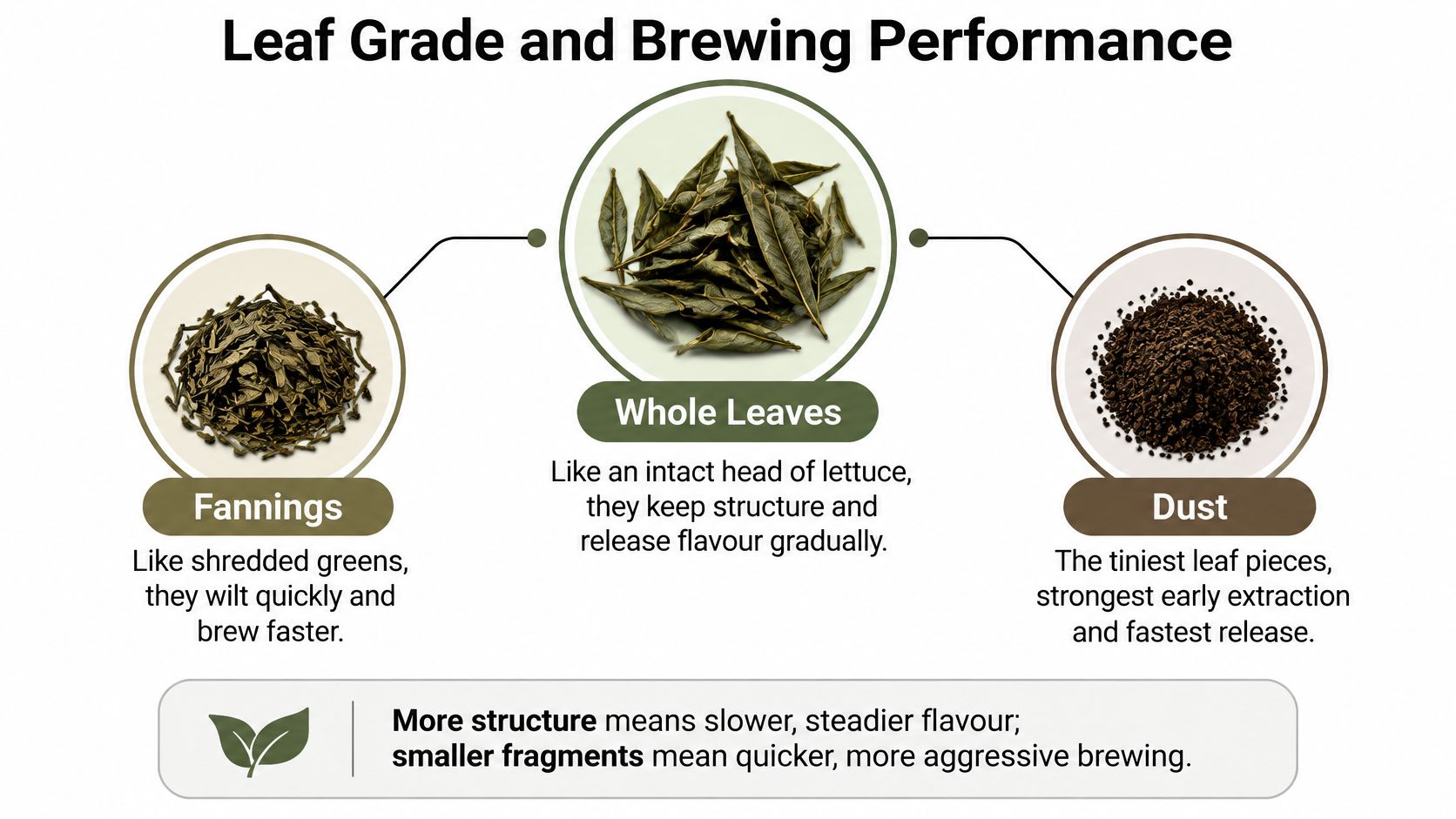
Grade shows up in extraction before it appears on a label. Whole leaves hold their structure, hydrate gradually, and release flavour over time. Fannings and dust give up most of what they have early, which can make the first sip seem strong before the liquor turns harsh or thin.
The brewing difference comes from extraction. Smaller particles expose more surface area to water, so they brew faster and turn bitter sooner. Read grade against purpose, though. CTC black tea is deliberately crushed for chai and strong milk tea, so broken leaf can suit a drink built for speed and intensity.
| Leaf style | What it is | Brewing behaviour | Best use |
|---|---|---|---|
| Whole leaf | Intact or large leaves and buds | Opens gradually, supports several infusions | Sipping teas and multi-infusion sessions |
| Broken leaf | Leaf split into smaller pieces | Releases flavour faster, shorter window | Everyday black teas and blends |
| Fannings | Small particles left after sorting | Strong first cup, bitter when over-steeped | Tea bag and quick-brew products |
| Dust | Fine powder at the bottom of a pack | Very fast extraction, cloudy liquor, can taste harsh | Mostly for bags; rarely a loose leaf choice |
Do a Dry-Leaf Check First
Spoon a measure onto a white plate before brewing. Look for even pieces, healthy colour for the style, and few powdery particles collecting underneath. Smell the dry leaf, then smell the warmed empty pot after adding it. Dull, papery, or stale odours rarely become fresh in water.
A mixed pile can be normal in a blend because its ingredients differ. In a single-style tea, wide variation usually means some pieces over-extract while others barely open. Powder beneath larger leaves can dominate the first cup, producing bitterness and thinness together.
Brew Brands the Same Way
Use the same test for every candidate so the brand, rather than your method, creates the difference.
- Weigh the leaf. Use about 2 to 3 g per 250 ml unless the brand gives a different dose you want to test.
- Match the water to the style. Use the printed temperature rather than boiling water for everything.
- Time the steep. Stop at the listed time and remove the infuser completely.
- Judge the first cup. Note intensity, balance, aroma, and harshness.
- Re-steep twice. Compare how much flavour and body remain in the second and third infusions.
A study of 24 commercial green teas published through the National Center for Biotechnology Information reports two useful brewing ranges: infusions prepared for 5 to 10 minutes at 80 to 100°C generally produced higher antioxidant capacity than shorter, cooler brews, while approximately 80°C for 3 to 5 minutes offered a practical compromise between antioxidant extraction and drinkability. It also found that finely broken particles released catechins rapidly during the first infusion, while intact leaves enabled more sustained release.
Those results give you two fair comparison measures. First-cup intensity shows how readily the leaf releases flavour. Second-infusion retention shows whether whole-leaf structure delivers a longer session. A tea that remains balanced through later infusions can spread its price across more cups; a tea that peaks once and fades offers less brewing value even when the first sip impresses.
Grade is a physical leaf property. Packaging language cannot establish it, and whole leaf cannot guarantee flavour by itself.
Whole leaf can extend a brewing session. The cup still decides whether the leaf was worth buying.
Sourcing and Testing Claims That Hold Up
"Single origin" sounds precise until you ask which origin. Use a specificity ladder instead. Country is the weakest step, region is better, garden or estate is stronger, and harvest year adds a time marker you can compare between purchases.
Each step narrows what a brand can hide. "India" could describe many styles and seasons. "Darjeeling" narrows the region and expected character. A named estate and harvest year narrow it further, making a disappointing repeat purchase easier to identify as a batch change rather than your imagination.
Single-estate tea isn't automatically better than a blend. A good blend can balance body, aroma, and cost across components, and it can stay more consistent when one crop changes. The test is disclosure. A credible blend names its main components or at least their regions and styles.
Five-Point Checklist
- Origin to region at least: Country alone is a weak signal.
- Harvest year printed: This helps you separate current stock from old inventory.
- Named cultivar or style: Look for a tea you can recognise and compare.
- Batch number with a lab report: The number on the pack should match the published result.
- Certifier name and number: An organic claim should identify who certified it.
A useful report covers pesticide residues, heavy metals, and moisture, names the third-party laboratory, and belongs to the batch you're buying. A generic certificate from a supplier, with no batch connection, is weaker. It shows a system exists, but it doesn't prove what's in your pouch.
Merchants face the same specificity problem when they turn supplier facts into searchable listings. Clear guidance on writing product descriptions that keep claims specific helps prevent regional and batch details from dissolving into adjectives. For large catalogues, TAGit AI Product Tag Generator for Shopify generates product tags from images, titles, and descriptions, with bulk processing and auto-processing for new products. Tags improve discoverability. They don't verify a claim.
Watch for these red flags.
- Undefined grades: "Premium grade" with no standard, leaf description, or comparator.
- Unsupported health language: "Detox" or similar promises with no evidence tied to the product.
- Moving sourcing: Origin details change between the tin, collection page, and product page.
I would trust a plain label with checkable facts over elegant language that avoids every fact. Specificity is the claim.
Comparing Loose Leaf Grades Side by Side at Tealyra
A wide catalogue helps only if you can compare like with like. Tealyra is an online store selling loose tea, tea bags, and accessories, which makes it useful for a practical exercise. Pick one style you drink often, then compare options by leaf form, origin detail, pack size, and brewing guidance before you compare flavour adjectives.
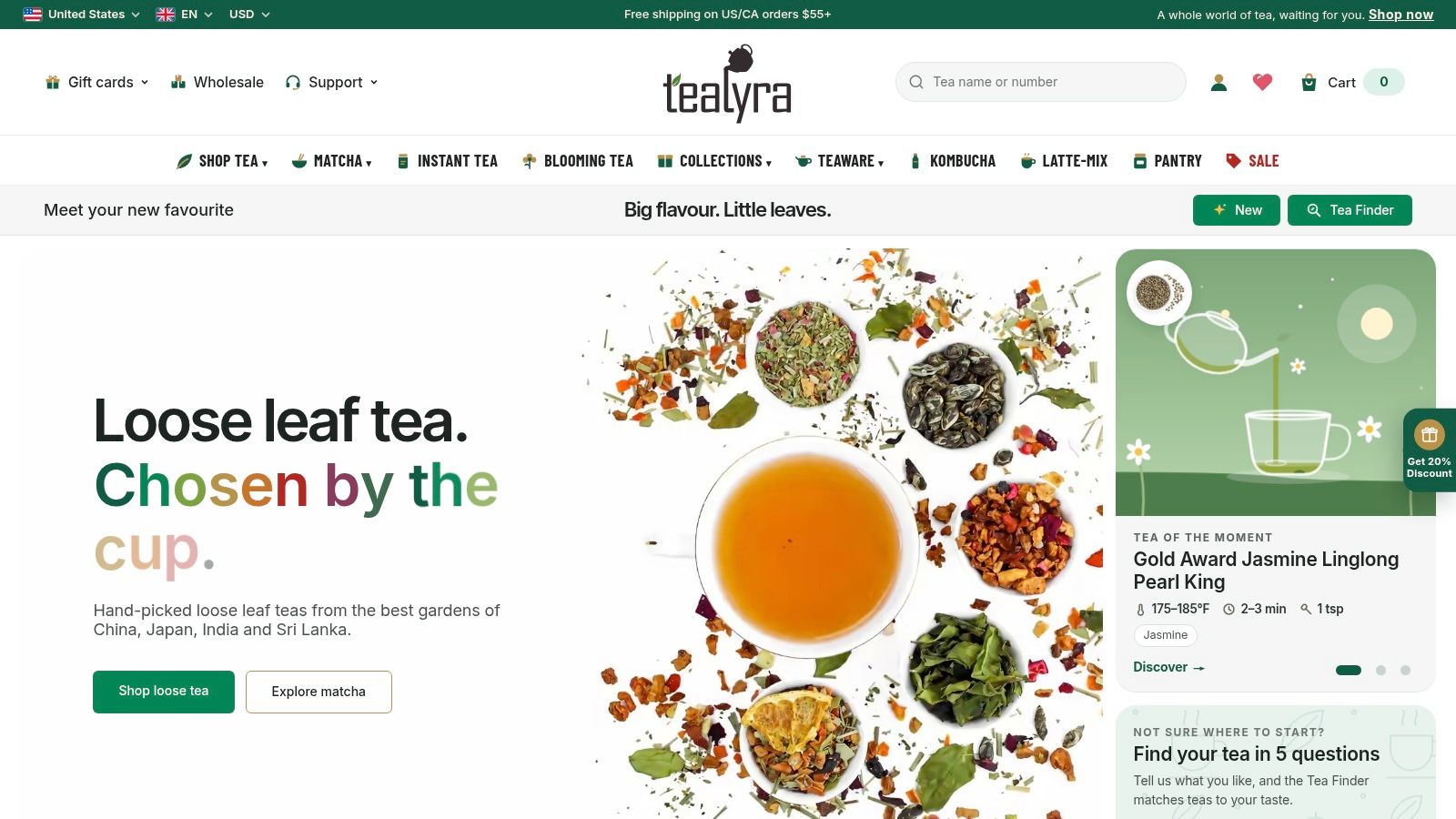
Start with a narrow shortlist rather than browsing every collection. Say you want a black tea for breakfast. Separate whole and broken leaf options, note the net weight, then calculate cups at the same dose. A stronger broken leaf may suit milk better, while a larger leaf may give a cleaner cup without milk. Neither wins until you state the job.
For green tea, compare the recommended temperature and whether the product is presented as a named style or a broad blend. For herbal blends, read the full ingredient list rather than relying on the front-of-pack name. Accessories matter here too. A basket infuser with room for leaves to open will test whole leaf more fairly than a small ball that compresses it.
Use the store as a comparison shelf for loose leaf tea brands and formats, then apply the same evidence questions you'd ask anywhere. Can you identify the style, dose, net weight, and likely number of infusions? Can you start with a smaller amount before committing to a large pack?
Tealyra is the right choice when you want breadth for side-by-side selection across teas and accessories in one order. It's less useful if your priority is a single estate lot with batch-specific documentation, because a broad catalogue and a specialist single-lot seller solve different problems. Buy the smallest sensible quantity, brew it under controlled conditions, and let retention across infusions tell you whether the grade justifies reordering.
Freshness Markers on Packaging and Labels
A resealable zip does one job: it closes the pouch after you open it. It cannot tell you how the tea was sealed at the factory, how long it sat on a warm shelf, or how much oxygen was trapped inside. Oxidation during storage and transport happens before the zip ever matters, so a smooth reseal proves nothing about the leaf's condition at the moment you buy.
Light, oxygen, moisture, and warmth drive oxidation and aroma loss. The leaf grade section showed why broken leaf fades faster than whole leaf, and weak packaging erases that advantage either way.
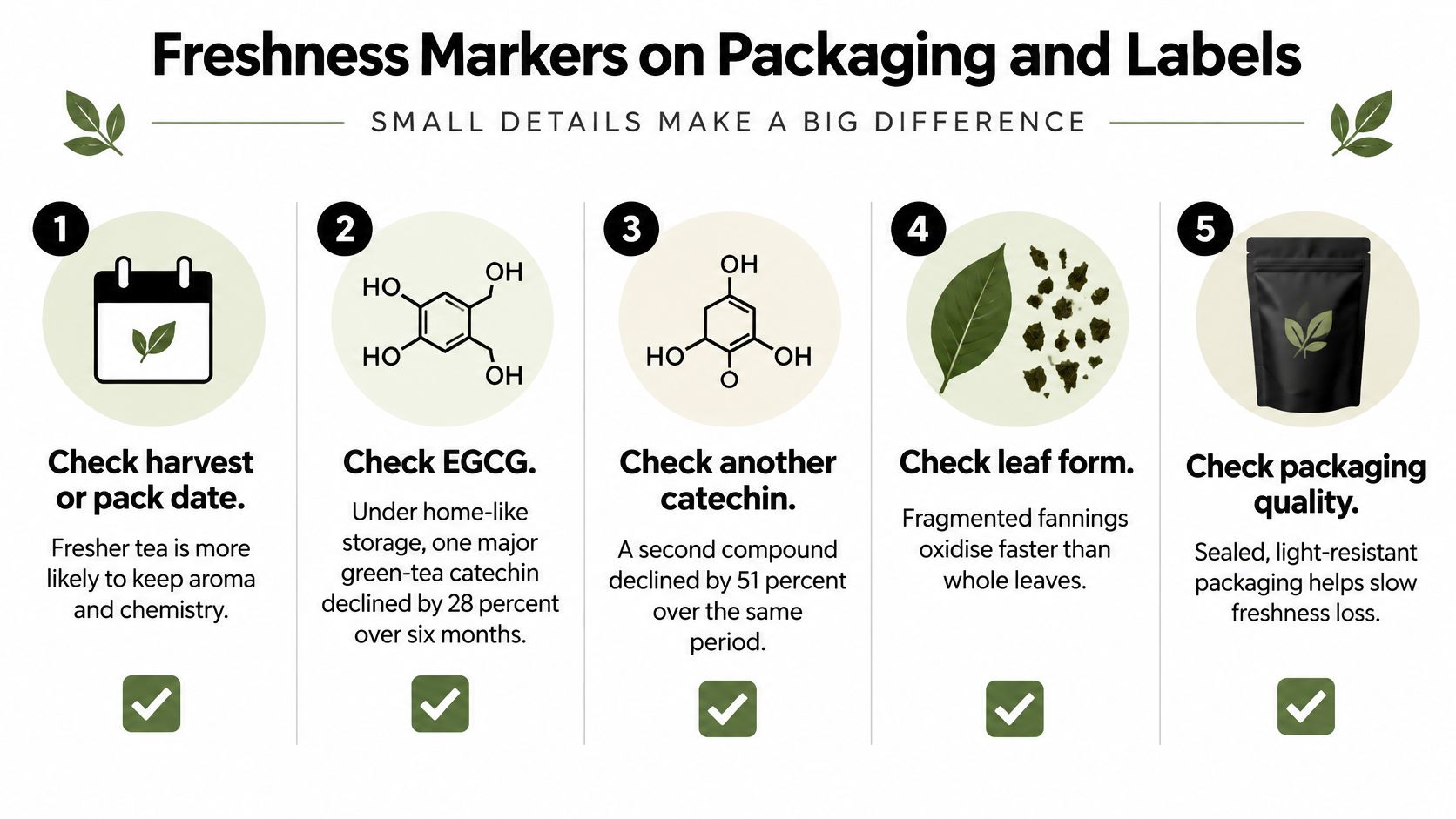
The Tufts University expert review on stored tea reports that, under home-like storage conditions, epigallocatechin gallate (EGCG) declined by 28% over six months and another major green-tea catechin declined by 51%, while dried-tea moisture of 4 to 6% is a suitable storage range, deterioration accelerates above 6%, mold risk rises substantially above 7%, and oxygen below 0.1% is a target for hermetic packaging intended to suppress oxidation. Those figures are not a promise that every tea declines at the same rate. They show why an undated pack in clear material is a weak freshness claim.
Packaging Features to Require
- Opaque or foil barrier: blocks light and slows oxygen and moisture transfer better than a clear window pouch.
- Heat-sealed inner liner: the factory seal shows the pack has stayed closed since packing.
- Harvest or pack date: a best-before date alone doesn't reveal the tea's age.
- Unopened versus opened guidance: a strong label separates sealed shelf life from post-opening freshness.
That last distinction matters at home. Every opening exchanges air, and a large half-empty tin holds more oxygen around the remaining leaf. Buy a large amount and the approach shifts: keep the main supply sealed, and move a small working quantity into a small airtight tin.
Store tea airtight, dark, cool, and dry, away from spices and the steam above a kettle. Skip the fridge unless the brand says the sealed pack is suited to it, because condensation when you pull a cold pack out adds the moisture you were trying to avoid. Let a cold sealed pack return to room temperature before opening it.
Freshness also lives in your nose. A current date cannot rescue tea that smells flat, dusty, or like its storage cupboard, and a slightly older whole-leaf tea in a genuine barrier pack can outperform a younger tea sold from an open jar. Date, barrier, and aroma have to agree. When they do, the leaf keeps performing through the last scoop; when they don't, you are paying for aroma that left the bag before it reached your kettle.
Is Loose Leaf Really Safer Than Tea Bags
Tea format affects one part of exposure: the packaging that contacts hot water. Loose leaf can reduce packaging-derived exposure, while the leaf itself and the rest of the supply chain remain separate questions.
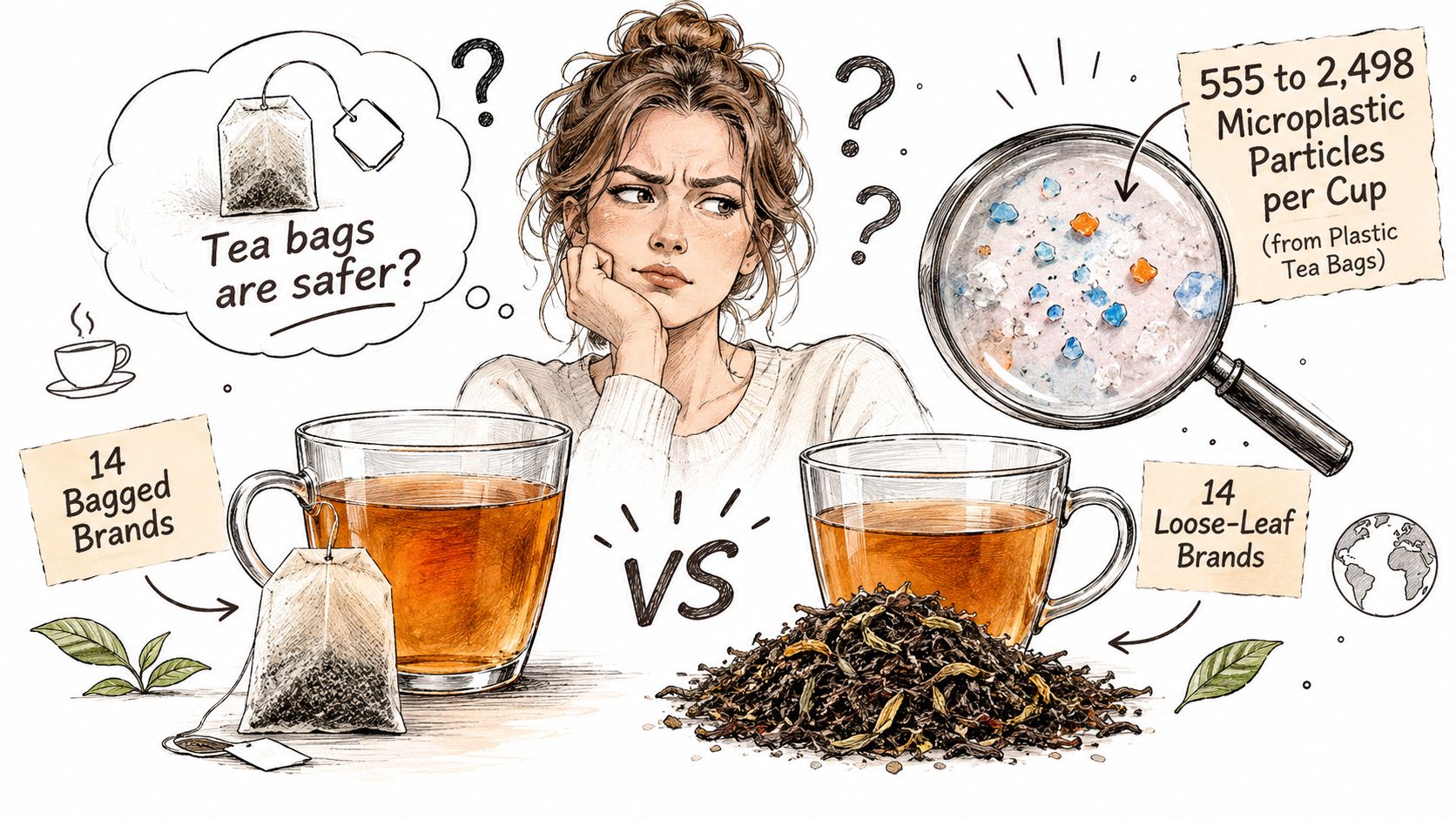
A comparison of 14 bagged and 14 loose-leaf tea brands reported in a News.com.au account of the plastic tea bag study found approximately 555 to 2,498 microplastic particles per cup from plastic tea bags and about 0.3 to 2.4 particles per cup from loose-leaf tea. The loose-leaf samples still contained particles, and the brands were purchased in Turkey, so treat these figures as results from that comparison, not a prediction for every market or product.
For the particles found in loose leaf, the study's authors pointed to environmental exposure, agricultural sources, processing equipment, and ambient air. Plastic-free covers one input, not the field, factory, transport, or packaging. A label can describe a bag material; it cannot establish the cleanliness of the leaf or the full route from production to cup.
The clip below shows how preparation choices affect what reaches the cup, another factor to consider alongside packaging.
Three Buyer Questions
- What is the bag or packaging made of? Plastic, paper, plant-based material, foil, and mixed layers have different material trade-offs.
- What is tested in the tea itself? Look for batch-specific pesticide and heavy-metal test results, if the brand publishes them.
- What does organic certification cover? It concerns certified production rules; it does not certify every contaminant or packaging material.
Loose leaf reduces packaging-derived exposure but cannot promise a clean cup. Consider packaging, leaf quality, and brewing performance separately, and compare the price per cup before treating a brand claim as value.
Caffeine Levels by Tea Type and What Changes Them
Black tea is often quoted at roughly 50 mg of caffeine per cup, and green tea at 20 to 45 mg, in the TeaBox tea FAQ on caffeine and tea types. Use those figures as a starting range, not as a promise for the specific pouch in your hand. Your cup can land outside the expectation when you change the leaf or the brew.
Caffeine levels depend on species and cultivar, leaf grade and particle size, dose, water temperature, steep duration, agitation, and water volume. Loose leaf is not necessarily higher or lower in caffeine than a tea bag. It provides more control over grams per cup, but that flexibility also leads to more variation if you scoop casually.
Weighing is the practical fix. If a morning cup feels stronger than expected, reduce the grams before you blame the tea type. If you're replacing coffee, change one variable at a time so you know whether dose, temperature, or steep time caused the difference.
Re-steeping lowers caffeine from one infusion to the next, but it doesn't make later cups caffeine-free right away. A long multi-infusion session can still deliver a meaningful total. That's why "green tea" or "energising blend" isn't enough information for someone who's pregnant, caffeine-sensitive, or avoiding evening stimulation.
Separate the labels. Decaf means reduced caffeine, not none. Herbal tisanes aren't made from Camellia sinensis and are caffeine-free only when their ingredients contain no caffeine-bearing additions. Ask whether a brand's caffeine figure is a laboratory measurement under stated brewing conditions or an estimate. An honest estimate is useful. An estimate presented as a precise personal dose is not.
Pick Your Brand With a Price-per-Cup Check
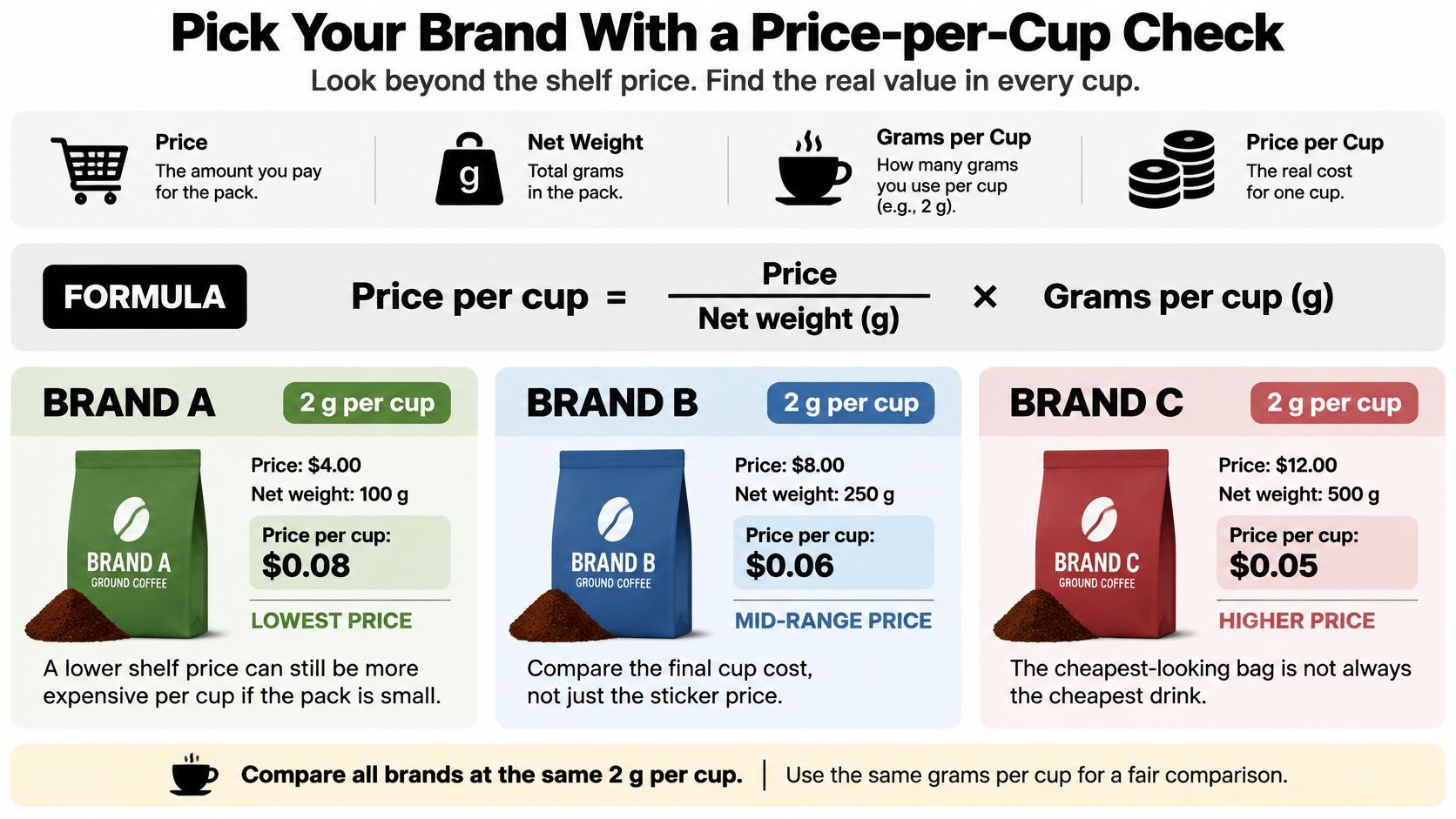
Price per tin can make a small pack look like a better deal. Compare brands at the same dose instead: cost per cup equals price divided by net weight, multiplied by 2 g for a 2 g serving.
The figures below are illustrative. Replace them with current shelf prices before comparing actual products. Each example uses the same dose, so pack size is the only variable in the cup-count calculation.
| Example brand | Price (USD) | Net weight | Cups per pack (at 2 g) |
|---|---|---|---|
| Brand A | 18 | 100 g | 50 |
| Brand B | 12 | 50 g | 25 |
| Brand C | 30 | 250 g | 125 |
In this illustration, Brand A costs 36 cents per cup, Brand B costs 48 cents, and Brand C costs 24 cents. Brand B has the lowest shelf price; Brand C has the lowest cost per cup. The larger pack is better value only if you use it while the tea still tastes fresh and it meets your other criteria.
Re-steeping affects value too. If one 2 g dose delivers two satisfying infusions, record the cost per drinking session alongside the cost per first cup. A higher price per gram may be justified when the tea retains its flavour across infusions and its sourcing, freshness, and testing information holds up. A heavier tin or longer product story does not, by itself, improve the tea.
Buying Sequence
- Use the scorecard threshold from earlier to choose two or three brands to compare.
- Calculate cost per cup using the same grams per serving.
- Buy the smallest size from the strongest candidate for a controlled trial.
- Follow the printed brewing instructions and rate first-cup intensity and second-infusion retention.
- Reorder only if taste and batch information hold up through the trial pack.
Keep a note of dose, temperature, steep time, worthwhile infusions, and cost per session. A few recorded brews make comparisons more concrete than product adjectives. If two teas taste equally good, favour the one with clearer batch and packaging information. If the cheaper tea performs better in the cup, let the result guide your choice.
Buying rule: Repeat purchases should rest on batch information and your own cups, not on the label alone.
Choose two teas, calculate their cost at 2 g per cup, and start with the smaller trial pack from the stronger candidate. Compare the brews before committing to a larger size.
Shopify apps by Yassine Malti
Put this into practice
-

TAGit · Product tags
SEO-friendly product tags, generated in bulk · 50 tags/month free
-

ALT SEO · Image alt text
AI alt text for every product image · 100 images/month free
-

RANKit · Meta titles & descriptions
AI meta titles and descriptions, sized for Google · 50 meta tags/month free