The most popular advice about featured snippets is also the least useful: format a short answer, win the box, and enjoy more traffic. For a Shopify store, the better question is whether that answer gives shoppers a reason to visit, or lets them finish their search without opening your store.
Learning how to get featured snippets means choosing attainable queries, presenting useful answers, and measuring what happens after Google displays them. Treat the snippet as a distribution decision, not a trophy. A sizing guide that brings buyers to the right product can be valuable; an answer box that replaces profitable product-page visits might not be.
Table of Contents
- Find Snippet Queries You Can Realistically Win
- Match Each Query to the Right Snippet Format
- Technical Signals That Support Eligibility
- Snippet Click Benchmarks and What to Track
- Shopify Pages Where Snippets Come Easiest
- Confirm the Click Trade-Off Before You Chase the Snippet
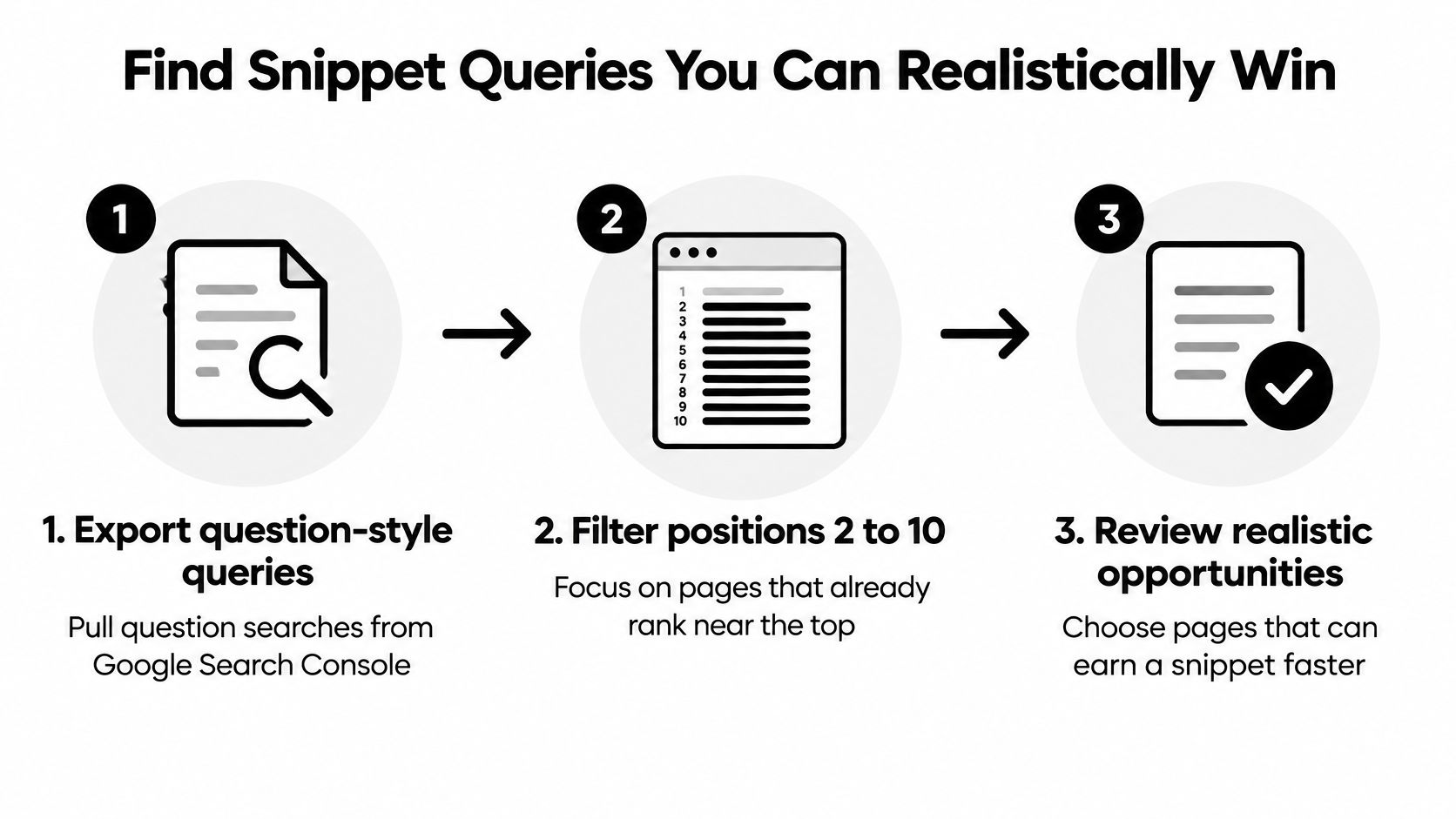
Find Snippet Queries You Can Realistically Win
Export question-style queries from Google Search Console. Open the Performance report, select search results, and look for phrases beginning with what, how, which, why, and can. Export the queries with their landing pages so you can work on existing demand rather than inventing topics.
Filter for pages already near the top. I would start with queries whose average positions fall between second and tenth, then verify their actual results. Average position blends different searches and devices, so treat it as a shortlist filter rather than a fixed ranking.
Inspect the live results. Search each query in a private browser window on desktop and mobile, using your target market's location where possible. Record whether a featured snippet appears, its paragraph, list, or table format, and the source page.
Assess whether you can provide a better answer. Inspect the holder's clarity, product relevance, supporting detail, and usability. A confusing answer on a competing page is an opportunity; a stronger domain alone isn't a reason to abandon a useful query.
Score commercial usefulness alongside attainability. Favor questions that lead naturally to product selection, troubleshooting, or a buying decision. Deprioritize isolated facts that shoppers can consume without needing anything your store offers.
The ranking filter matters. An Ahrefs analysis of approximately 112 million keywords, reported by Search Engine Land, found that 99.58% of featured snippets came from pages already ranking within the top 10. Better answer formatting isn't a substitute for a competitive, relevant page.
Use this workflow to separate realistic candidates from content projects that need broader SEO work.
Build a shortlist you can act on
Question wording is a useful discovery filter. Ranktracker's featured-snippet statistics report that question-based queries triggered snippets approximately 40–50% of the time in 2025, compared with 8–12% for non-question queries. Your live results still decide whether an individual query belongs on the list.
Use long-tail keyword research to uncover specific buyer questions, such as choosing a necklace length for a particular neckline. For merchants combining ecommerce with local demand, Silva Marketing's featured snippet tips for Prescott businesses offer a locally focused companion resource.
Keep your working sheet compact: query, landing page, current position, displayed format, snippet holder, and buyer next step. Choose a small batch you can edit and monitor carefully, rather than spreading changes across the entire catalog.
Match Each Query to the Right Snippet Format
Query patterns and the snippet format to build
| Query pattern | Format to build | Length | Example heading |
|---|---|---|---|
| What is [term] | Paragraph | Aim for 40–60 words as an editing guideline | What Is a Featured Snippet |
| How to [task] | Numbered list | Plan 4–8 steps when the task supports them | How to Add Structured Data to a Product Page |
| Types of [X] or ways to [Y] | Bulleted list | Aim for 4–7 distinct items | Types of Snippet Formats |
| [X] vs [Y] or best [X] | Table | Use 3–5 useful columns | Snippet Formats Compared |
| [Product] sizes or specifications | Table | One row per option | Product Size Chart |
These are drafting guidelines, not eligibility thresholds. Don't pad a simple task to satisfy an item count or remove a necessary qualification to hit a word target. The answer's shape should follow the question.
A definition needs a self-contained paragraph. For example, a featured snippet is an extracted answer that Google displays prominently in search results, with attribution to its source webpage. The reader shouldn't need the preceding introduction to understand what the passage describes.
A process needs sequence. Start each step with an action verb, such as measure, compare, select, or check, and keep the order consistent with what the shopper does.
Choose structure by the buyer's task
A jewellery shopper comparing chain materials needs differences, not a generic list of benefits. A table can organize material, maintenance, and suitability so the shopper can compare like with like.
For product specifications, use explicit units in the headers. Give each product option its own row, and don't mix package dimensions with product dimensions under an ambiguous size label.
Use these distinctions when editing:
- Ordered list: Each action depends on an earlier action, or the sequence represents a meaningful ranking.
- Bulleted list: The items are alternatives, categories, or independent considerations.
- Table: Readers need to compare the same attributes across options.
- Paragraph: Readers need an explanation, definition, or conditional answer.
Extraction test: Read the proposed answer without the surrounding page. If its subject, units, or conditions become unclear, it isn't self-contained yet.
Record the format Google displays on each device, but don't reproduce a competitor's weaknesses. A misleading comparison doesn't become useful because it fits inside a table.
For blog content, connect the answer to a relevant buying journey using this approach to optimizing Shopify blog posts for search and sales. Put examples, supporting evidence, and product-selection help after the complete answer, rather than inserting a sales pitch into the definition itself.
Technical Signals That Support Eligibility
Does adding structured data guarantee a featured snippet?
Schema markup alone does not earn a featured snippet. Check whether Google can access, render, and understand the answer on the page.
A peer-reviewed analysis of 163,412 keywords found associations between snippet eligibility, organic ranking, and natural keyword placement across page elements such as headings, body text, image alt text, links, and lists. Use those findings to guide your headings and copy, while writing the answer for the reader first.
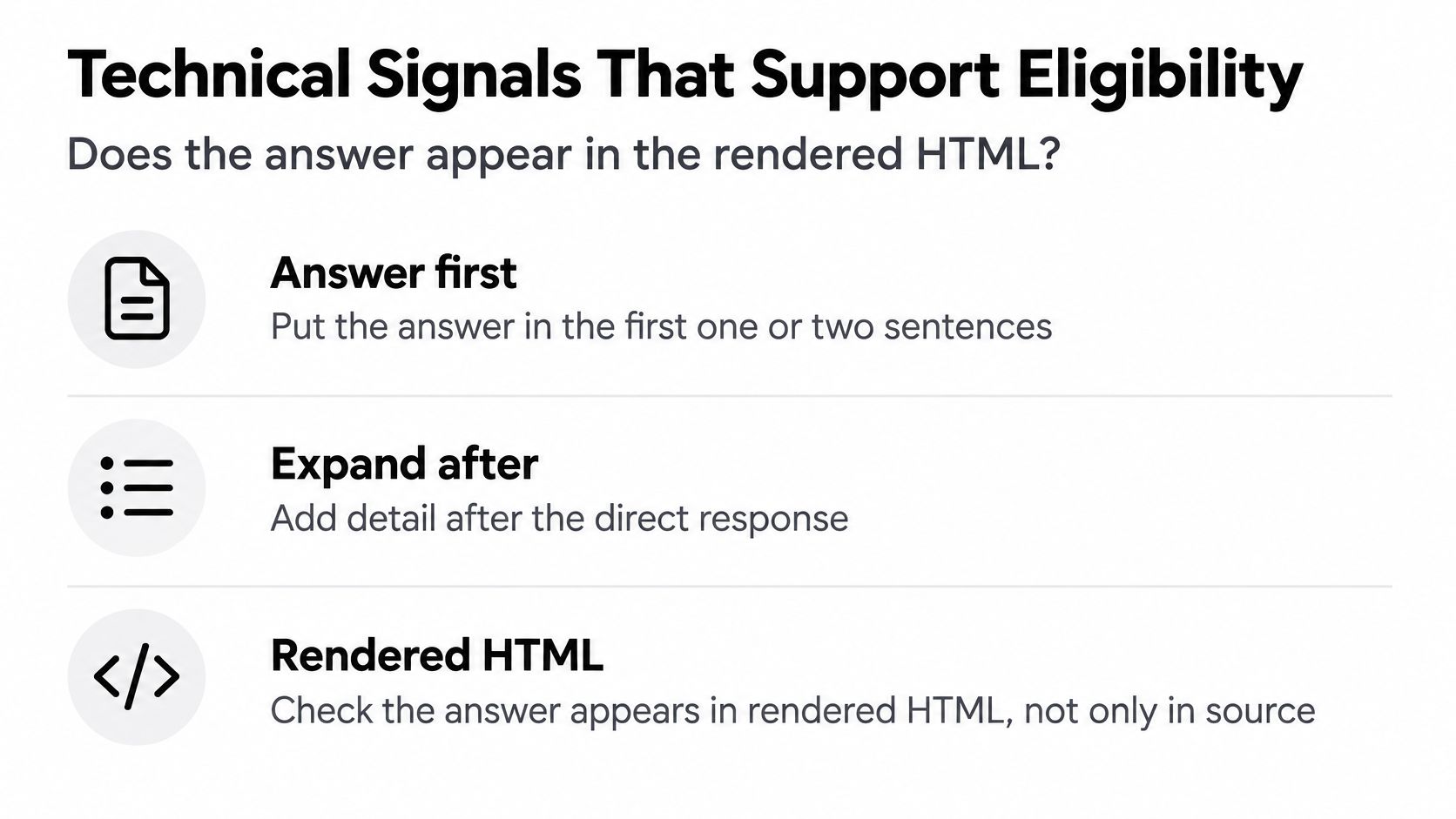
Start with URL Inspection in Google Search Console. Check indexation, inspect the live URL, and review its rendered HTML for the answer text. For example, a product page may show size guidance in the editor, but an accordion app might insert that text only after a shopper clicks. Confirm the answer appears in Google's rendered page before changing the copy.
Check the template, not just the editor
A clean answer in Shopify's editor can render poorly in the published template. Check the storefront on mobile, expand relevant accordions, and make sure tables remain readable without clipping important columns.
Use actual ordered or unordered lists rather than numbers separated by line breaks. Build comparisons as HTML tables, not screenshots. Write image alt text to describe the image and help people understand it, rather than to repeat target keywords.
Add internal links from related guides and collections where they help shoppers reach relevant information. Before changing an established URL to include a question phrase, weigh the redirects and maintenance involved. Improving the existing page is often simpler.
Verify these items on the published page:
- Indexable URL: No accidental noindex directive, blocked access, or conflicting canonical destination.
- Answer first: The direct response sits immediately beneath its descriptive heading.
- Focused headings: Each question introduces a distinct answer, rather than several unrelated topics.
- Semantic structure: Steps, items, and comparisons use appropriate HTML.
- Relevant content: Avoid repeating a generic FAQ block across products with different details.
A shared template can keep presentation consistent, but each product needs an answer that reflects its own sizing, materials, and care requirements.
Snippet Click Benchmarks and What to Track
Average click-through rate by SERP state
| SERP state | Result position | Average CTR | What it means |
|---|---|---|---|
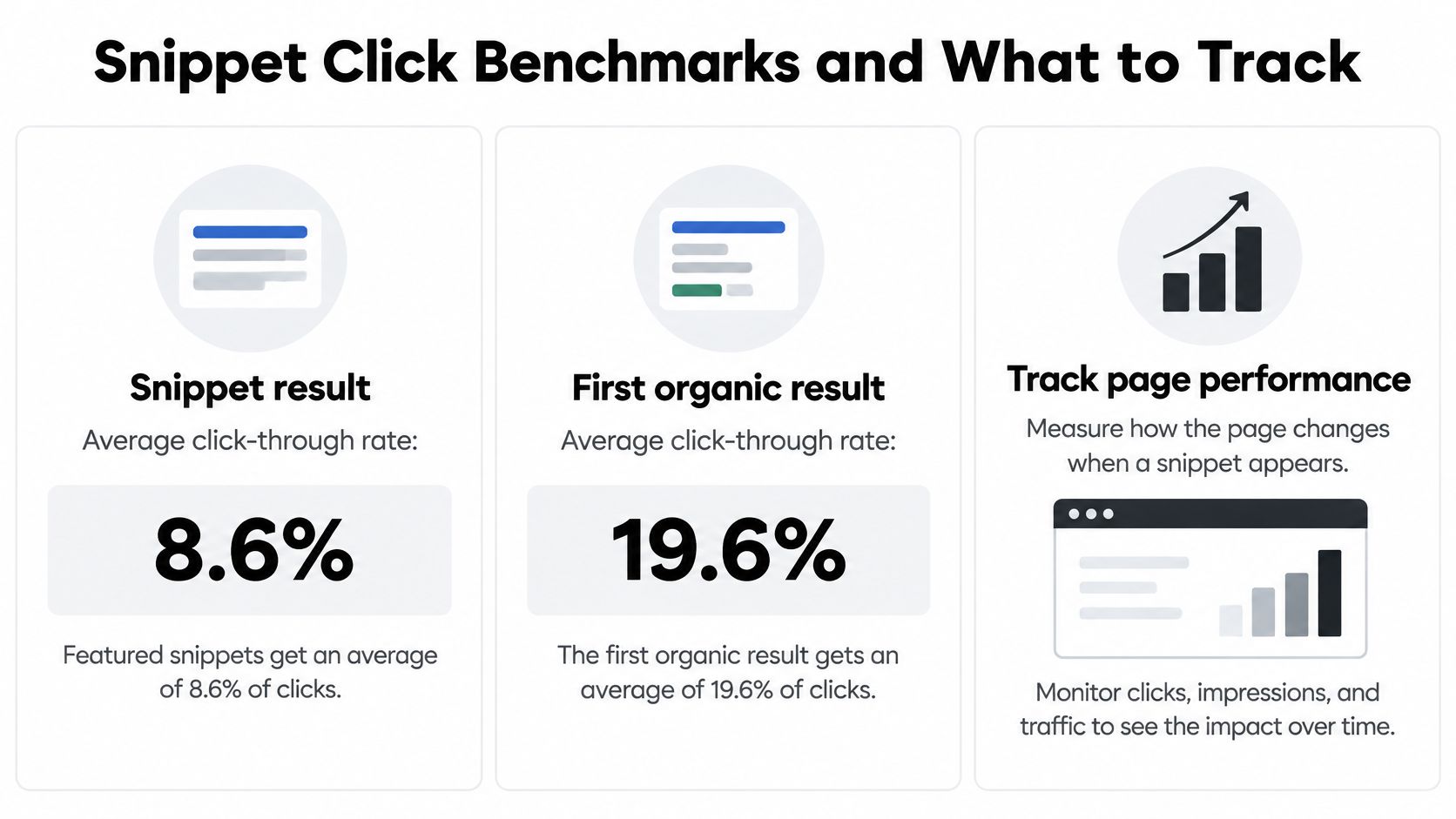
| Featured snippet present | Snippet result | 8.6% | The snippet takes prominent space and receives a share of clicks |
| Featured snippet present | First organic result | 19.6% | A page ranking first may receive fewer clicks when a snippet appears |
| No featured snippet | First organic result | 26% | A reference point for the first result without a snippet |
The Product Philosophy benchmark puts the first organic result at 19.6% CTR when a featured snippet appears. For a Shopify store already ranking first, that figure matters: winning the snippet could increase visibility while reducing clicks to the product or guide below it. The figures describe different search-result states, so treat them as a reference point rather than a forecast for your store.
Don't add the snippet and organic figures together to forecast traffic. Query mix, ranking, device distribution, and competing search features all affect the result.
Establish a query-level baseline
Record the target query, landing page, organic position, snippet owner, displayed format, impressions, clicks, and CTR. Keep country settings consistent, and separate desktop from mobile.
Search Console doesn't provide a dedicated report for featured-snippet ownership. Combine its performance metrics with a dated manual SERP log or rank-tracking tool. Use this Google Search Console workflow for comparing queries and pages to keep your comparisons consistent.
Change one controllable variable at a time, such as answer placement or comparison format. Record the publication date so you can compare the right periods.
Read a before-and-after test carefully
You could compare the 30 days before an edit with the 30 days after it, using equal-length windows. This is a testing choice, not a promise that Google will reassess the page within that period.
Suppose a sizing guide gains snippet ownership and impressions, while its clicks and visits to linked product pages fall. The new placement has increased exposure, but that alone doesn't make it a business win.
Before rolling back, check:
- Ranking changes: Did the page's underlying organic position move?
- Demand changes: Did seasonal interest or promotions affect the comparison?
- SERP changes: Did Google introduce an AI Overview, shopping results, or another competing feature?
- Traffic quality: Did product engagement improve despite fewer visits?
A screenshot proves that Google displayed your answer. It doesn't prove that the change helped your business.
Judge the result by qualified visits and product engagement, not position zero alone. Keep formats that sustain useful traffic; revise those that increase exposure while reducing visits.
Shopify Pages Where Snippets Come Easiest
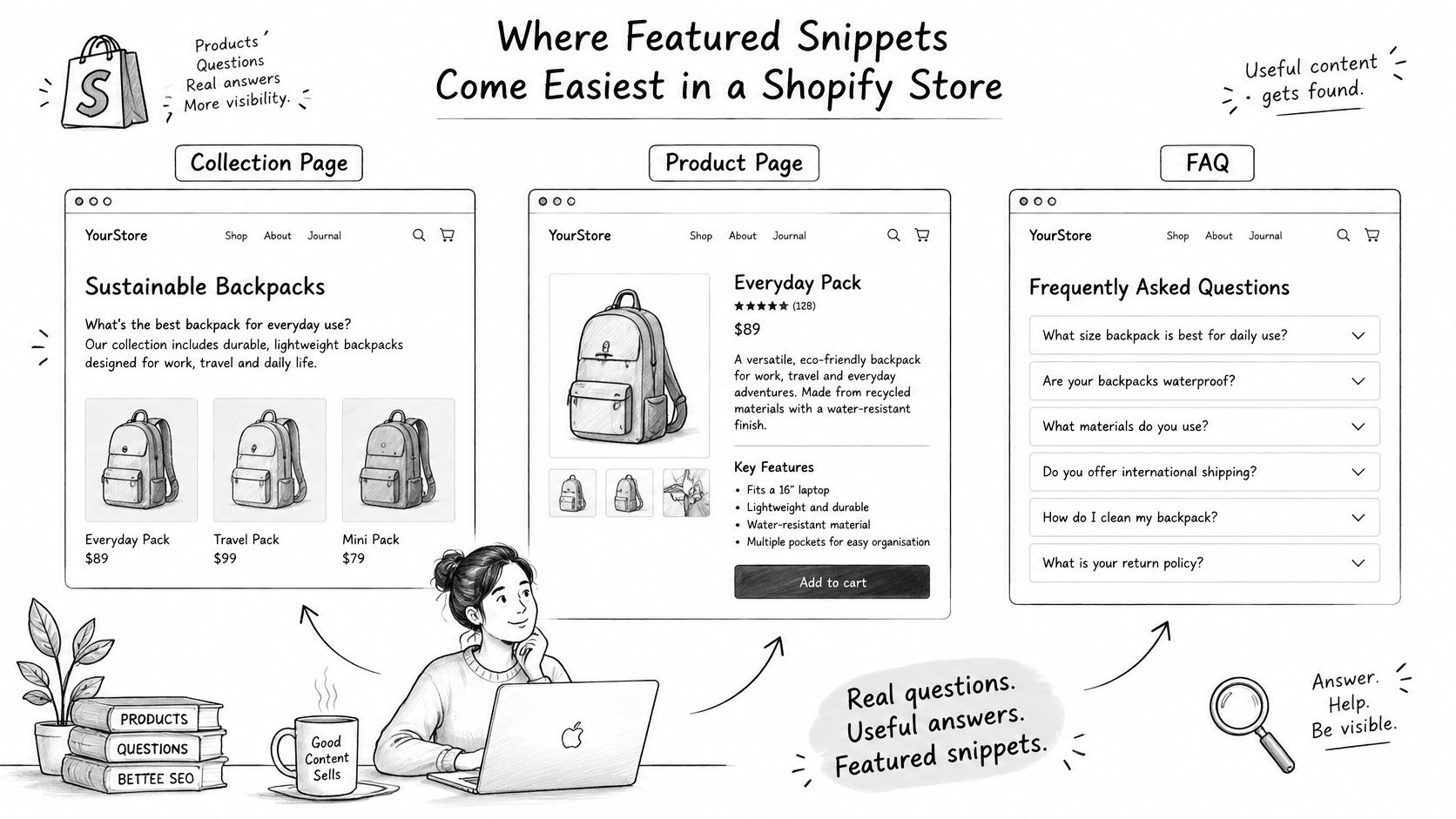
Start with pages that already help buyers make decisions. Their advantage isn't a special Shopify setting; it's the product knowledge you can turn into a clear answer.
Place content where shoppers need it, rather than adding the same FAQ block everywhere.
Collections and product pages
On a collection page, place a concise buyer answer above the product grid without pushing products unnecessarily far down the screen. A candle shop could explain how burn time differs by candle size and usage, using its actual product specifications rather than inventing a category-wide estimate.
On a product page, put the size chart near the variant selector, care instructions beside material details, and shipping information near the purchase decision. Keep product-specific facts distinct from store-wide policies.
For a jewellery store, a dedicated ring-sizing page could present a numbered measurement process, explain how to use the resulting measurement, and link to the appropriate size options. Don't imply that every measuring method is equally accurate or omit conditions that affect the fit.
Useful template additions include:
- Collection guidance: Explain which product characteristics suit a particular need.
- Product specifications: Label measurements, materials, and compatibility precisely.
- Care instructions: Give independent actions as a readable bulleted list.
- Policy answers: State the actual return window and important conditions directly beneath the relevant heading.
A visual walkthrough can complement the template audit.
Blog posts and catalog maintenance
Give a how-to post a clear primary question, then support the answer with usable instructions and relevant product links. Blogger SEO AI Blog Agent for Shopify can generate, schedule, and publish SEO blog posts with product links; review its drafts for product accuracy and buyer usefulness before relying on them.
For catalog cleanup, export a backup product CSV and identify missing image alt text and weak SEO titles in a spreadsheet. Preserve product handles and unrelated fields, edit only the intended columns, and test the import on a limited sample before updating the remaining catalog.
Confirm the storefront output after import, not just the spreadsheet values. These housekeeping changes support a clearer catalog, but they aren't substitutes for an answer that satisfies the query.
Confirm the Click Trade-Off Before You Chase the Snippet
Should a merchant pursue a featured snippet if it reduces clicks? Not automatically. Fewer visits might be acceptable if the remaining visitors buy more, but visibility alone doesn't establish that outcome.
Distinguish a classic extracted answer from an AI-generated search response. Google's AI features documentation explains how supporting webpages can appear in AI search features; don't assume that winning a conventional snippet produces the same exposure or click behavior.
Snippet availability can also change substantially. Keywords Everywhere's analysis of one million randomly selected results pages, summarized by Ighenatt, found featured-snippet visibility fell from 15.41% of tracked US desktop SERPs in January 2025 to 5.53% in June 2025. That is a bounded observation about those results, not a forecast for every merchant's queries.
Choose the objective by query type
Use intent to decide what a worthwhile outcome looks like:
- Informational questions: Pursue useful exposure when the topic connects to your products. Pair the answer with original examples, care guidance, or troubleshooting detail, and judge whether visitors progress toward a relevant purchase.
- Product comparisons: Pursue the answer box when your page offers a better next step, such as a size finder, compatibility check, or comparison tool. Give the comparison fairly, then make the next action obvious.
- High-intent questions fully resolved on Google: Be selective. If the answer replaces a profitable product-page visit, prioritize the purchase experience instead of expanding the page solely to attract an answer box.
Don't withhold essential shipping, returns, compatibility, or safety information to manufacture curiosity. Preserve a useful next step, not an incomplete answer. A shopper should click because the page helps them choose, not because you deliberately concealed a necessary fact.
Make the keep-or-revise decision
Compare query visibility and clicks with landing-page add-to-cart events, assisted conversions where your analytics supports them, and relevant product-page visits. Track branded searches separately as context, not proof that a snippet caused later demand.
Set a review date when you publish each change. Keep the experiment when it supports your commercial objective; revise the answer or stop prioritizing that query when qualified traffic deteriorates without a compensating business benefit.
This month, select your shortlisted queries, record their baselines, and make controlled edits. At your review, decide which answers deserve continued investment based on buyer behavior, not the prominence of the box.
Yassine Malti builds SEO-focused Shopify apps and custom automations for content, on-page optimization, and repetitive store workflows. Visit Yassine Malti to explore ready-made tools or discuss a custom workflow that supports your snippet tests and connects useful answers to relevant products.
Shopify apps by Yassine Malti
Put this into practice
-

Blogger · SEO blog posts
An AI blog agent that writes and publishes for you · 50 credits/month free
-

ALT SEO · Image alt text
AI alt text for every product image · 100 images/month free
-

RANKit · Meta titles & descriptions
AI meta titles and descriptions, sized for Google · 50 meta tags/month free