First-party data is information a business collects directly from people through its own website, store, app, purchases, and customer interactions. 39% of cookies were first-party and 61% were third-party in HTTP Archive's measured web sample, but data collected directly still isn't free to use for any purpose.
That distinction challenges the most popular advice about this topic. First-party data isn't a magic, privacy-safe replacement for third-party cookies. It's a permissioned customer relationship. For a Shopify merchant, that relationship can improve retention, personalization, and measurement, but it also creates duties around consent, transparency, security, retention, and deletion.
Table of Contents
- What First-Party Data Actually Means for a Shopify Store
- First-Party Data Compared to Second-Party and Third-Party Data
- How to Collect First-Party Data on Shopify Without Breaking Trust
- Activating First-Party Data Across Personalization and Measurement
- Privacy and Compliance Duties That Come With First-Party Data
- Where First-Party Data Falls Short and What to Use Instead
- A 30-60-90 Day Roadmap, Best Practices, and Common Mistakes
What First-Party Data Actually Means for a Shopify Store
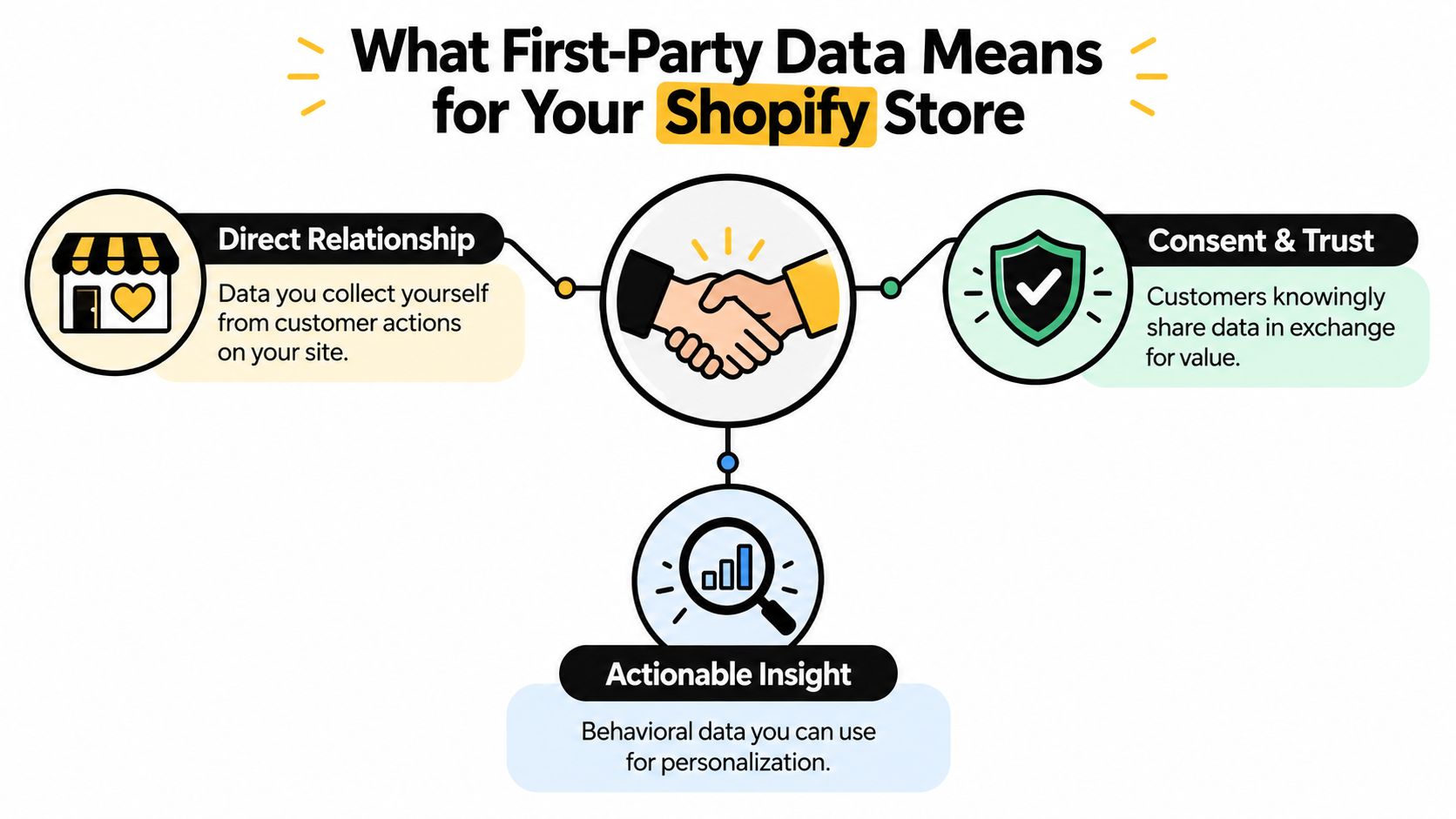
A practical definition is simple: first-party data is information your business collects directly through customer touchpoints it operates or controls. Those touchpoints include a Shopify storefront, checkout, account area, mobile app, loyalty program, support desk, survey, or physical shop. A legislative definition used in Massachusetts similarly describes first-party data as personal data collected directly from a consumer through a website, physical location, or online service operated by the first party. The Massachusetts legislative text provides that reference.
The phrase “first-party” describes more than collection. It combines three questions:
- Who has the relationship? Your store, not an unrelated broker, interacts directly with the customer.
- How was the information collected? The customer entered it, purchased something, browsed your site, contacted support, or responded to a request.
- What permission exists? The customer must receive appropriate notice, and the business must use the information within a lawful and stated purpose.
An email captured during checkout is first-party data because the customer shared it with your store. An order record is also first-party data, including products purchased, delivery details, and transaction history. A product-view event on a collection page can qualify too, although an anonymous behavioral event and an identified customer profile carry different privacy and activation implications.
A returning customer's loyalty interaction adds another layer. Their points balance, preference selection, review, or reward redemption may help your team understand the relationship, but it doesn't automatically authorize unrelated advertising or AI analysis.
The Shopify distinction that causes confusion
A Meta pixel event is not the same thing as a Shopify customer record. The event may be sent to an external advertising platform for measurement or audience activity, while the order record lives in the merchant's operational systems. Both can describe a product interaction, yet their controllers, purposes, permissions, and retention practices may differ.
The same principle applies to an email list. A newsletter subscription may support marketing messages if the customer opted into that purpose. An email collected to send an order confirmation supports fulfillment, but that collection alone doesn't necessarily mean the customer agreed to promotional email.
For a broader introduction, Adwave explains first party data with useful background on the terminology. The practical Shopify playbook below focuses on how to collect, connect, activate, and govern these records without confusing direct access with unlimited permission.
First-Party Data Compared to Second-Party and Third-Party Data
The easiest way to separate the categories is to ask whose customer relationship produced the information.
| Data type | Source | Shopify example | Primary risk |
|---|---|---|---|
| First-party data | Your direct customer touchpoints | Checkout email, purchase history, account activity, support conversation | Reusing data beyond the stated purpose |
| Second-party data | A partner's first-party data, shared under an agreement | A complementary brand shares an agreed audience for a joint campaign | Unclear consent, partner governance, or incompatible purposes |
| Third-party data | An outside provider aggregates or licenses information from external sources | A purchased audience segment used for prospecting | Unknown provenance, weak relevance, and privacy exposure |
First-party data is broader than email
A Shopify merchant's first-party data can include orders, returns, subscription status, product views, searches, cart activity, email clicks, loyalty actions, reviews, survey answers, and support conversations. Some of these signals are declared by the customer. Others are observed from behavior. Both can belong to the merchant's direct relationship when collected through its own channels, but they shouldn't be treated as interchangeable.
Zero-party data sits inside this broader first-party category. When a customer tells your store, “I prefer fragrance-free products,” selects a communication preference, or answers a product quiz, they're providing information intentionally. “Zero-party” describes the explicit way the customer shares it. “First-party” describes the direct relationship through which your business receives it.
Second-party data is different. Suppose a skincare brand partners with a wellness retailer and receives an agreed audience segment for a joint campaign. The receiving brand didn't collect that information directly. It's another organization's first-party data, shared under a commercial and governance arrangement.
Third-party data is further removed. An external provider may aggregate information from multiple sources and license an audience to advertisers. That can support reach, but the merchant may know less about how the information was collected, whether the audience matches its actual customers, and which permissions apply.
The web remains a mixed environment. HTTP Archive's 2024 Web Almanac found that 39% of cookies were first-party and 61% were third-party, while Google Analytics appeared on at least 60% of websites as a first-party analytics tool. The Web Almanac's cookie analysis also makes clear why cookie classification shouldn't be confused with the full concept of first-party data. A purchase record, survey response, or support transcript may have no cookie at all.
How to Collect First-Party Data on Shopify Without Breaking Trust
Collection starts with the surfaces your team already controls. The mistake is installing more tracking before deciding what each field is for, who may use it, and how it will connect to a customer record.
Start with identity and events
Use a stable customer identifier where appropriate, and document the events you care about. A simple schema might include product_view, add_to_cart, and purchase, with timestamps, product identifiers, source context, and consent status. The identifier should connect checkout, account, email, app, and support activity without creating duplicate profiles every time a customer switches device or channel.
A Shopify Plus team may also use server-side event capture where it fits its architecture. That can improve reliability when browser signals are blocked or incomplete, but it doesn't turn an unauthorized event into permitted marketing data. Technical control and legal permission remain separate questions.
Audit every collection surface
- Checkout fields: Collect the email and shipping information needed to process the order. Keep optional marketing choices separate from required fulfillment fields.
- Accounts and subscriptions: Offer account creation or subscription enrollment with a clear explanation of the benefit and the communication purpose.
- Post-purchase questions: Use a survey after delivery to ask about fit, preferences, or satisfaction. Tools such as Gorgias, Recharge, or Klaviyo forms may feed different systems, so define the destination and purpose.
- Behavioral events: Record browsing, search, and cart actions with the right consent controls. Anonymous behavior can support aggregate analysis, while identified behavior requires more careful governance.
- Support and reviews: Treat customer-service conversations, product reviews, and feedback as customer information, not as an unrestricted copy bank for campaigns or model training.
- Preference centers: Let customers choose the message types and channels they want, then synchronize those choices across your email, SMS, and audience systems.
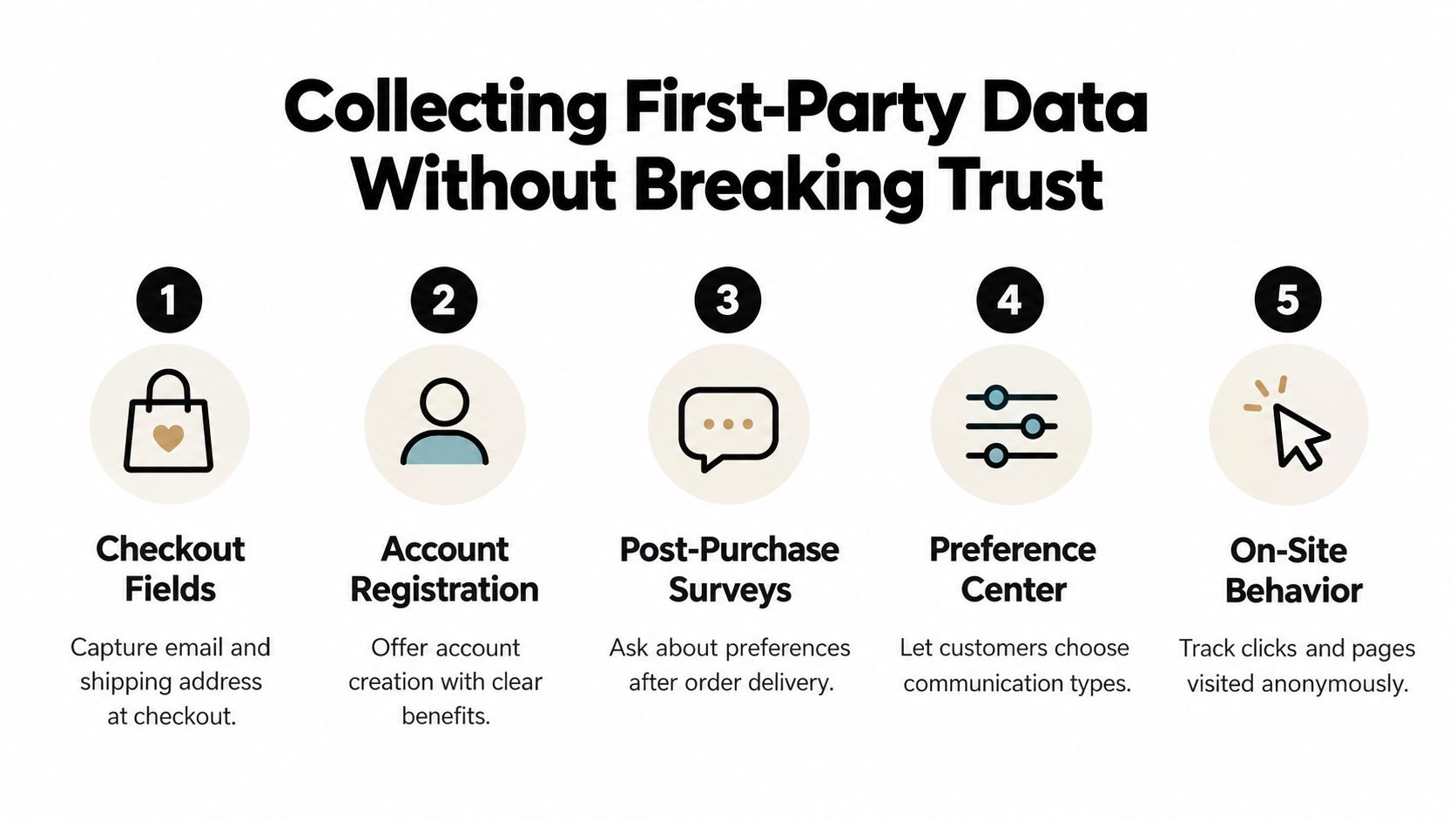
A useful next step is to map each field to its source, purpose, identifier, retention rule, and downstream tools. This turns a scattered Shopify stack into an auditable customer model. It also helps explain why integration matters: Boston Consulting Group research reported that organizations linking their first-party data sources generated up to twice as much incremental revenue from a single ad placement, communication, or outreach, and achieved 1.5 times better cost-efficiency metrics than organizations with limited integration. The Google and BCG research summary provides the cited findings.
If email acquisition is a current gap, this guide on how to build an email list offers practical collection ideas. For catalog hygiene rather than customer identity, RANKit AI Meta Tags Generator for Shopify can generate SEO-friendly product meta tags individually or in bulk from product images, titles, and descriptions.
Activating First-Party Data Across Personalization and Measurement
Collection only creates potential. The commercial value appears when your team joins reliable events to a permitted customer relationship and uses the result for a specific job.
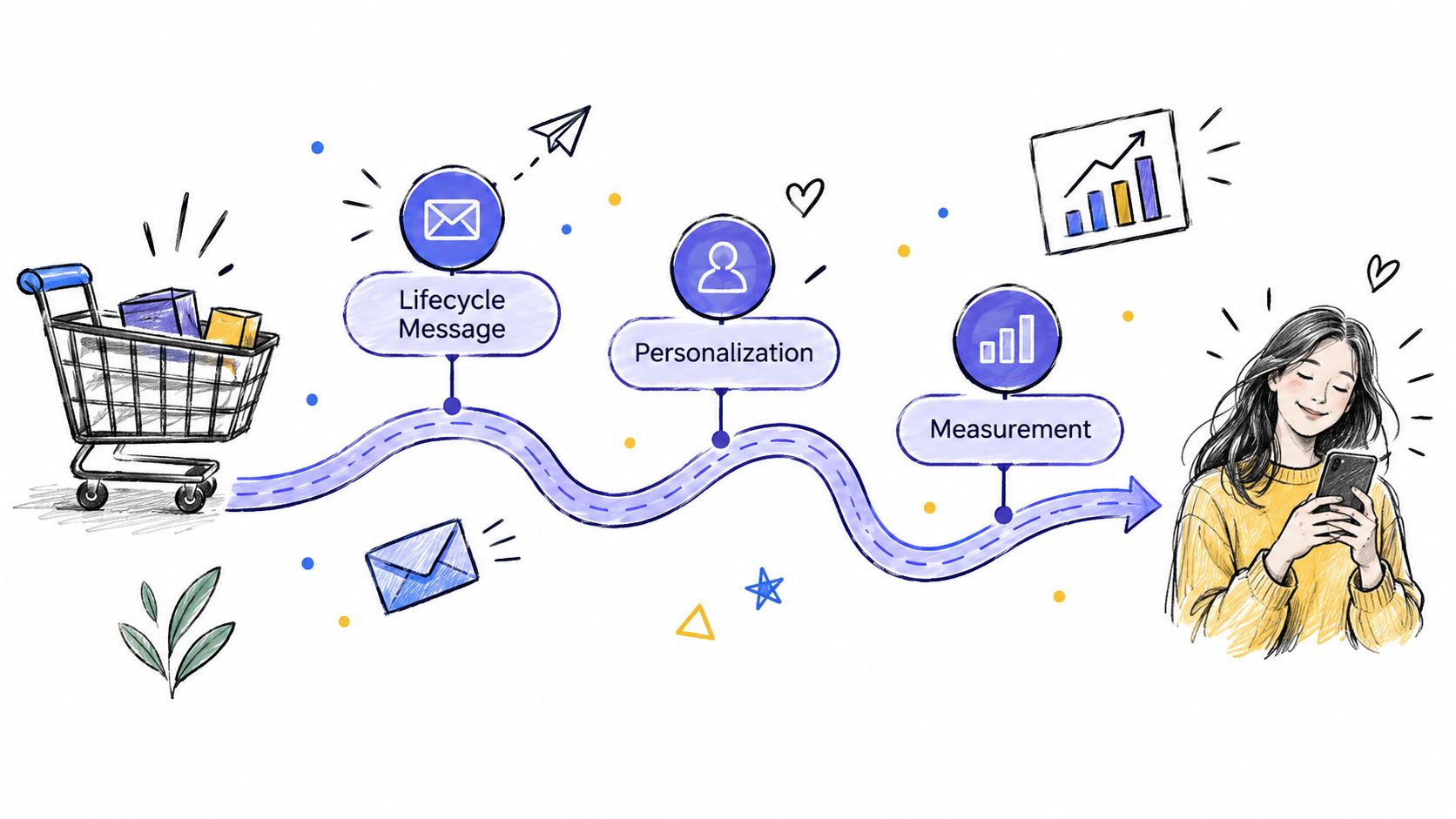
Consider a deterministic segment: a known customer viewed Product A, added it to a cart, abandoned checkout, and later purchased through an SMS link. Those are joined events, not guesses based on a broad interest category. A lifecycle system can suppress the abandoned-checkout reminder after the purchase, send a relevant post-purchase message, and attribute the order to the appropriate customer journey if the permissions and tracking design support that use.
Three useful activation patterns
Lifecycle messaging is often the safest starting point. A Klaviyo flow can distinguish an abandoned checkout from a completed purchase, suppress converted customers, and use subscription state to avoid sending irrelevant replenishment messages.
On-site personalization can use a customer's recent product interaction to adjust recommendations or merchandising. The experience should remain proportionate. Showing a related product can be useful; exposing sensitive assumptions or following a customer across unrelated contexts can feel intrusive.
Measurement depends on disciplined identity and deduplication. Match Shopify orders against email, SMS, browser, and advertising-platform conversions so one purchase isn't counted as several. Use the resulting report to understand channel contribution, then supplement platform attribution with tests or incrementality analysis where feasible.
Service and retention provide another strong use case. A support agent who can see an order, subscription state, and prior issue can resolve the customer's problem without asking them to repeat the story. The same data can identify customers who need help, but it shouldn't automatically trigger promotional targeting.
Consumer expectations set a high bar. A 2024 global study of 23,730 consumers found that 53% were highly concerned about personal-data privacy, while only 33% trusted companies to use their information responsibly. Adobe's discussion of the study supports the case for restraint as well as relevance.
Practical rule: Use the narrowest data and purpose that can accomplish the customer or business task.
A Shopify team can turn that rule into a quarterly activation backlog: one consent-aware lifecycle flow, one joined measurement report, one preference-based recommendation, and one service workflow. Guidance on marketing automation for ecommerce can help connect these workflows to broader operational planning.
Privacy and Compliance Duties That Come With First-Party Data
The phrase “first-party” describes the relationship, not an exemption from privacy law. If an email address, order history, browsing record, or support transcript identifies or can be linked to a person, the merchant needs a lawful and transparent basis for collecting and using it.
Under GDPR, consent must be freely given, specific, informed, and unambiguous, obtained through a clear affirmative action. People must also be able to withdraw consent. The European Union's GDPR guidance sets out these requirements.
Turn legal principles into Shopify controls
A checkout marketing checkbox shouldn't be preselected, bundled into an unrelated required field, or written so broadly that customers can't understand what they're accepting. The notice should explain the communication type, purpose, and relevant channel. Operational messages, such as order confirmations, should remain distinct from optional promotional marketing.
Purpose limitation matters after collection too. The fact that a customer gave you a phone number for delivery updates does not automatically authorize promotional SMS. A support transcript collected to resolve a complaint should never become training material for every AI workflow in your stack.
Retention needs a rule. Define how long each category remains useful or legally necessary, then apply that rule across Shopify, the email service provider, SMS platform, customer support system, warehouse, analytics layer, and advertising audiences. A deletion request that removes a profile from Shopify but leaves a connected audience or warehouse record unresolved is incomplete.
Keep an auditable data contract
For each important field or event, document:
- Source: Where did the information come from?
- Purpose: Why was it collected?
- Consent status: What did the customer choose, and when?
- Jurisdiction: Which regional rules apply?
- Retention: When should the record be reviewed or deleted?
- Recipients: Which tools or partners receive it?
The record should preserve the consent version, wording shown, timestamp, selected purposes, and withdrawal history. When a customer withdraws marketing permission, synchronization must not reintroduce them into an active audience from an older export.
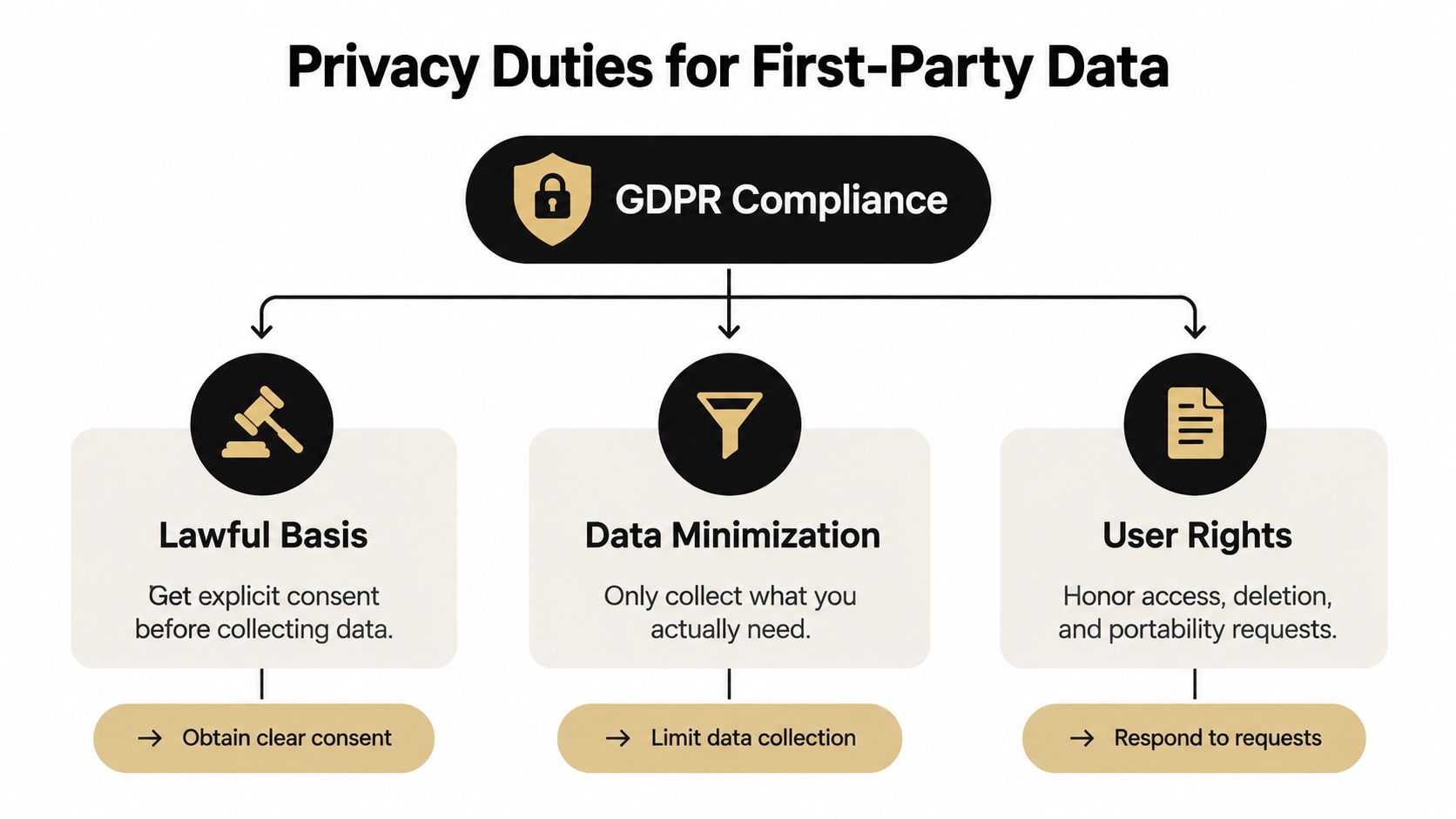
U.S. state privacy laws add another layer of review. The exact duties vary by jurisdiction, but merchants should still ask the same operational questions: What did we collect, what did we disclose, why are we using it, and how will we honor access, correction, opt-out, or deletion requests where applicable?
For clearer policy language and store-specific disclosures, these privacy policy tips for online stores are a useful practical reference. SMS programs require their own careful consent and suppression handling, so merchants should also review SMS marketing for ecommerce before activating phone-based campaigns.
Where First-Party Data Falls Short and What to Use Instead
First-party data is strongest where the customer already has a relationship with your store. It can support retention, service, personalization, and conversion analysis because the merchant has direct behavioral and transactional context.
It isn't a complete replacement for external signals. A customer database reflects people who have interacted with the brand, so it may be too narrow, too concentrated in existing buyers, or biased toward the audiences the merchant has already reached. A small store can have excellent customer records and still lack enough breadth for reliable prospecting.
A February 2025 survey of 168 brand and agency executives found that only 46% reported making some effort to source first-party data. The same report identified scale, completeness, organizational silos, and compliance as limitations. The AdExchanger and DISQO survey provides that context.
Build a combined measurement approach
Use first-party records for known customers and lifecycle decisions. Add contextual advertising when you want to reach people based on the content or environment they're viewing rather than a personal profile. Use modeled measurement, platform-side reporting, and privacy-safe audience tools where they fit your legal and commercial requirements.
Browser policy also remains fragmented. Safari, Firefox, and Brave restrict or block many third-party-cookie use cases, while Google's April 2025 decision to continue supporting third-party cookies in Chrome complicates simple claims that cookies are disappearing. That decision doesn't remove consent obligations or solve cross-browser identity fragmentation.
A customer list can be excellent for retention and poor for discovery at the same time. That isn't a failure. It's a signal to assign each data source the job it can perform well, instead of forcing owned records to solve acquisition, reach, and measurement problems they weren't designed to solve.
A 30-60-90 Day Roadmap, Best Practices, and Common Mistakes
A sound first-party data program starts with inventory, not another app. Give the team a sequence that separates collection problems from identity problems and activation problems.
Days 1 to 30 for the audit
Document every Shopify, email, SMS, support, loyalty, survey, analytics, and advertising signal. For each one, record its source, identifier, consent state, purpose, recipient, and duplication risk.
Check whether:
- checkout and account records create duplicate customer profiles;
- browser and server events count the same purchase twice;
- marketing consent is separate from fulfillment consent;
- suppression requests reach every connected tool;
- anonymous events are being merged with identified profiles without a clear rule.
Days 31 to 60 for the architecture
Choose a stable customer identifier and define the event schema for actions such as product_view, add_to_cart, and purchase. Store timestamped consent records beside the profile or event, then route governed data to the appropriate warehouse, CRM, customer-data layer, or activation platform.
Set a data contract for fields that matter. It should state how the value was collected, what the customer was told, which purposes are allowed, and when the value should expire or be deleted.
Days 61 to 90 for activation
Build one joined segment, such as customers who viewed a product, abandoned checkout, and later purchased. Create one deterministic measurement report that deduplicates Shopify orders against channel events. Then launch one consent-aware audience or lifecycle flow and verify suppression before expanding.
The best data stack is the one your team can explain field by field.
Best practices worth keeping
- Treat identity as infrastructure: Don't let every application invent its own customer key.
- Version consent: Preserve what the customer saw and selected, not just a yes-or-no flag.
- Separate purposes: Keep fulfillment, service, analytics, personalization, and advertising distinct.
- Measure incrementality: Don't treat platform-reported conversions as the whole business result.
- Document the contract: Make provenance, permission, retention, and recipients visible.
Mistakes that create avoidable risk
- Calling every pixel event first-party: A merchant may trigger the event, but an external platform can still receive and process it.
- Using pre-checked consent boxes: Silence or bundled acceptance doesn't provide the clear affirmative action required for valid GDPR consent.
- Keeping everything forever: Storage without a retention rule increases exposure and reduces data quality.
- Syncing unsuppressed audiences: A withdrawn customer can reappear through a warehouse export or connected app.
- Ignoring deliverability: Email permission is only useful when messages reach the inbox and remain relevant.
Start next week by exporting your source and field inventory, then mark every field as operational, marketing, analytical, or unknown. That single exercise usually reveals where Shopify data is duplicated, where consent is ambiguous, and which activation can be built safely first.
Yassine Malti offers Shopify apps and custom automations for SEO, content workflows, conversational commerce, and store operations, which can complement a governed data stack without replacing its consent controls. Visit Yassine Malti to explore practical Shopify tools and discuss a custom workflow for your store.
Shopify apps by Yassine Malti
Put this into practice
-

RANKit · Meta titles & descriptions
AI meta titles and descriptions, sized for Google · 50 meta tags/month free
-

Describer · Product descriptions
Product descriptions written from your own product data · Free: 50 descriptions/month
-

LLMs TXT · llms.txt for AI tools
A short llms.txt of your real store links · Free