You update a product page, add sharper photos, and send traffic to it. Shoppers still leave without choosing a size or adding the item to their cart. Your description calls the product “premium” and “versatile,” but it never explains whether the fabric stretches, how the cream feels, or when the handmade order ships.
Shopify Product Description Examples That Help Shoppers Make Decisions shows you how to replace vague claims with details shoppers can use. You get Shopify product description examples for clothing, beauty products, and handmade goods, plus a practical structure for turning specifications into clear buying guidance. Each example focuses on a decision your customer needs to make before ordering.
A useful description connects a feature to its everyday effect, then answers the question that could stop the purchase. For a cotton shirt, that might mean explaining the fit and shrinkage risk rather than listing the fiber alone. For a face oil, it means describing texture and application without making unsupported skin-care claims.
You also see what to include in a Shopify product description and what to leave in a size chart, shipping policy, or care guide. The aim is enough detail to support a choice without burying the answer. Treat each example as a starting point, not copy to paste across products with different materials, uses, or limitations.
Table of Contents
- 1. What makes a Shopify product description help shoppers decide?
- 2. Shopify product description examples for clothing
- 3. Shopify product description examples for beauty products
- 4. Shopify product description examples for handmade products
- 5. What to include in a Shopify product description: a reusable formula
- 6. SEO product description examples for Shopify that still sound natural
- 7. Use AI product descriptions for Shopify as a draft, then review
1. What makes a Shopify product description help shoppers decide?
A useful description closes the gap between seeing a product and knowing whether it fits your needs. The strongest Shopify product description examples explain what you get, who it suits, and what using or owning it involves.
Your copy does not need to persuade every visitor. It needs to help the right shopper choose confidently, even when that means telling someone a fitted shirt has no stretch or a handmade order takes two weeks to dispatch.
Answer the questions shoppers have before buying
Start with the questions your photos cannot reliably answer. A shopper can see the shape of a bag, but cannot tell whether it holds a laptop, has an inside pocket, or includes the shoulder strap shown beside it.
Baymard’s research on insufficient product descriptions shows that shoppers seek details such as materials, dimensions, ingredients, and included items to assess a product. Use your support tickets and return reasons to identify which missing details cause uncertainty in your store.
- Identity: Name the product plainly, including its intended use, rather than relying on a collection name.
- Suitability: Explain fit, compatibility, or intended conditions so shoppers can judge whether it works for them.
- Expectations: State what arrives, what requires separate purchase, and any relevant preparation or production time.
If you are deciding what to include in a Shopify product description, prioritize information that could change the buying decision. Keep broader page checks separate with the Shopify product page SEO checklist.
Turn product features into useful benefits
A feature is a product attribute; a benefit explains why that attribute matters in use. Connect the two without inventing an outcome that your product cannot support.
For example, “zip closure” names a feature. “A zip closure keeps the main compartment closed while you carry the bag” explains its practical value without promising theft protection or waterproofing.
| Product detail | Decision-helping copy |
|---|---|
| Adjustable shoulder strap | Adjust the strap to carry the bag higher or lower against your body. |
| Removable cushion cover | Remove the cover for cleaning, following the supplied care instructions. |
| Made-to-order mug | Your mug is made after purchase; allow 10 business days before dispatch. |
Practical rule: Follow each important feature with its useful consequence, then check that both statements are accurate. Do not turn “soft fabric” into an unsupported promise about sensitive skin.
Match the detail to the product and purchase risk
Purchase risk is the uncertainty a shopper faces about fit, performance, cost, or the difficulty of returning an item. Higher-risk purchases usually need more explanation, but that does not mean every product needs a long story.
A simple replacement knob may need dimensions, material, and compatible fittings. A costly made-to-order dining table needs measurements, finish details, delivery arrangements, assembly requirements, and clear information about natural variation.
When asking how long should a Shopify product description be, use completeness rather than a fixed word count as your test. Put the decisive facts first, then organize supporting detail into short paragraphs or labeled bullets. Cut repetition, not information shoppers need before paying.
2. Shopify product description examples for clothing
A shopper likes your jacket in the product photos but pauses at the size selector. You need to explain whether it fits over a sweater, how the fabric feels, and what happens when it needs washing.
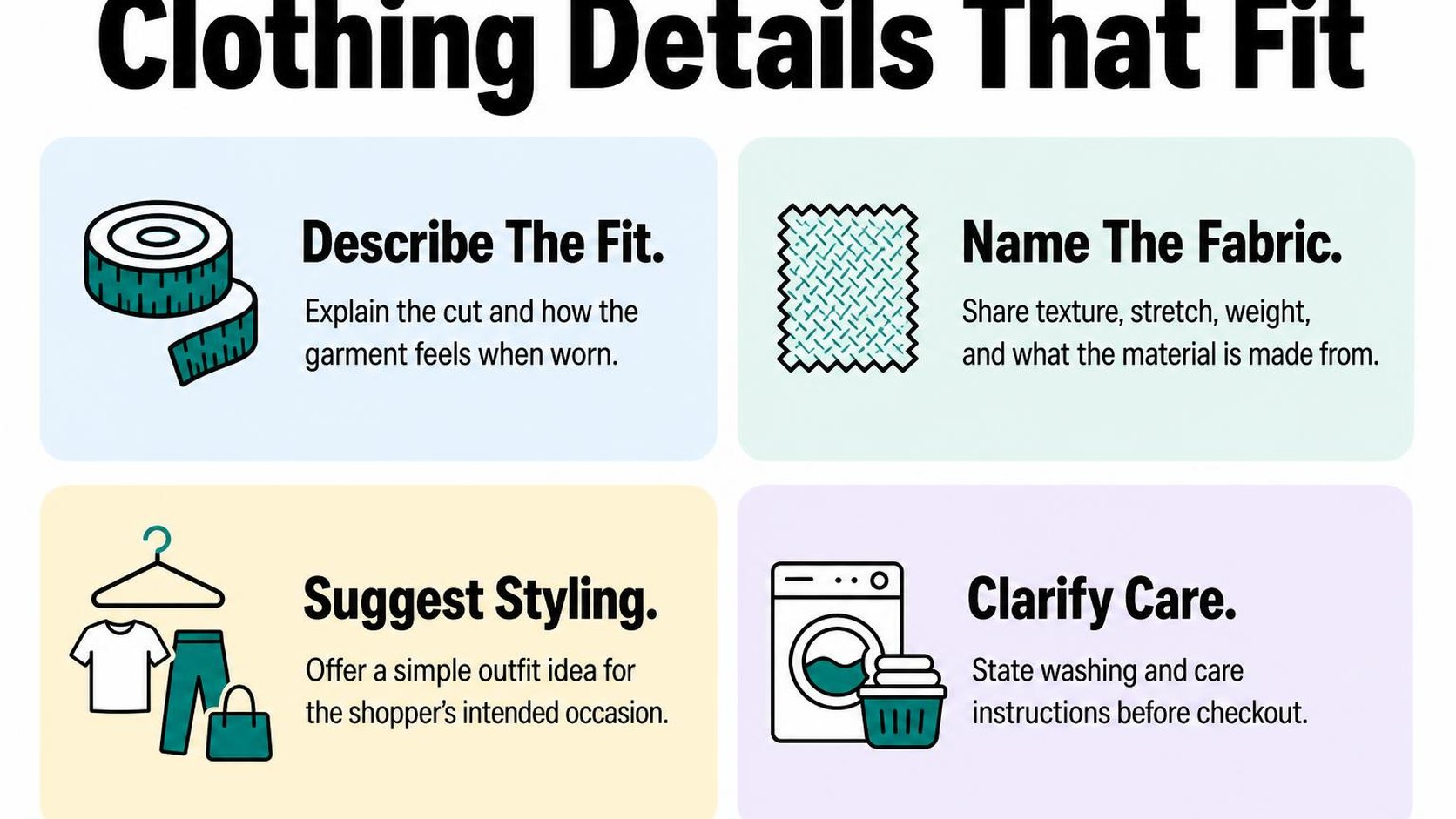
Useful Shopify product description examples for clothing connect those questions to details you can verify. Sensory language helps someone picture wearing the garment, but it should sit beside measurements and material information, not replace them.
Lead with fit, fabric, and feel
Start with the garment’s shape and intended use. “A relaxed cotton jacket for layering over a T-shirt or light knit” gives your shopper more direction than “the perfect jacket for every occasion.”
Fit describes how a garment sits on the body, including its shape and room through areas such as the shoulders, chest, and hips. Explain what “relaxed” means for this particular item rather than assuming your shopper interprets it the same way you do.
- Fit: Identify a straight, fitted, oversized, or cropped shape, then support that description with garment measurements.
- Fabric: Give the verified fiber composition. Add fabric weight or stretch information when your supplier provides it or you can confirm it.
- Feel: Use observations such as “smooth lining” or “lightly brushed surface” after checking a sample. Avoid promises such as “never itchy” or “comfortable in any weather.”
Specific details make the description less dramatic but more useful. Do not turn cotton content into a claim that a jacket keeps everyone cool or suits every skin type.
Make sizing and care details easy to find
Put the size guide near the size selector and summarize the most relevant fit details in your description. If you give a model’s height and worn size, treat that as context rather than proof that the same size fits your shopper.
Distinguish body measurements from garment measurements, and state whether flat measurements run across the item or around it. Copy care instructions from the verified care label instead of guessing from the fiber content.
- Sizing: State the measurement method and units, and explain any verified variation between sizes.
- Care: Include the washing method, drying restrictions, and any separate-care instructions shown on the label.
- Options: Name colors consistently across copy and selectors. See how product swatches help shoppers compare options when you present several shades.
Example: describe a versatile everyday jacket
The following Shopify product description template uses hypothetical specifications. Replace every material, construction, and care detail with information verified for your own garment before publishing.
Example: Add a light layer with this relaxed, straight-cut cotton jacket. The unlined construction and smooth woven surface make it an option over a T-shirt or light knit, while two front patch pockets keep small essentials within reach.
The hip-length shape pairs with jeans or straight-leg trousers. Check the garment measurements in the size guide against a jacket you already wear, allowing room for your preferred layers.
Details: 100% cotton; unlined; button front; two patch pockets. Machine wash cold with similar colors and line dry, following the care label.
3. Shopify product description examples for beauty products
A shopper reaches your moisturizer page and sees “your new skincare essential.” That leaves practical questions unanswered: does it feel rich or light, when does it go on, and what comes in the jar? Useful Shopify product description examples for beauty products answer those questions without turning cosmetic copy into a treatment promise.
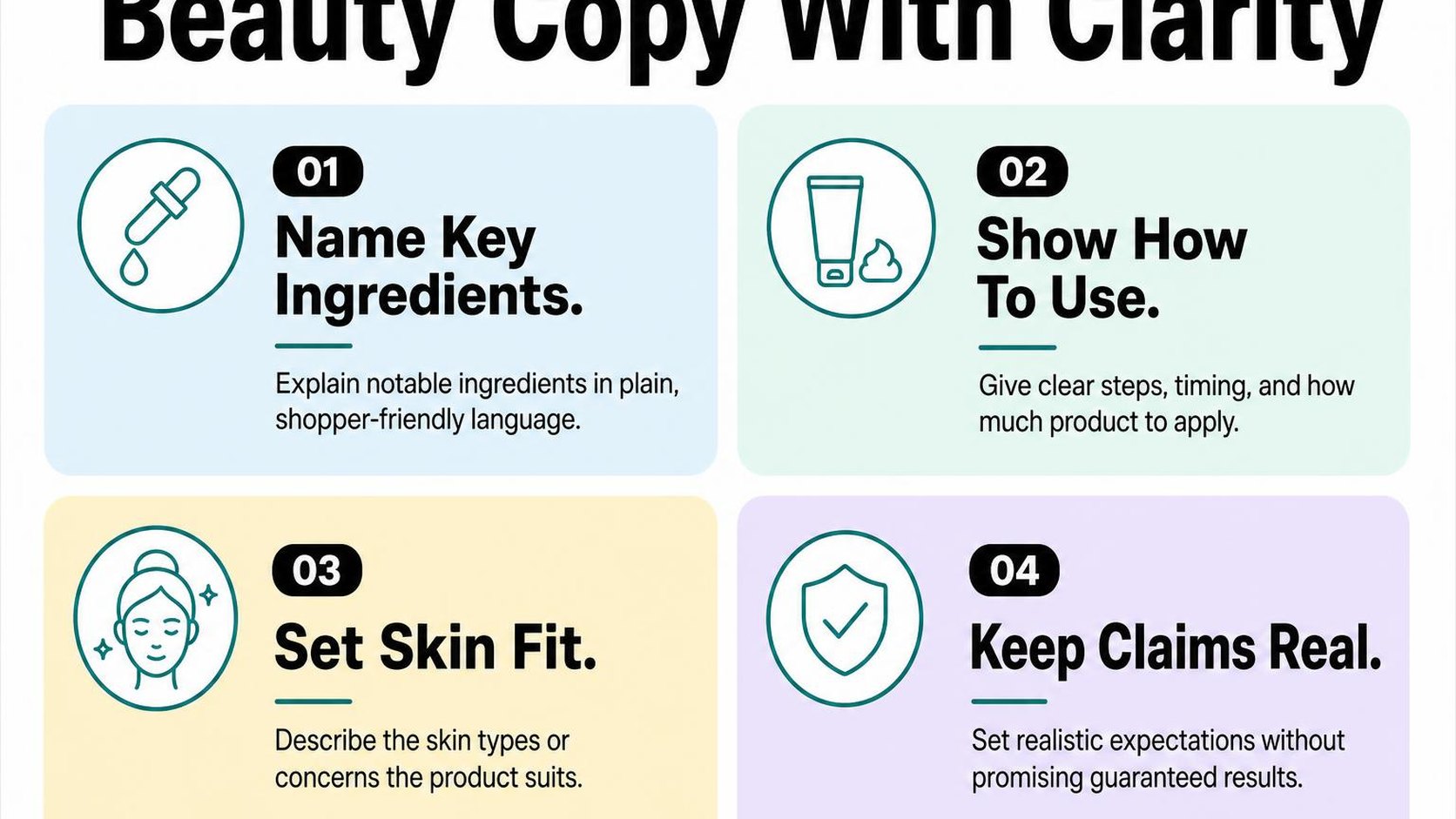
Explain texture, use, and routine placement
Describe the experience using details you can verify for the finished product. “Lightweight lotion” and “thick balm” help shoppers picture different textures; “perfect for everyone” gives them no useful basis for choosing.
Explain where the product fits into a routine using the manufacturer’s directions. Keep application instructions separate from expected results: telling shoppers when to apply a cream does not establish how quickly it works.
- Texture: Describe the consistency and finish only as supported by product information or an appropriate assessment. Do not assume an ingredient makes the finished formula non-greasy.
- Application: Give the verified amount, application area, and frequency. Include relevant label precautions rather than inventing universal instructions.
- Routine placement: State whether the product goes after cleansing or at another specified step. Do not imply it replaces sunscreen unless its labeling supports that use.
State ingredients and product details accurately
Give shoppers the full ingredient list, pack size, packaging format, and any verified fragrance information. An INCI list is an ingredient list using standardized cosmetic ingredient names; preserve the supplied wording rather than rewriting it into marketing language.
An ingredient’s presence does not, by itself, prove a finished product delivers a particular result. You can identify glycerin in the formula without claiming that the moisturizer repairs damaged skin or treats eczema.
For the U.S. market, the FDA’s guidance on cosmetic labeling claims explains that claims must be truthful and not misleading, and that disease-treatment or structure-and-function claims can make a product a drug. Do not treat competitor wording as evidence for your own claims.
Practical rule: Keep each claim tied to documentation for your specific product. If you cannot verify “hypoallergenic,” “dermatologist tested,” or a stated duration of hydration, leave it out rather than softening it with “may.”
Example: describe a daily moisturizer without overpromising
The following example uses hypothetical specifications, not a tested formula. Replace every texture, ingredient, packaging, and usage detail with verified information before publishing, and place the actual full ingredient list and label precautions alongside the description.
Example: Add a moisturizing step after cleansing with this daily face lotion. Its lightweight texture spreads easily, and the pump bottle lets you dispense it without dipping your fingers into a jar. Apply one pump to clean, dry facial skin each morning, following the label directions. The 50 mL bottle contains a formula made with glycerin and squalane, with no added fragrance. This moisturizer does not provide sun protection; use a separate sunscreen as directed.
This version gives your shopper a texture, routine step, application amount, and pack size to assess. It avoids promises about acne, irritation, or guaranteed results while leaving room for the product details that support a purchase decision.
4. Shopify product description examples for handmade products
A shopper likes your handmade mug but pauses before adding it to their cart. Will the glaze match the photo, can you add a name, and will it arrive before a birthday? Useful Shopify product description examples answer those questions without making handmade work sound identical to factory production.
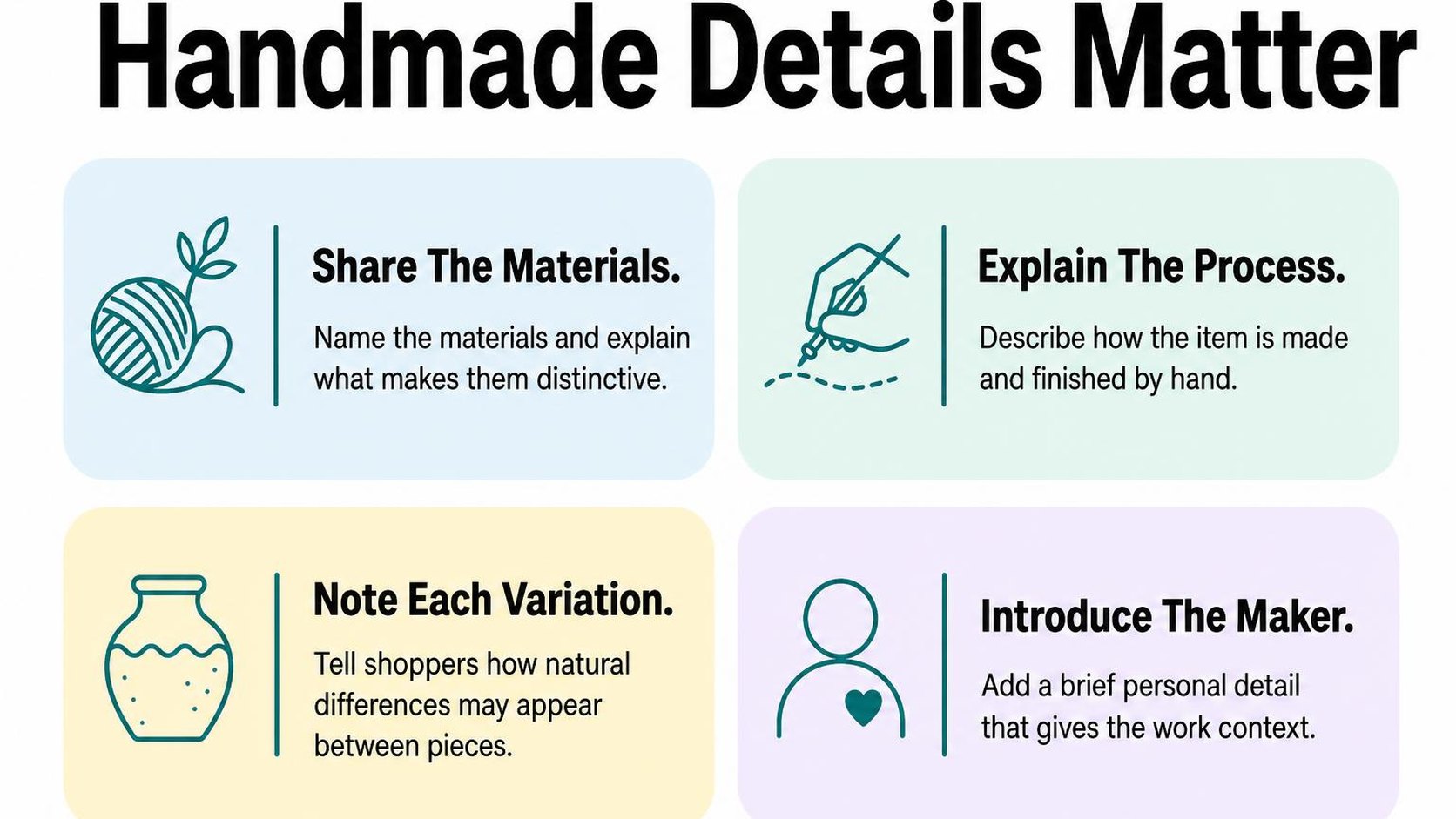
Your process gives the product context, but your shopper still needs dimensions, care instructions, and a realistic shipping window. Explain what makes each piece different, then separate those differences from the specifications you promise.
Show the maker's process and materials
Replace “crafted with love” with details your shopper can assess. Name the material, explain the relevant making steps, and connect them to the finished object. For a ceramic mug, wheel-thrown stoneware and a hand-applied glaze describe more than “premium artisan quality.”
Keep the process selective: your shopper needs the steps that explain appearance, use, or price, not a complete studio diary. Only include claims such as food-safe, dishwasher-safe, or locally sourced when you can support them for the product you sell.
- Materials: Identify the clay, glaze, wood, fabric, or metal rather than using “natural materials” alone.
- Process: Specify whether the item is thrown, cast, carved, stitched, or assembled by hand.
- Customization: State the available choices, character limits, placement, and how your shopper submits instructions.
- Everyday fit: Include capacity, dimensions, weight where relevant, and care requirements.
Set clear expectations for variation and lead time
Lead time is the period between placing an order and having it ready to ship. Give that window separately from delivery transit time, so “ready to ship in three weeks” does not read as “at your door in three weeks.”
Describe acceptable variation precisely. A slightly different glaze pattern is not the same as an unspecified capacity or a handle that differs substantially from the photos. If you offer personalization, explain whether it changes your production window and direct shoppers to your applicable cancellation and return terms.
Practical rule: Explain what can vary, what stays within a stated range, and when the order leaves your studio. Do not use “each piece is unique” to excuse missing specifications or defects.
Example: describe a made-to-order ceramic mug
The following example assumes these specifications match your actual product and production schedule. Replace every measurement, option, and timing detail with verified information before publishing.
Example: Choose a wheel-thrown stoneware mug for your morning coffee or tea. Each mug holds approximately 350 mL and measures about 9 cm tall, with a rounded handle and a hand-applied blue glaze. Glaze markings and small differences in shape vary from piece to piece; the photos show representative finishes, not the exact mug you receive.
Add up to eight letters to the underside by entering your text in the personalization field. Check your spelling before ordering; lettering appears exactly as submitted. Hand-wash with mild soap and avoid sudden temperature changes.
Your mug is made after you order and ships within three to four weeks. Delivery time starts after dispatch and depends on your destination. One mug is included; photo props are not.
5. What to include in a Shopify product description: a reusable formula
You open two product pages in your store: one lists technical details without explaining them, while the other promises comfort without giving measurements. Both leave the shopper with unanswered questions. The useful pattern behind Shopify product description examples is not a particular writing style; it is a sequence that helps someone decide whether the item fits their needs.
A Shopify product description formula is a repeatable order for presenting the buying information: intended use, benefits, supporting facts, and practical details. Use that order as a checklist, not a requirement to give every product the same paragraphs.
Use a shopper-first opening, benefits, and proof
Start with the situation your product serves, then connect a feature to a useful outcome. “Keep your keys separate from your laptop in a zipped internal pocket” gives the shopper more to assess than “designed for everyday convenience.”
Proof means the verified detail that supports your statement, such as a pocket measurement, material composition, or documented test result. Keep the promise within what that evidence actually establishes; a zipped pocket does not make the whole bag theft-proof.
- Opening: Name the product and its main use without making the shopper read a brand story first.
- Benefit: Explain what a relevant feature helps the shopper do, avoid, or choose.
- Support: Add a measurable detail or observable design feature instead of an unsupported superlative.
Add specifications, usage, care, and shipping details where relevant
Prioritize details that could change the purchase decision. A garment needs fit information; a concentrated cleaner needs dilution instructions. Do not bury a purchase constraint beneath several paragraphs of lifestyle copy.
| Information | Question it answers | What to verify |
|---|---|---|
| Specifications | Will it fit or work for you? | Dimensions, materials, compatibility, included items |
| Usage | How do you use it correctly? | Instructions, quantities, limitations |
| Care or storage | How do you maintain it? | Cleaning method, storage conditions, restrictions |
| Shipping | When does it leave the store? | Processing time, dispatch exceptions, destination limits |
Separate processing time from delivery estimates, and keep product-specific exceptions close to the buying information. Avoid copying a fixed arrival promise into every description when timing changes by destination or variant.
Apply a Shopify product description template
A Shopify product description template turns the formula into drafting prompts. Replace each bracket with a verified fact, then remove any line that does not help the shopper.
- Opening: Choose [product] for [specific use or need].
- Benefit and support: [Feature] helps you [outcome], with [supporting detail].
- Purchase details: Check [size, compatibility, materials, or contents] before ordering.
- Ownership details: Use [instructions] and follow [care or storage guidance].
- Fulfillment: Allow [verified processing time] before dispatch; delivery depends on [relevant conditions].
For help turning these prompts into natural copy, follow a practical guide to writing product descriptions. Adapt the emphasis: clothing may lead with fit, while a replacement component leads with compatibility. Keep shared facts consistent, but do not invent differences or repeat irrelevant sections just to fill the template.
6. SEO product description examples for Shopify that still sound natural
You open Search Console and see impressions for “linen summer shirt,” but your product page only calls it “The Weekend Edit.” The name fits your brand, yet the copy never explains what you sell. These Shopify product description examples show how to add useful search language without turning your page into a list of keywords.
Use the primary phrase where it fits the product
A primary phrase is the main search wording that accurately describes your product. Choose it around the item’s identity and intended use, not a popular query that only loosely matches. “Linen summer shirt” fits a linen shirt; it does not fit a polyester shirt with a linen-like texture.
Put that phrase in a clear opening sentence when it reads naturally. Then use the remaining space to answer purchase questions rather than repeat variations of the same wording.
- Forced: “Shop our linen summer shirt, the best summer linen shirt for your linen shirt wardrobe.”
- Useful: “This linen summer shirt has a relaxed fit and a straight hem you can wear untucked. Check the garment measurements if you prefer a closer fit.”
- Verification: Use the second version only when the fabric, cut, and hem match the actual item. Search-friendly wording does not excuse unsupported details.
Write unique copy for products with similar features
When ten products share the same material, you do not need ten invented benefits. Keep common specifications consistent, then explain genuine differences such as dimensions, shape, finish, or intended use. Unique copy gives each product a distinct, accurate explanation rather than swapping synonyms in an otherwise identical paragraph.
For two handmade ceramic mugs, capacity and handle shape may give shoppers a clearer choice than a different lifestyle story. If only the glaze changes, describe that difference honestly and keep the shared care instructions.
- Smaller mug: “This 250 ml ceramic mug holds a smaller serving of coffee. Its compact shape takes up less space on a crowded breakfast tray.”
- Larger mug: “This 400 ml ceramic mug holds a larger serving of tea. Check its height against your coffee machine’s clearance before ordering.”
- Shared facts: Repeat verified material and care details where shoppers need them. Do not remove essential information just to make every sentence different.
Choose a useful length instead of chasing a word count
How long should a Shopify product description be? Long enough to explain what the item is, whether it fits the shopper’s needs, and any limitations that affect the purchase. A simple mug needs less explanation than a replacement part with several compatibility requirements.
More words give you room for useful detail, but they also make key facts harder to find. Shopify’s guidance on writing product descriptions recommends scannable copy, specific features, and factual claims—not padding to reach a target length.
Practical rule: Stop when the shopper can identify the product, compare the relevant options, and check essential purchase details. Add missing answers, not extra keyword repetitions.
7. Use AI product descriptions for Shopify as a draft, then review
You open a new product in Shopify, find two supplier bullet points, and need a description before launch. AI product descriptions for Shopify can speed up that first draft, but fluent copy is not proof that the details are correct. Use the Shopify product description examples above as a standard for useful answers, not wording to copy across your catalog.
Give AI accurate product facts and a clear tone
Build a source brief: a short record of verified product facts and writing instructions. Include the intended shopper, materials or ingredients, measurements, included items, care instructions, and differences between variants. Tell the tool to flag missing information rather than fill gaps.
Define your tone with concrete instructions: “Use plain English, address the shopper as you, and avoid exaggerated promises.” Add one approved description as a reference, but keep its product facts separate so they do not migrate into the new draft.
AI Product Description—ChatGPT drafts descriptions from each product’s title, existing copy, tags, and up to five photos, in your language and tone, with instructions never to invent materials, sizes, or claims. Those instructions do not replace your review; an unclear photo or incorrect source detail still needs checking.
Check every detail, claim, and variation before publishing
Compare the draft against your approved product specifications, not another generated answer. A photograph may show a textured fabric, but it does not verify that the fabric is linen. Remove unsupported statements even when they sound plausible or make the item easier to sell.
- Facts: Verify dimensions, units, composition, compatibility, care, and package contents against reliable product records.
- Claims: Check the evidence behind wording such as “waterproof,” “hypoallergenic,” or “lasts all day.” Do not let AI turn a modest feature into an unsupported promise.
- Variants: Confirm that colors, sizes, quantities, and materials apply to the selected option. Separate shared details from variant-specific information.
Practical rule: If you cannot trace a statement to a verified product fact or supporting evidence, remove it or hold the draft until you can confirm it.
Run a final shopper and SEO review
Read the draft as someone deciding whether this item solves a specific need. Search intent is the need behind a search; your copy should answer that need with product details, not repeated phrases. For a travel mug, explain capacity and lid operation before adding lifestyle language.
Use this checklist on your next product page before publishing. A fast draft saves time only if the final copy helps shoppers choose without creating avoidable surprises.
- Product identity: Can you immediately tell what the item is and who it suits?
- Decision details: Are purchase-critical facts and relevant limitations easy to find?
- Brand voice: Does the wording sound like your store rather than a generic sales pitch?
- Search wording: Does the product type appear naturally, without forced keyword variations?
- Final preview: Have you checked mobile formatting, variant wording, and the saved page for errors?
Yassine Malti is the developer behind this guidance, writing from hands-on store work.
Put this into practice
Start with the store you already have, then use the guides on the blog for the next page that needs the same treatment.
Shopify apps by Yassine Malti
Put this into practice
-

Describer · Product descriptions
Product descriptions written from your own product data · Free: 50 descriptions/month
-

LLMs TXT · llms.txt for AI tools
A short llms.txt of your real store links · Free
-

Blogger · SEO blog posts
An AI blog agent that writes and publishes for you · 50 credits/month free