You've got a catalog that needs fresh copy, a blog folder full of half finished drafts, and a product launch that can't wait for a copywriter to clear their calendar. AI powered content generation looks like the obvious shortcut, until the first batch invents a material, repeats the same intro across a collection, or sounds nothing like your brand. The fix isn't a better prompt alone. It's a pipeline that grounds the model in your store data, checks its claims, and measures revenue instead of page count.
Table of Contents
- What AI Powered Content Generation Actually Means for a Store
- The Core Technologies Behind the Output
- A Production Workflow for Shopify Content
- SEO Best Practices and the Risks Worth Naming
- Tooling Options From Off-the-Shelf to Custom
- A Worked Example for a Mid-Size Catalog
- Measuring What Actually Matters
- Quality, Ethics, and Your Operating Checklist
What AI Powered Content Generation Actually Means for a Store
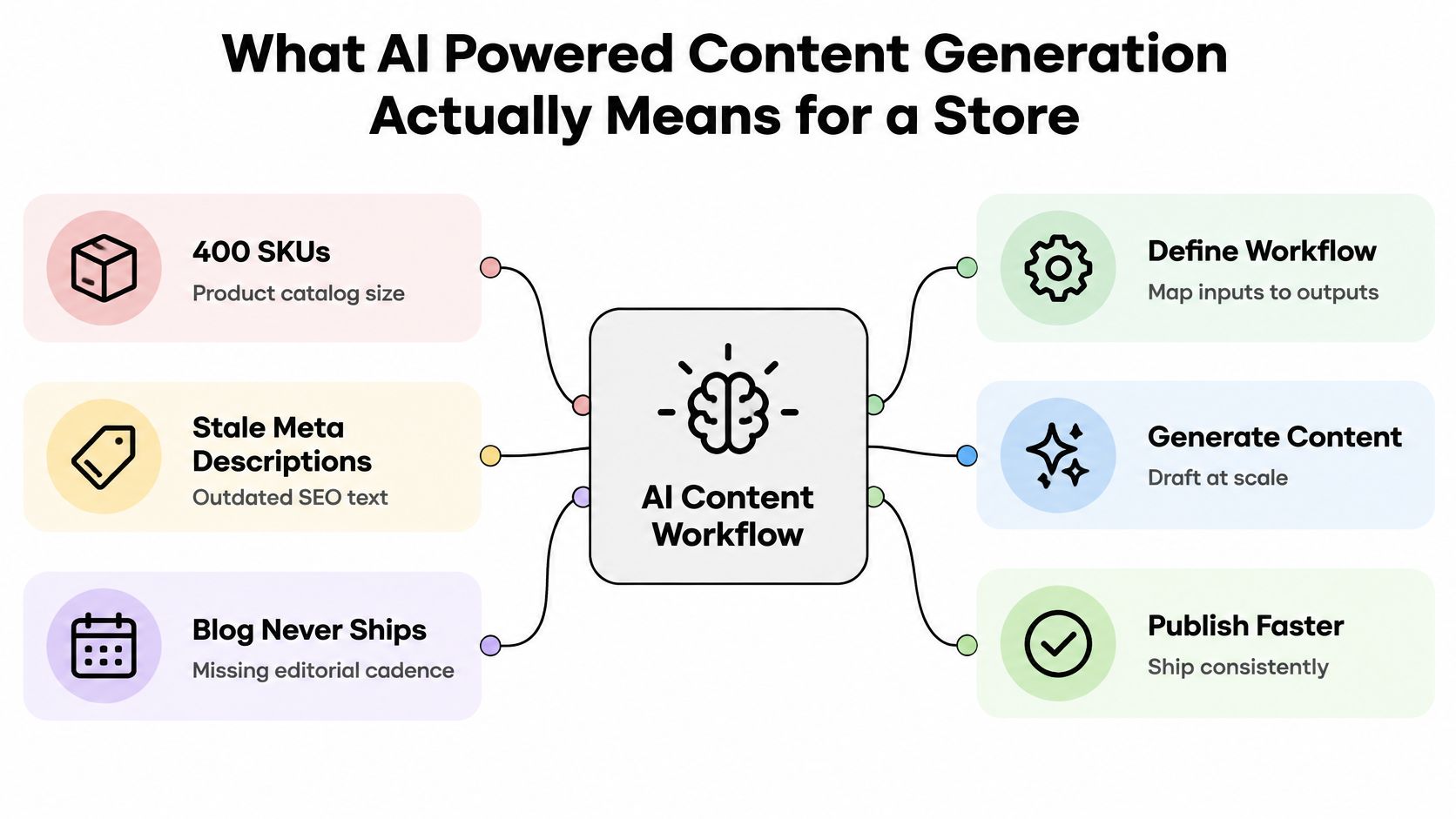
A merchant with 400 SKUs, stale meta descriptions, and no time to write collection copy doesn't need more text. You need text that's accurate, distinct, and publishable without a full rewrite. That's the gap between pasting a product title into a chatbot and running a production system.
AI powered content generation for a store means four parts working together. A language model drafts. Structured product and brand data constrain what it can say. Retrieval pulls current specs, policies, and approved claims into the prompt. A human reviews anything customer facing, regulated, or commercially sensitive before it ships.
How to Spot a Thin Wrapper
Ask a vendor three questions. Where does the model get its facts, from your catalog or from its training data? Can it show which source supports each claim? What happens when price, stock, or ingredients change after generation? If the answers are vague, you're buying a text button, not a workflow.
- Raw draft: Fast, fluent, and unverified. Useful for brainstorming and first passes.
- Production output: Grounded in retrieved store data, checked for unsupported claims, and routed to review.
- Refreshable content: Regenerated or flagged when source data changes, so pages don't go stale.
Adoption data puts this in context. OECD data on AI use by company size reported that, in 2024, AI technologies were used by an average of 40.1% of large companies across OECD member countries, compared with 11.9% of small companies, while SME adoption of language generation systems ranged from 1.3% in Romania to 17.8% in Denmark.
That gap isn't mainly about appetite. Smaller teams feel the cost of cleanup fastest. If every generated description needs heavy editing, you haven't saved time, you've moved it. A real pipeline reduces editing load because facts, tone rules, and banned claims are set before generation starts.
If a tool can't name its source data and its review step, treat its output as a draft, never as publishable copy.
The Core Technologies Behind the Output
Three components do most of the work, and each one fails in a different way. Knowing which part broke tells you what to fix instead of rewriting prompts at random.
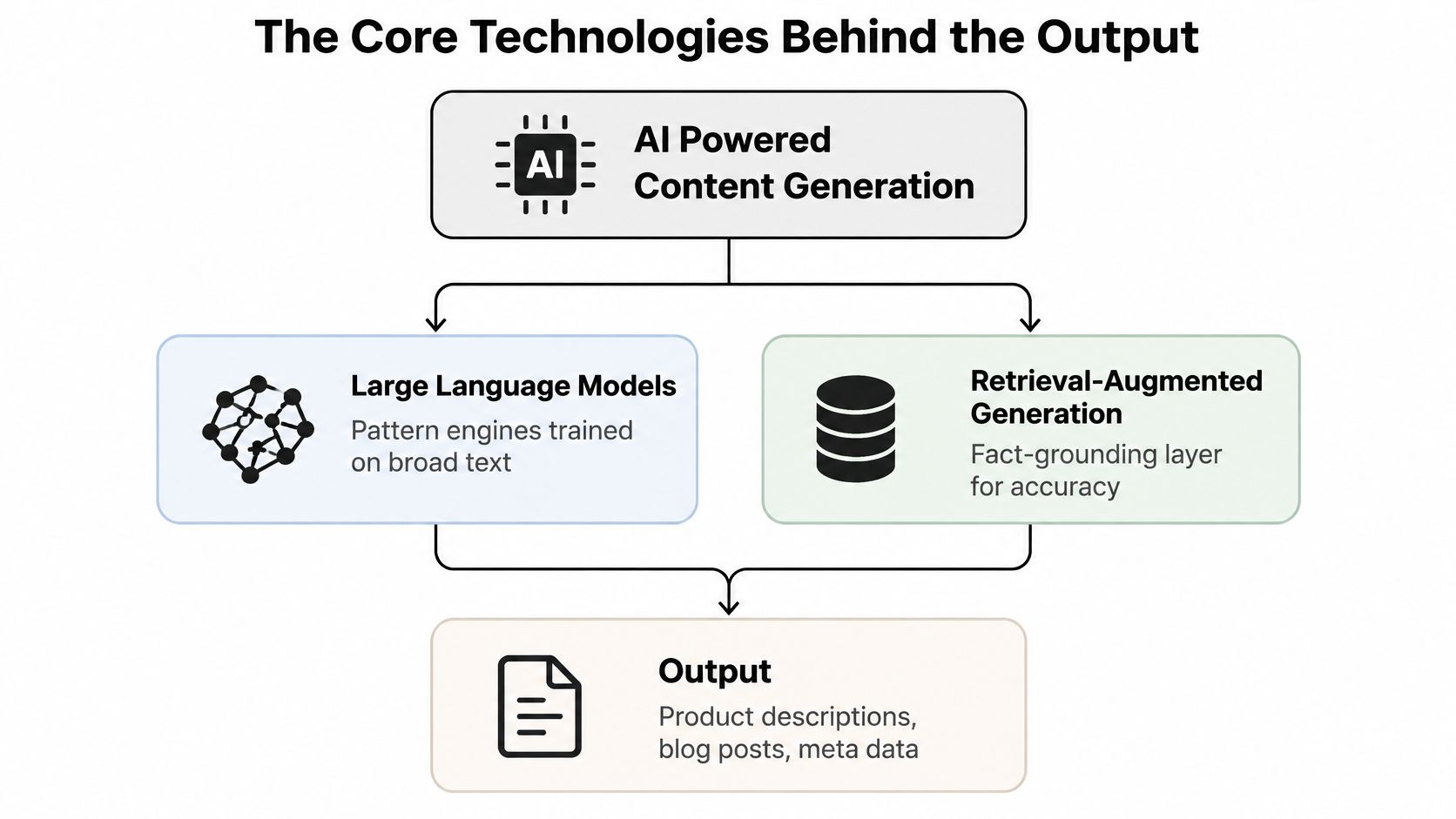
The diagram below maps those components to the outputs merchants ship.
The Writer, the Reference Shelf, and the Librarian
A large language model is the writer. It's a pattern engine trained on broad text, so it's strong at structure, phrasing, and adapting tone. It's weak at knowing your current dimensions, warranty terms, or whether a variant is discontinued. Fluency is not evidence.
Retrieval-augmented generation, or RAG, is the reference shelf. Before drafting, the system retrieves relevant product specs, collection rules, shipping policies, and approved claims from your own data, then asks the model to write from that evidence. When RAG is missing, the model fills gaps from memory and invents plausible details.
Embeddings act as the librarian. They turn your catalog and policy documents into searchable representations, so the system can find the right care instructions or compatibility note quickly. Poor indexing creates a specific failure mode. The writing looks polished, but it pulled the wrong product's facts or missed a required attribute entirely.
- Model failure: Generic phrasing, repetitive structure, tone drift across pages.
- Retrieval failure: Correct style, wrong or incomplete facts.
- Indexing failure: Relevant source exists in your data but never reaches the prompt.
Hybrid use is already normal outside ecommerce. A 2025 survey of 1,041 UK undergraduates on generative AI use found that 92% had used AI in some form, with text generation use rising from 30% to 64% year over year and 18% including AI generated and edited text directly in assessed work.
That pattern matters for stores. Most useful workflows aren't publish the raw output. They're explain, summarize, brainstorm, draft, and revise with a person controlling the final version. Your stack should be built for that loop, not for unattended publishing on day one.
A Production Workflow for Shopify Content
Build the workflow around evidence first, generation second. That order sounds obvious until you see how many setups generate a full page and then ask someone to fact check prose that was never grounded.
The five stages below show where automation helps and where it should stop.
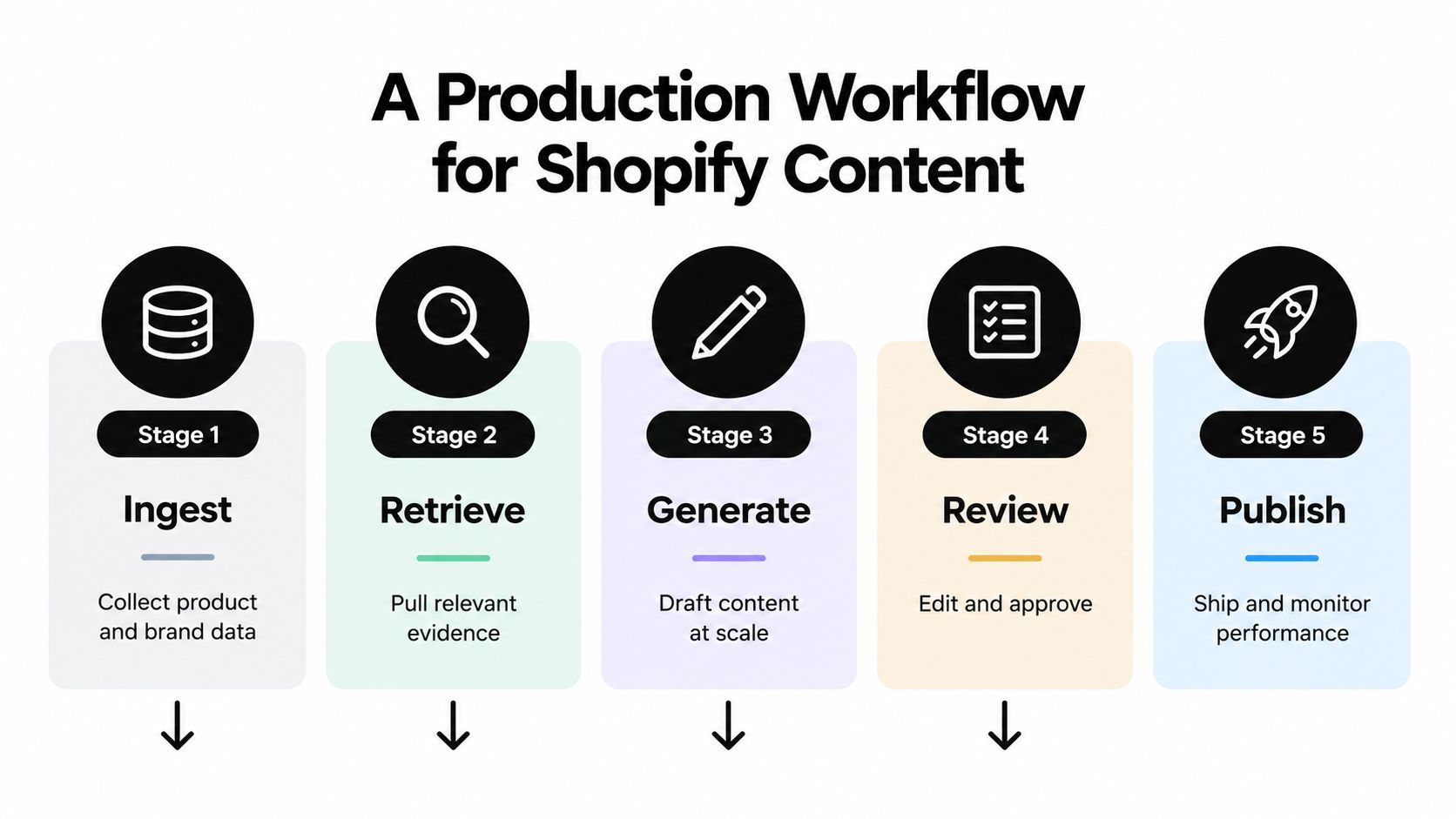
Five Stages That Hold Up in Production
- Ingest clean source data: Pull titles, metafields, specs, inventory status, policies, and brand rules into one maintained source. Fix contradictions here, not in the editor.
- Retrieve per attribute: For a buying guide or FAQ, retrieve price, dimensions, materials, compatibility, warranty, and availability separately. Don't let one search result carry the whole page.
- Generate with constraints: Set length, structure, required evidence, banned claims, and tone examples. Require the draft to stay inside retrieved facts.
- Check claims before review: Score evidence coverage, unsupported claim rate, and citation correctness. Send low coverage drafts back for regeneration, not to your editor.
- Review and publish with triggers: A person approves high value, regulated, or fast changing pages. When source data changes, flag affected pages for refresh.
Retrieval quality drives the result more than teams expect. The FRAMES evaluation of multi-step retrieval reported baseline accuracy of 0.40 without retrieval and 0.66 with a multi-step retrieval pipeline, an improvement of more than 50%, showing that retrieval and reasoning, not just the underlying model, drive end to end factuality.
That's why query decomposition matters for comparative content. Split the customer question into parts, retrieve evidence for each part, and synthesize only when the evidence set is complete. A polished comparison with one missing source can still reach the wrong conclusion.
The walkthrough below is useful for seeing how generation fits into a broader store build rather than sitting in isolation.
Escalation rule: Conflicting sources, low evidence coverage, or rapidly changing commercial data should trigger human approval, not direct publication.
SEO Best Practices and the Risks Worth Naming
AI drafting doesn't change what makes a page worth ranking. It changes how fast you can create pages that either meet that bar or miss it at scale.
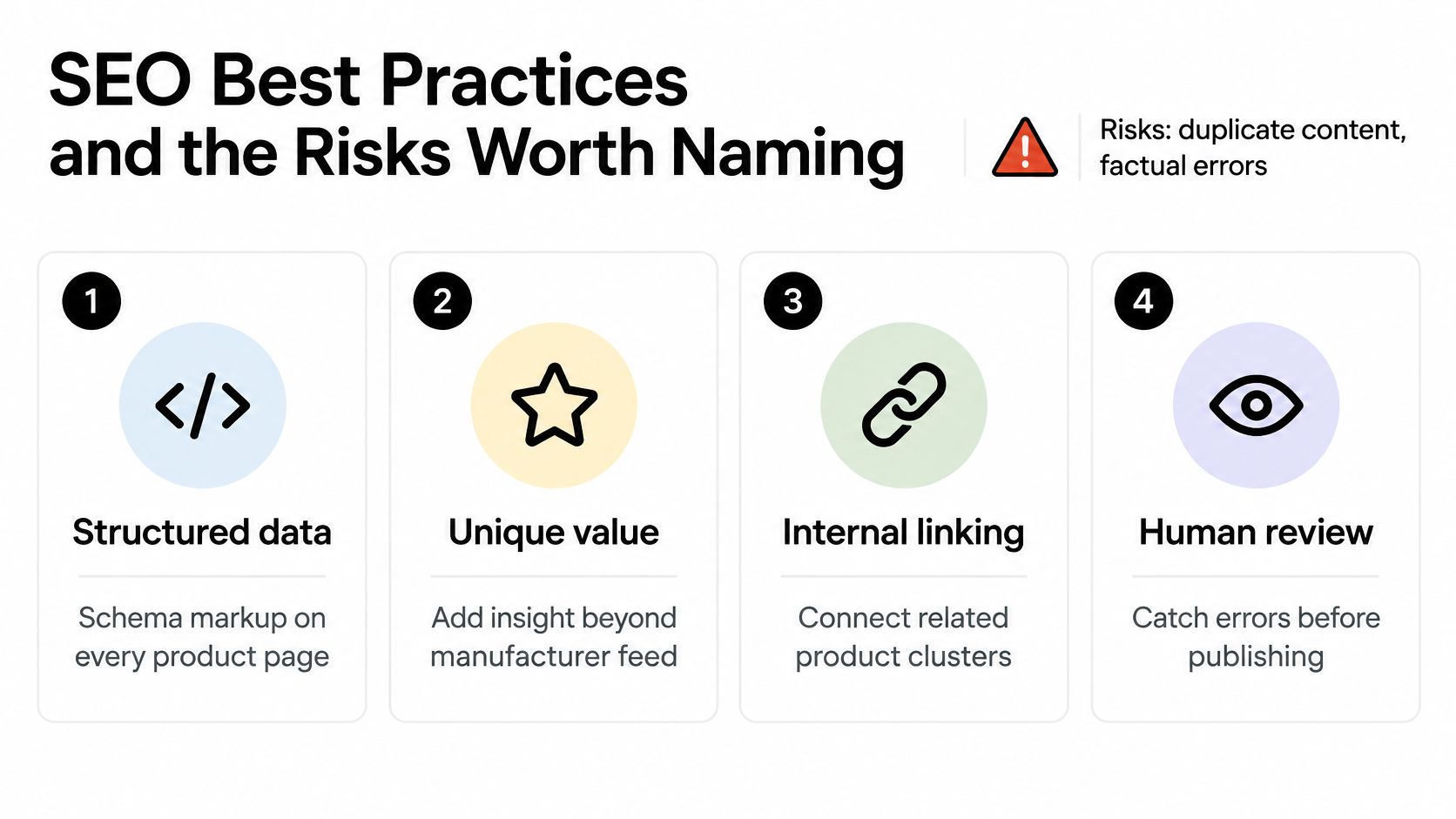
Guardrails Before You Publish
- Structured data on every product page: Keep schema aligned with visible price, availability, and product facts. Generated copy that contradicts markup creates avoidable trust problems.
- Unique value beyond the feed: Add sizing guidance, use cases, care details, comparisons, or first party observations the manufacturer feed doesn't contain.
- Internal linking tied to collections: Link products to relevant guides, compatible items, and collection pages based on real catalog relationships, not keyword stuffing.
- Refresh cadence over one shot generation: Review top pages when specs, pricing, or search intent shifts. Stale AI copy ages the same way stale manual copy does.
For the broader technical and on page foundations, practical ecommerce SEO best practices for Shopify stores covers the checks that sit underneath any content system, human or automated.
Risks That Deserve Plain Language
Thin and near duplicate variants are the fastest way to waste crawl effort. If size or color is the only difference, consolidate the copy strategy instead of generating slightly reworded pages. Search engines don't need hundreds of versions of the same paragraph, and neither do shoppers.
Hallucinated specs carry commercial risk, not just ranking risk. Wrong dimensions, materials, or compatibility claims drive returns and support tickets. Retrieval reduces that risk, but it doesn't remove it.
That's not caution for its own sake. The CRAG benchmark results on retrieval augmented generation used 4,409 question answer pairs and reported that leading models reached no more than 34% accuracy, while straightforward RAG improved accuracy only to 44%, showing retrieval alone is not enough and must be paired with human review for high value pages.
Treat that as an operating instruction. Automate drafting and checking, keep people on regulated claims, health and beauty efficacy language, and your highest revenue pages. What doesn't work is mass generation with no sampling, no claim checks, and no owner for corrections.
Tooling Options From Off-the-Shelf to Custom
The right path depends on catalog complexity, not ambition. A focused store with clean data can get real value from an app this week. A merchant syncing a PIM, multiple languages, and custom metafield logic will hit app limits quickly.
Three Paths and Their Trade Offs
Shopify native features plus a connected model suit light needs. You can draft descriptions, emails, and meta copy with low setup, but you'll manage prompts, evidence, and review yourself. That works for small batches. It breaks when consistency across a full catalog matters.
Off the shelf Shopify apps handle narrow, repeatable jobs well. Bulk generation, auto processing for new products, and real time progress tracking save the most time when the task is well defined and the inputs are stable. The trade off is ceiling. If your rules don't fit the app's fields, you'll work around it.
Custom automation fits when content has to talk to a PIM or ERP, follow strict claim rules, or generate across languages from one source of truth. Yassine Malti builds Shopify apps and custom automations in this category, which is one route among others when off the shelf logic can't express your catalog rules.
For a side by side view of categories, a roundup of the best AI tools for Shopify helps you separate drafting assistants from catalog scale systems before you commit.
Where Narrow Tools Earn Their Place
Meta tags are a good test case because the job is repetitive, structured, and easy to audit. RANKit AI Meta Tags Generator for Shopify generates SEO friendly meta tags based on product images, titles, and descriptions, with bulk processing, auto processing for new products, multi language support, and customizable generation using keywords and prompts.
That's the pattern to look for. Bounded input, bounded output, visible progress, and a human can spot check results fast. Open ended blog generation needs far more editorial control, so don't judge both jobs by the same standard.
If your team also uses conversational tools outside work, it's worth tracking family-friendly ChatGPT alternative updates to see how guardrails and content controls are evolving in consumer facing assistants. The expectations shoppers bring from those tools shape what they'll tolerate on your store.
- Choose native or app based tooling when: The task is repetitive, inputs are clean, and errors are easy to catch.
- Choose custom when: Claim rules, integrations, or languages make generic workflows create more cleanup than they remove.
A Worked Example for a Mid-Size Catalog
Take a fictional DTC skincare brand with 600 SKUs, messy image alt text, thin collection pages, and product descriptions copied from suppliers. The goal isn't to automate everything. It's to automate the surfaces where evidence is structured and review is fast, while keeping editors on claims and brand storytelling.
Start with meta titles, meta descriptions, and alt text. Those jobs have clear inputs and quick quality checks. Then move to product description refreshes for top sellers, using retrieved ingredients, usage instructions, and approved claims. Blog content comes last, built from real customer questions in support tickets and search queries, not from a keyword list with no product connection.
Where AI Content Fits in a 600-SKU Catalog
| Content Surface | Automation Level | Human Touchpoint | Suggested Tooling |
|---|---|---|---|
| Meta tags | High, bulk with sampling | Spot check top collections | Dedicated meta tag app |
| Image alt text | High, scheduled refresh | Review brand terms and accessibility | Alt text automation |
| Product descriptions | Medium, draft from retrieved specs | Approve claims and tone | RAG workflow plus editor |
| Collection pages | Medium, structured templates | Check merchandising logic | Template driven generation |
| Blog guides | Low to medium, outline and first draft | Full editorial review | Drafting model plus editor |
The review queue is where this succeeds or fails. Sort it by revenue and risk, not by generation order. Best sellers, regulated claims, and pages with low evidence coverage go first. Low risk meta copy can move in batches with sampling.
For the writing standards editors should apply in that queue, guidance on how to write product descriptions that convert gives a useful baseline for structure, benefits, and specificity before you automate any of it.
On images, ALT SEO: AI Alt Text Generator creates descriptive alt text using AI, can process an image catalog or schedule updates, and lets merchants tailor output with industry keywords and brand terminology. In this example, that fills an accessibility and SEO gap without asking editors to handwrite hundreds of image descriptions.
Early warning signs are practical. Watch for rising returns tied to description errors, support questions the page should have answered, near identical intros across a collection, and editors rewriting instead of approving. Any of those means your evidence, constraints, or routing rules need work, not more volume.
Measuring What Actually Matters
More pages is not a result. It's an input, and a dangerous one if it's the number your team celebrates.
Search journeys now run partly through AI answers. A shopper can discover your product in an AI summary, return later through branded search, and buy after an email click. Last click reporting credits the email, misses the content that started the journey, and teaches you the wrong lesson about what to produce next.
Metrics That Survive Attribution Loss
- AI answer visibility: Track impressions, answer inclusion, placement, citations, and query refinements where your tooling exposes them.
- Assisted commercial impact: Compare assisted conversions, branded search growth, product page engagement, and revenue per visitor after AI assisted launches.
- Content quality signals: Monitor returns, support questions per product, and correction rate in review. Fast production with rising corrections isn't efficiency.
- Annotation discipline: Log launch dates for AI assisted batches in analytics so you can separate content effects from promotions and seasonality.
The commercial case for tracking AI referred sessions separately is concrete. Microsoft's discussion of AI search conversion measurement cites Amsive finding that 56% of sites experienced higher conversion rates from AI driven sessions, with high traffic sites converting at 7.05% versus 5.81% for organic traffic, while Similarweb reported global ecommerce conversion rates of 11.4% for AI referrals compared with 5.3% for organic referrals.
Don't read that as proof your store will see the same lift. Read it as a reason to segment AI referrals in your own analytics, connect Search Console and order data, and check chatbot logs and post purchase surveys for discovery paths your reports miss.
Judge a content system by qualified visits, citations, and revenue it influences, not by how many drafts it produced this week.
Test changes in controlled batches. Refresh one collection, hold a comparable collection steady, and compare engagement and revenue per visitor. You'll learn more from that than from regenerating the whole catalog and hoping rankings explain themselves.
Quality, Ethics, and Your Operating Checklist
Disclosure is where quality and ethics meet conversion. SurveyMonkey's 2025 research on consumer views of AI marketing content found that 43% of U.S. consumers said they were less likely to buy from a company that relied on AI generated marketing content, while a separate study cited by Status Labs reported that visibly disclosing AI generated advertisements increased perceived ad trustworthiness by 73% and overall company trust by 96%.
Both signals can be true. Disclosure hurts when it reads as mass produced and unsupervised. It helps when it signals honesty and human oversight. Test phrasing and placement, especially AI assisted and human reviewed on editorial and advertising content, and measure add to cart rate, conversion, returns, and support questions.
- Accuracy bar: Every material claim traces to retrieved store evidence.
- Originality bar: Add first party detail beyond supplier feeds.
- Consent bar: Don't feed customer data into prompts without a clear basis.
- Synthetic media bar: Label generated imagery clearly. Before reusing supplier or creator assets, understand what an AI watermark remover removes so provenance signals aren't stripped by accident.
- Operations bar: Assign review owners, version your prompts and models, and audit published pages on a schedule.
Run that checklist weekly and you'll catch drift before shoppers do.
If you're ready to move from one off prompts to a grounded content pipeline with retrieval, review rules, and measurement built in, Yassine Malti builds SEO focused Shopify apps and custom automations for exactly that kind of work. Visit Yassine Malti to explore ready made apps or discuss a bespoke build that fits your catalog and existing stack.
Shopify apps by Yassine Malti
Put this into practice
-

ALT SEO · Image alt text
AI alt text for every product image · 100 images/month free
-

RANKit · Meta titles & descriptions
AI meta titles and descriptions, sized for Google · 50 meta tags/month free
-

Describer · Product descriptions
Product descriptions written from your own product data · Free: 50 descriptions/month