Generative engine optimization (GEO) is the work of making your pages easy for AI search tools to find, understand and cite in their answers. For a Shopify store, that work mostly happens in product data: titles, descriptions, alt text, meta tags, tags and the questions your pages answer. It is repetitive across hundreds of products, which is why we build single-purpose apps that run those updates in bulk or on a schedule, with rules you set and a review step that shows what changed.
This guide explains what GEO is, what separates it from classic SEO, what to fix on a store, how to measure it honestly, and which claims to treat with caution.
Table of Contents
What generative engine optimization actually means
AI search tools such as Google’s AI features, ChatGPT and Perplexity do not just list ten links. They interpret a question, often expand it into related searches, retrieve relevant pages and write a combined answer. Google describes this in its own guide: its AI search can use retrieval-augmented generation and query fan-out to pull in current pages and run related searches before it composes a response. Each assistant works a little differently, so treat that as Google’s description, not a rule for every tool.
GEO is the label for improving your chance of being part of those answers. You will also see it called AEO (answer engine optimization) or generative search optimization. Google’s guide treats these as labels for work to improve visibility in AI search, and says its generative features stay grounded in core Search ranking and quality systems.
The founding research paper, GEO: Generative Engine Optimization, frames the goal as visibility inside a generated response. Because answers blend several sources, where and how prominently you appear matters, not only whether you are listed. The paper reports gains of up to 40% in its experimental setting. That is a lab figure, not a promise of more traffic or sales, so use it as a reason to take content quality seriously and not as a forecast.
GEO versus SEO: what changes for a store
Traditional SEO aims at ranking and clicks. GEO adds a second question: is your brand or product mentioned, cited and described accurately in an AI answer? Search Engine Land’s October 2026 guide puts it this way: GEO widens SEO’s focus from rankings and clicks to being mentioned or cited, while the technical and quality foundations overlap.
That overlap is the good news for a merchant. You are not starting a second discipline. You are making the first one more complete.
For ecommerce, the difference shows up in the details an AI system needs to tell products apart:
-
Attributes such as size, material, compatibility and intended use
-
Variant structure, so one product with six colors is not six confusing pages
-
Prices and availability
-
Clear images with accurate descriptions
-
Answers to the questions a buyer asks before purchasing
A system that is asked for “a waterproof daypack for commuting under a set budget” can only recommend a product whose page states those facts plainly.
Start with the foundations Google says still apply
Before any GEO-specific work, confirm the basics. Google’s guide says a page must be indexed and eligible to appear with a Search snippet to be eligible for its generative Search features, and it adds that eligibility does not guarantee crawling, indexing or serving. So:
-
Make sure your product and collection pages are crawlable and not blocked by accident.
-
Keep unique, people-first content with clear headings and organization.
-
Meet the technical requirements for Search.
-
If you sell products, keep your Merchant Center feed accurate, since Google notes that feeds can support product visibility.
The same guide says you do not need special GEO schema or content broken into tiny chunks for its generative features. Structured data still supports rich results, so keep your standard product markup correct, but do not chase exotic tricks.
Our own walkthrough on making Shopify content easier for AI search to understand covers the store-level checks in more detail, and the guide to ranking in Google AI Overviews focuses on Google’s feature specifically.
The product data that AI answers draw on
Shopify’s GEO playbook makes a point that is easy to act on: product facts belong in structured, standard fields, including complete titles, descriptions, options, images, prices and taxonomy, not trapped in theme display logic where a crawler may never read them. It also advises grouping variants under one parent product and using specific categories and literal names instead of vague marketing labels.
Here is what that means field by field.
Titles and descriptions
Shopify’s ecommerce AEO guide recommends stating dimensions, materials, use cases and other factual details in simple declarative language, instead of relying only on brand copy. Compare two descriptions of the same bag:
-
“Meet your new everyday obsession. Effortless style for every adventure.”
-
“20-liter daypack in 600D recycled polyester with a padded 15-inch laptop sleeve, water-resistant coating and a removable rain cover. Designed for commuting and day hikes.”
Only the second gives an AI system something to quote. You can keep your brand voice and still lead with the facts. If you want a method for this, see our guide to writing better Shopify product descriptions with AI.
Alt text and image context
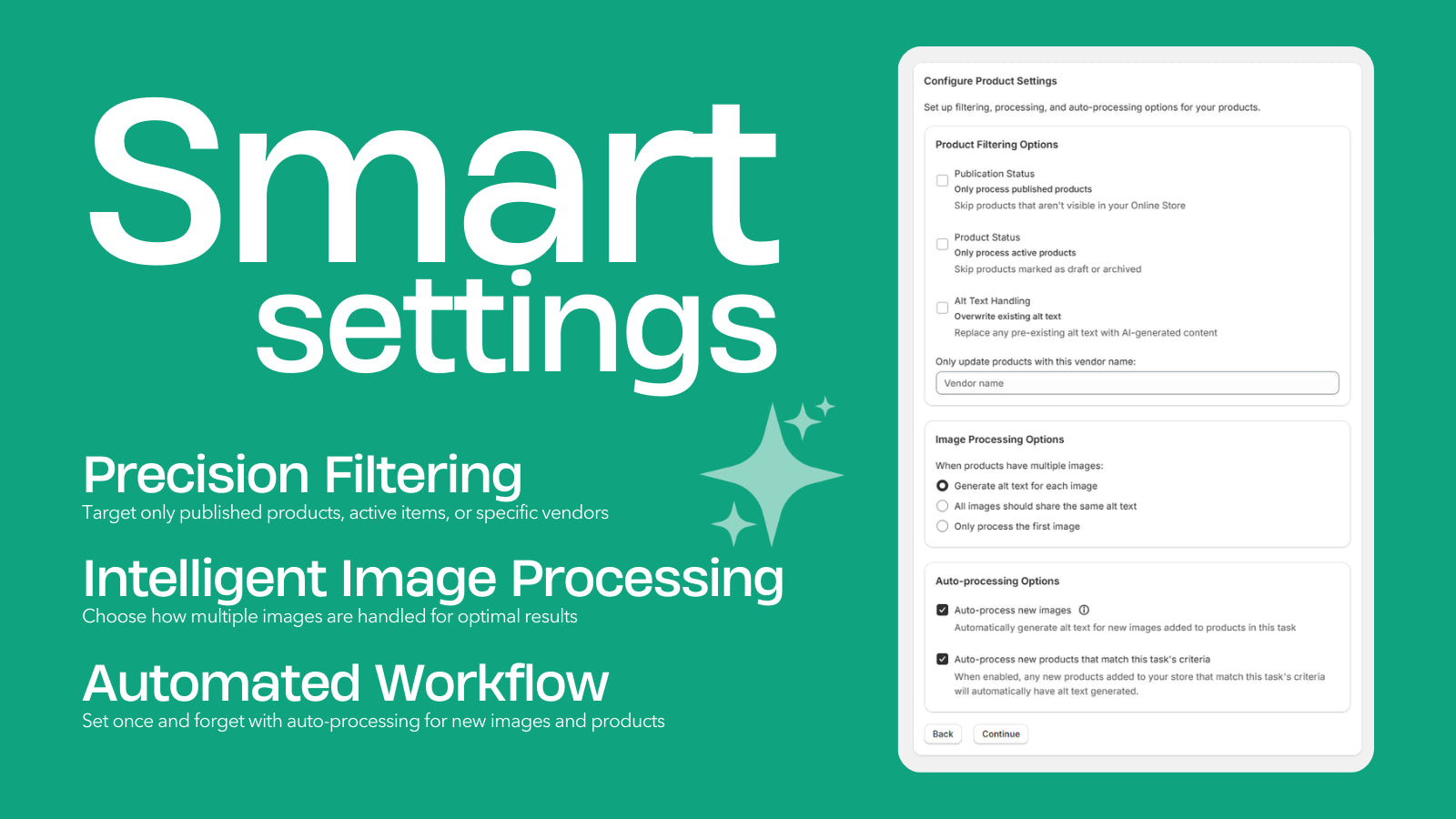
Images carry facts too: color, shape, what is shown in use. Descriptive alt text makes those facts readable as text. Writing it by hand for a catalog of several thousand images is the sort of job that never gets finished, so it tends to stay undone.
Meta titles and descriptions
These remain the summary a search engine sees first. Specific, accurate summaries that match what the page really says serve both classic results and AI features.
Tags and taxonomy
Consistent tags and a specific product category help systems group your catalog correctly. Inconsistent tagging (“tee”, “t-shirt”, “T Shirts”) splits signals that should be one.
Question-and-answer content
Search Engine Land’s Shopify SEO playbook recommends conversational copy, question-and-answer sections for shopping queries, clear specifications, and useful headings, lists, tables and visuals. Short FAQ blocks on product pages and helpful blog posts that answer pre-purchase questions fit here.
A practical GEO workflow for a Shopify store
The hard part for a merchant is not understanding GEO. It is applying it consistently across a catalog. This workflow works at any size, and at each step we note where bulk automation saves the most time.
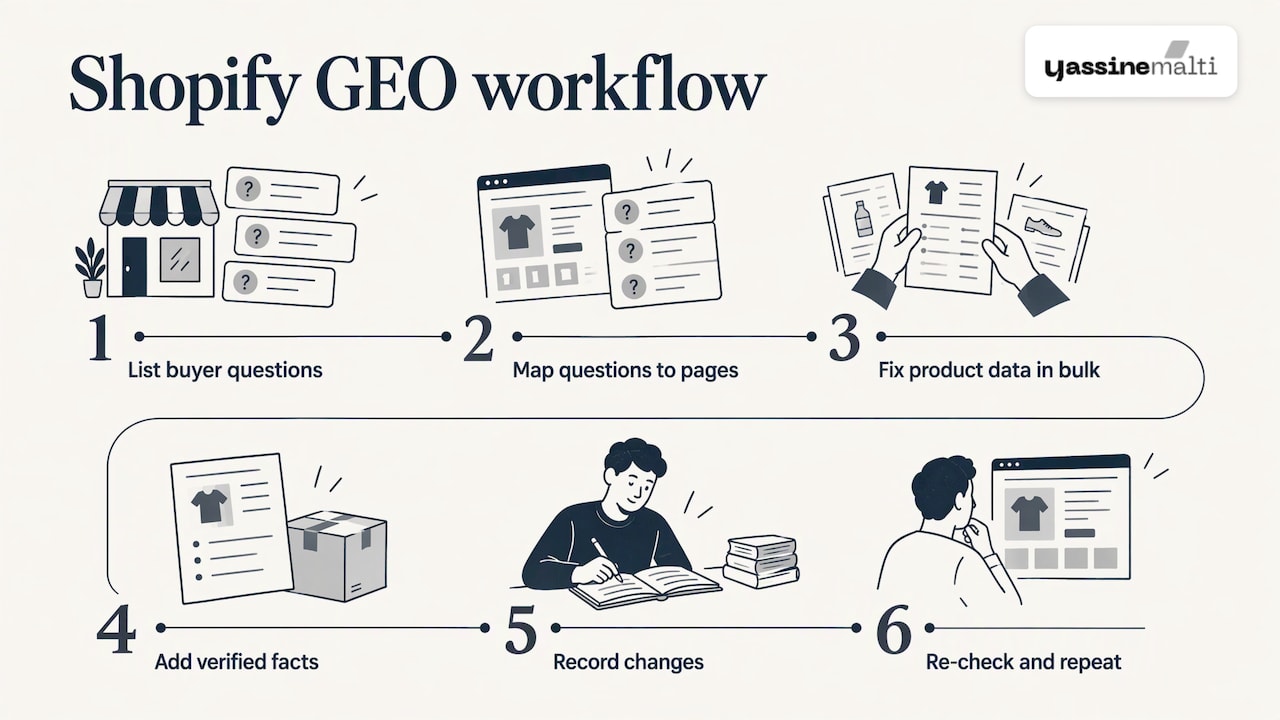
Step 1: List the questions your buyers ask
Start with the questions that come before a purchase: which size, which material, what is it compatible with, how does it compare, how do I use it. Pull them from customer emails, support chats, reviews and your existing keyword list. Shopify’s guide notes that stores can start from existing keyword lists when they begin testing prompts.
This step is judgment work and stays yours. Write down 20 to 50 questions and keep the list.
Step 2: Map each question to the page that should answer it
For every question, decide which single page is the best destination: a product page, a collection page or a blog post. Then check whether that page actually answers it in plain text. Gaps usually fall into a few types: missing attributes, vague copy, no alt text, weak or duplicated meta tags, inconsistent tags.
Step 3: Fix the product data in bulk
This is where the time goes, and where automation pays off. Our apps each do one job, so you can apply them to the gaps you found:
-
ALT SEO generates image alt text.
-
RANKit generates meta titles and descriptions.
-
TAGit handles product tags.
-
Describer writes product descriptions and is offered free.
-
Blogger writes SEO blog posts for the questions that deserve a full article.
-
LLMs TXT generates llms.txt files and is offered free.
The apps support bulk or scheduled tasks and configurable rules, so you tell each one how to write for your store (your terminology, the attributes to mention, the tone) and then run it over the whole catalog or a selected group of products. Review controls show what changed, so you approve what goes live instead of accepting output blindly. The apps are designed to work together while staying optional: you install only the one that matches the gap in front of you.
A sensible order for most stores is alt text first (fast, low risk), then meta tags, then tags, then descriptions for the products that matter most to revenue.
Step 4: Add your own facts before you publish
Automation writes faster than you can, but it cannot know what you have not told it. Put real specifications, materials, sizing notes and care details in the instructions and the product fields. Keep claims evidence-based and honest about limits. Do not invent certifications, performance figures or customer experiences. That protects your customers and also keeps the page consistent with what an AI system can verify elsewhere.
Step 5: Record what you changed
Keep a simple log: which products, which fields, what date. Without it you cannot tell later what moved the numbers. The review view in our apps shows the before and after of each edit, which makes that log easier to keep.
Step 6: Re-check and repeat
Catalogs change. New products arrive, descriptions drift, and old ones go stale. Scheduled tasks let new products receive the same treatment automatically, with the same rules and the same review step.
How to measure GEO without fooling yourself
AI platforms give far less reporting than Search Console does. Shopify’s guide points out that AI prompt tracking lacks the keyword-impression data of traditional search. A realistic approach has three parts.
Baseline referral traffic. In Shopify Analytics, filter by referrer name or order referrer name and compare sessions and sales from AI assistants against your other sources. Do it before you change anything so you have a starting point.
Sample prompts by hand. Run a fixed set of relevant questions in the AI tools your buyers use, and note whether your store or products appear and how they are described. Shopify’s guide frames prompt coverage as an imperfect sample, and that is the right way to read it.
Keep the test consistent. An independent 2026 survey of GEO research recommends repeated measurements, paraphrased prompts, controls and human validation instead of a single screenshot or a single visibility score. Hold the question set, the location and the tools steady between rounds, and treat a before-and-after change as a signal, not proof that one edit caused it.
Pair those observations with Search Console and your analytics referral data, then with orders. Visibility and mentions are not revenue on their own, so keep them in separate columns of your report.
Claims to treat with care
GEO is new enough that confident promises are common. A few guardrails:
-
Be wary of guaranteed placement. Google’s guide advises skepticism toward ranking promises or claims of access to its internal systems, and notes that following best practices does not guarantee crawling, indexing or serving.
-
Do not build pages just to steer AI answers. The same guide cautions against creating separate pages primarily to manipulate AI responses and against seeking inauthentic mentions. Write for shoppers, and AI systems benefit as a side effect.
-
Read lab results carefully. The 2026 survey notes that the headline visibility gains in the original research were measured with documents placed in a fixed context. They do not on their own show better organic retrieval, lasting traffic or conversions.
The practical conclusion is calm: complete, accurate, well-organized product content is useful for shoppers, classic search and AI answers alike. You are improving the asset, whichever interface reads it.
What a store owner should do first
If you have an afternoon, do this:
-
Confirm your key pages are indexed and crawlable.
-
Pick your 20 best-selling products and rewrite titles and descriptions around plain facts.
-
Fill every missing image alt text.
-
Review meta titles and descriptions for duplicates and vague wording.
-
Standardize your tags and group variants under one parent product.
-
Write down your baseline AI referral sessions and your prompt list.
Then run the same steps on the rest of the catalog in bulk. Our overview of AI search visibility for Shopify walks through the same ground from the visibility side, and the piece on AI-powered content generation covers how to keep generated copy consistent.
Doing this across a whole catalog
The catalog-wide part of GEO is where hours disappear: thousands of images without alt text, meta tags written once and never revisited, descriptions that say the same thing in different words. Our Shopify apps each take one of those jobs, apply your rules in bulk or on a schedule, and show you what changed before it goes live. Describer and LLMs TXT are free. Paid plans start at $29 per month for Starter, $59 for Professional and $119 for Enterprise, or $290, $590 and $1,190 per year, as listed on the pricing page.
Browse the full set of Shopify SEO and content apps to see which one matches the gap in your store, or start from our AI product content solution if descriptions are your biggest backlog. If you are a developer who needs something built around your own workflow, we also take on custom Shopify app development.
FAQ
Is GEO replacing SEO?
No. Google’s guidance says its generative features remain grounded in core Search ranking and quality systems, and Search Engine Land describes GEO as an extension of SEO’s goals. Crawlability, helpful content and accurate product data still come first, and GEO adds attention to being cited and described correctly in generated answers.
Do I need special schema or new pages for AI search?
Google’s guide says no special GEO schema is required for its generative features, and it warns against creating separate pages mainly to influence AI responses. Keep your standard product structured data correct, fill product fields completely, and write pages that genuinely answer buyer questions.
How long before I see results?
No one can promise a timeline. AI platforms report little, and independent research has not established stable, cross-platform effects on traffic or conversions. Record a baseline, make changes in documented batches, and compare using the same prompts and the same analytics filters each time.
What should I fix first on a Shopify store?
Start with indexing and crawlability, then product titles and descriptions that state facts plainly, then alt text, meta tags and tags. Fix your best sellers first, since those pages carry the most revenue. After that, extend the same rules to the full catalog.
Sources
-
Google Search Central: Guide to optimizing for generative AI features
-
Optimizing Visibility in Generative Engines: A Critical Survey (arXiv, 2026)
-
Search Engine Land: The ultimate Shopify SEO and AI readiness playbook
Recommended
Shopify apps by Yassine Malti
Put this into practice
-

LLMs TXT · llms.txt for AI tools
A short llms.txt of your real store links · Free
-

Describer · Product descriptions
Product descriptions written from your own product data · Free: 50 descriptions/month
-

ALT SEO · Image alt text
AI alt text for every product image · 100 images/month free