You've rewritten product titles, cleaned up collection pages, and finally started seeing your store appear near the top of Google. Then a customer searches a product question and Google answers it before the blue links, using sources you don't recognize. Your store may still rank, but the click now depends on whether Google includes your page in the answer and whether the cited result gives shoppers a compelling reason to continue.
That's the practical challenge behind how to rank in Google AI Overviews. Shopify merchants need more than keyword coverage. They need technically accessible pages, concise answers, trustworthy product evidence, and a measurement system that connects visibility to branded demand and sales.
Table of Contents
- How AI Overviews Are Reshaping Search
- Creating Concise Answer-First Content
- Leveraging Structured Data and Authority
- Auditing Your Technical SEO Health
- Shopify-Specific Implementation and Automation
- Measuring What Matters in an AI-First World
How AI Overviews Are Reshaping Search
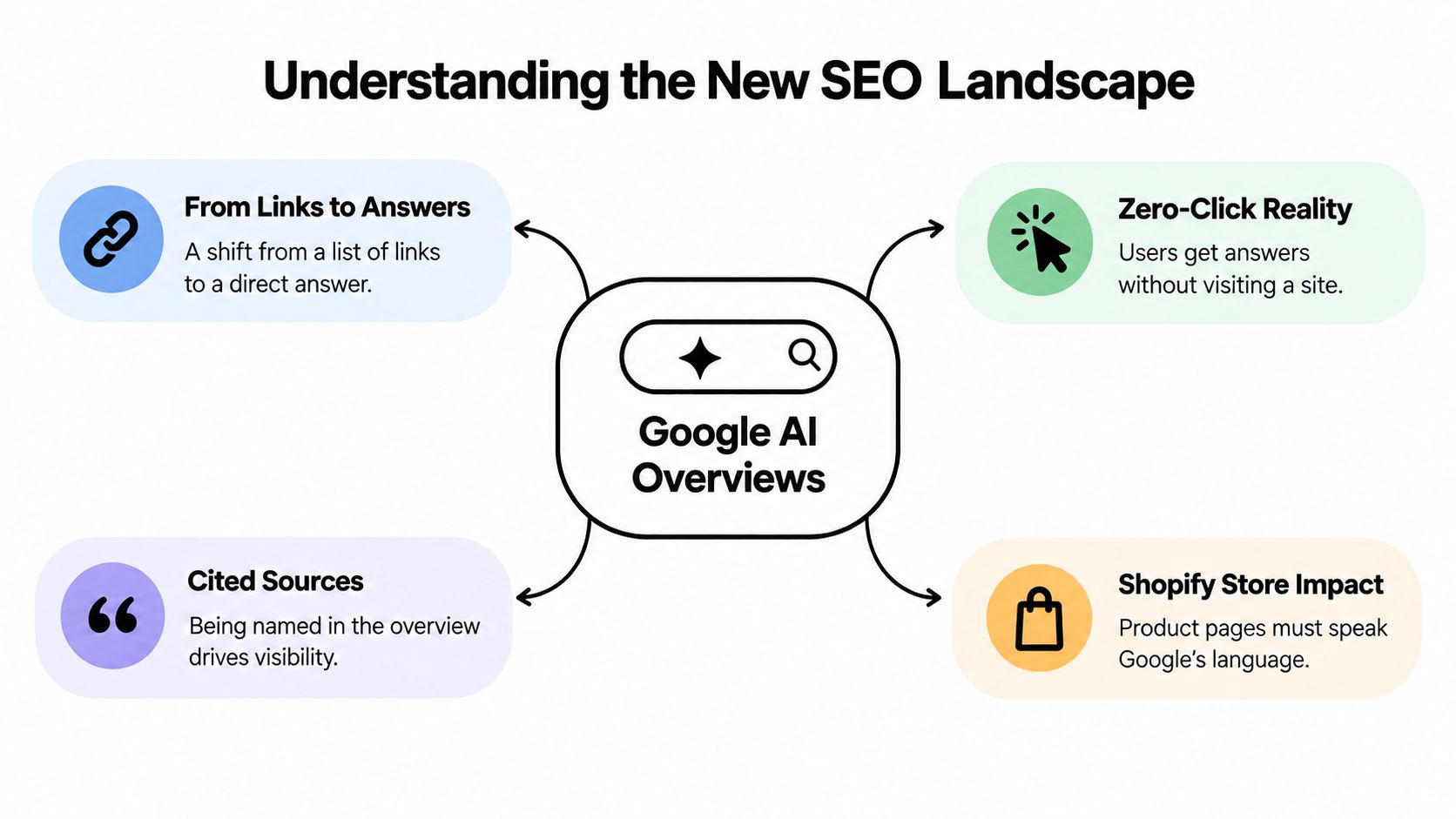
A Shopify store can hold strong organic positions and still lose attention on high-intent searches. A shopper asks whether a fabric is safe for sensitive skin or whether one model fits a specific device, and Google answers before the click. The traffic question is real, but it is only half the job. For stores, the goal is to win the citation and make that cited page persuasive enough to drive the next action, whether that is a product view, email signup, add-to-cart, or assisted sale.
Google rolled out AI Overviews across Search in stages, then expanded the feature into more markets and more complex query types. Google's overview of the rollout makes the bigger point clear. This is not a short test. It changes how organic visibility turns into visits and revenue.
For Shopify merchants, that changes page roles. A product page still needs price, options, compatibility, shipping details, returns, and proof that supports conversion. But many of the searches that trigger AI Overviews happen before the shopper is ready to land on a product page and buy. Google may combine claims from multiple URLs, summarize them, and show only a few supporting links. If your store wants that visibility, your content has to answer the question clearly enough to cite and support the purchase well enough to continue the journey.
Google also says there is no separate technical optimization system for AI Overviews. The basics still decide eligibility. Your pages need to be crawlable, indexable, policy-compliant, and useful, as explained in Google's AI features documentation. Query format still matters in practice, so stores should expect more AI Overview exposure on question-based searches and build pages that answer those questions directly.
That usually means expanding beyond product pages alone.
What changes for Shopify merchants
Stores that perform well here usually publish a connected set of assets, each with a specific job:
- Product pages for specifications, compatibility, options, limitations, and purchase actions.
- Collection pages that explain differences between product types and use cases.
- Comparison content that helps shoppers choose between models, materials, bundles, or sizes.
- Buying guides that answer broader pre-purchase questions while keeping a clear path to relevant products.
- Support content for setup, troubleshooting, care, shipping, returns, and post-purchase concerns.
This structure matters because clicks may go down on some informational queries while qualified visits improve. If Google answers the simple version of the question, your store still benefits when your page is cited, remembered, and chosen for the next step. In Shopify, that often means pairing educational content with practical conversion paths such as product cards, quiz flows, back-in-stock capture, review summaries, and follow-up email automation tied to the page topic.
The same discipline appears outside ecommerce. Advisor Momentum's SEO approach shows how clear topic coverage and audience-specific answers support visibility in a trust-sensitive category. The principle carries over to stores. Cover the decision, support the claim, and connect the answer to a commercial page without forcing the sale too early. This ecommerce SEO best-practices guide is also useful for reviewing the organic foundation under your AI Overview strategy.
Core principle: Google can't cite what it can't understand, and shoppers won't buy what the cited page doesn't substantiate.
AI Overviews raise the value of clear topical coverage, factual support, strong technical hygiene, and pages that do more than attract impressions. They need to convert attention into demand.
Creating Concise Answer-First Content
Answer-first content puts the page's primary response near the top, before a long introduction, brand story, or generic explanation. The format helps both readers and search systems identify the page's purpose quickly.
Start by writing one sentence that completes this prompt: “This page helps a shopper understand…” If the answer is “which running shoes work for flat feet,” the opening should answer that question directly, then explain the criteria and products. If the page is a product description, the opening should identify what the product is, who it suits, and the key condition that affects the buying decision.
A weak product introduction might say:
“Discover our premium everyday bottle, designed for modern lifestyles and made with care.”
That sentence supplies almost no decision-making information. A stronger version would state the product's material, capacity if verified on the page, intended use, compatibility, care requirements, and limitation. Don't add specifications just to make the copy sound authoritative. Use only facts your store can support through product data, documentation, testing, or clearly identified customer evidence.
A practical page structure
Use one defined intent per page. Then organize supporting information so each section can stand alone if a search system needs to extract it.
- Lead with the answer. Put a concise summary directly below the title or opening context. Keep it factual and specific.
- Name the decision criteria. Explain what matters, such as dimensions, materials, fit, compatibility, use environment, care, or delivery conditions.
- Support each claim. Link or refer to manufacturer specifications, testing methods, policies, or first-hand product evidence where appropriate.
- Handle trade-offs openly. State who the product isn't for, what it can't do, and which alternative may fit better.
- Use descriptive headings. Questions such as “Is this compatible with…?” or “Which material is better for…?” mirror real buying concerns.
- Finish with the next action. A comparison table, product selector, configuration tool, or relevant product link gives the shopper a reason to click.
A collection page shouldn't begin with several paragraphs of promotional copy. It should clarify what the collection contains, how the products differ, and which shopper should choose each group. A buying guide can open with a short recommendation, then show the reasoning, exceptions, and product paths.
Make extraction useful, not easy at any cost
Lists, tables, short paragraphs, and precise headings improve scanability. They don't guarantee a citation, and they shouldn't replace substance. Google's systems need enough context to distinguish a qualified claim from a vague marketing statement.
Conventional ranking remains important. One analysis reported that 76% of AI Overview citations came from pages in Google's top 10 organic results, while the median cited URL ranked third. The Digital Bloom analysis also reported citations from pages beyond the top 10, so top rankings aren't a guarantee. The practical order is to earn organic visibility, then improve the page's clarity and evidence.
For large catalogs, TAGit AI Product Tag Generator for Shopify can generate product tags from images, titles, and descriptions, process products individually or in bulk, auto-process new products, support multiple languages, and accept customizable prompts. Tags won't turn vague content into citation-worthy content, so review generated outputs for accuracy and keep the visible copy focused on shopper questions.
Leveraging Structured Data and Authority
Structured data helps Google classify what your page is about, but it only works when it matches what shoppers can see. On Shopify stores, that matters beyond visibility. If AI Overviews cite your page, the next step is conversion, and pages that overstate reviews, availability, or product details can lose trust before the visit turns into a sale.
Start with the template, then check the markup. Decide what information is present on each page type, then confirm that your theme or SEO app outputs schema that matches it. If a collection page contains buying guidance, product groupings, and clear selection criteria, the markup should support that. If a product page shows variant-specific pricing and stock, those fields need to stay synchronized with the live storefront.
Match schema to the page
Product structured data should describe the product the shopper is viewing, including its identity and the relevant offer details. Keep price, availability, variants, and similar fields aligned with the store's actual state. On Shopify, this usually means checking how your theme handles variant changes, sale pricing, and out-of-stock states rather than assuming an app got everything right.
Review structured data should reflect reviews visible on the page. Avoid marking up ratings pulled from an unrelated source, and avoid aggregate claims the page itself does not present. If the review content is thin or disconnected from the product being sold, it does little to support citation quality or buyer confidence.
FAQ structured data works when the questions and answers are visible and useful. A hidden block of generic FAQs added only for search engines weakens the page. It also misses the bigger opportunity, which is to answer the objections that stop a shopper from buying.
Test your implementation with Google's validation tools, then review Search Console for errors. More markup is not better by default. Accurate fields that stay current are safer than a large schema block full of stale or unsupported properties.
Build authority through evidence
AI Overviews often combine claims from several pages, so grounding matters. Research found that only 41.9% of overviews were fully supported by their citations across every verifiable claim, according to The NewsWise report on citation grounding. For Shopify merchants, that creates an opening. Pages with attributable, checkable information are easier to cite and easier to trust after the click.
Authority shows up in specifics:
- First-hand product testing, with the method and conditions explained.
- Compatibility tables, tied to identifiable models or versions.
- Transparent comparisons, including the criteria used and the cases where one option loses.
- Original photography and demonstrations, showing the product in its intended context.
- Clear policies, especially around returns, delivery conditions, warranties, care, and support.
- Consistent business information, across the store, publisher profiles, and relevant partner pages.
Internal links should connect answer-focused content to collection and product pages with descriptive anchor text that helps both Google and shoppers. A guide about choosing a backpack should point to the right capacity or use-case collection, not just the homepage. For a practical explanation of trust signals and experience, see E-E-A-T in SEO.
Off-site signals can reinforce that picture when they come from relevant, legitimate relationships. Backlinker SEO Auto Pilot Backlinks Posts offers a workflow for finding partner stores by niche, language, and location, submitting drafts for review, and tracking collaboration activity. Treat those placements as editorial partnerships. Useful content and relevance support both citation potential and the traffic that still needs to convert.
Auditing Your Technical SEO Health
AI Overviews can reduce clicks for some informational queries. Analysts at Ahrefs found that some top-ranking pages saw lower CTR when an AI Overview appeared (Ahrefs study). That makes technical SEO more tied to revenue for Shopify stores, not less. If your page gets cited, the visit that still comes through needs to land on a fast, accessible, trustworthy page that can move a shopper from answer to product.
Shopify covers core hosting and platform maintenance, but stores still break in familiar ways. Theme edits, app conflicts, faceted navigation, redirect chains, and script-heavy templates can stop Google from accessing, rendering, indexing, or interpreting the pages you want cited.
Start with commercial pages first. Check key products, collections, guides, and support content for indexability, internal links, and the correct canonical URL. If one page exists through multiple paths, signals can split and Google may choose the wrong version to evaluate or cite.
A store-owner audit checklist
- Crawl access: Review robots.txt and confirm important content is not blocked by accident.
- Indexability: Check status codes, noindex directives, canonical tags, and Search Console coverage.
- Rendering: Test important templates with scripts limited where practical. Make sure product names, descriptions, prices, policies, and links still appear in the HTML Google can process.
- Internal linking: Confirm every strategic page is reachable through clear navigation or contextual links.
- Mobile usability: Test variant selection, menus, accordions, and checkout paths on a real phone.
- Performance: Remove unnecessary app scripts and heavy assets from templates that do not need them.
- Duplicate paths: Review filtered URLs, tracking parameters, pagination, and alternate product URLs for canonical consistency.
- Structured data: Validate that markup matches the visible page and updates when product details change.
These checks do not make weak content stronger. They remove the avoidable technical faults that keep useful pages out of the running.
Watch app interactions
Apps often create the mess. One SEO app can inject canonical tags while another outputs schema for the same template. A popup app can slow mobile rendering. A theme update can strip supporting copy from collection pages or move product details behind scripts that fail to load cleanly.
Keep a simple inventory of SEO, merchandising, review, and marketing apps. Note which templates each app changes, what code it injects, and whether the change still earns its place. After any major release, test a product page, a collection page, a blog article, and a policy page. Do not assume one clean template means the rest of the store is fine.
Audit rule: Fix crawlability, rendering, and template errors before you scale content or automation. If citation opportunities increase while your store experience degrades, traffic quality drops and conversion suffers.
Shopify-Specific Implementation and Automation
A Shopify store usually feels the AI Overview shift first on high-intent searches. A shopper asks which product fits their setup, whether two items are compatible, or what to check before buying. If your store only has thin product pages, Google can cite another source for the answer and you lose both the click and the sale. The safer approach is to build topic clusters that can earn the citation, then send the shopper to a page that helps them buy.
Start small. Pick a tight set of queries tied to revenue, such as compatibility, setup, maintenance, and product comparisons. Then connect each cluster to the right assets: one guide, one collection explainer, selected product pages, and one support answer. That structure gives Google concise material to quote and gives the shopper a clear next step after the citation.
Automation helps when it reduces manual work without lowering trust. On Shopify, that usually means a draft pipeline with human review:
- Export product titles, descriptions, images, variants, specifications, and policy-relevant fields.
- Group products by use case, compatibility, material, audience, and commercial intent.
- Generate candidate questions from those groups.
- Draft answer-first sections using only approved product data.
- Send drafts for human review, with unsupported claims flagged for verification.
- Publish internally linked content after technical and editorial checks.
- Record the page, target query cluster, update date, and evidence used.
For stores building conversational workflows around catalog data, this Shopify and ChatGPT integration guide shows one way to connect product information to content operations. The same rule applies whether you publish a blog post, power an on-site assistant, surface recommendations, or draft help content. Product data stays the source of truth.
Where apps help, and where they don't
Content apps can speed up first drafts for buying guides, comparison pages, and pre-purchase questions. They cannot verify whether a spec changed last week, whether an accessory only fits one variant, or whether a limitation needs clearer wording on the page. A merchant or editor still needs to check those details before anything goes live.
The same trade-off applies to metadata and tagging. Automated titles and descriptions can keep a large catalog tidy. Tag rules can improve internal organization. Neither one fixes a collection page that does not explain differences between product types, buying criteria, or common mistakes.
AI Overviews have changed quickly, and the practical takeaway is straightforward. Build a system you can update. Use Shopify Flow or a similar internal process to trigger review when a product changes, a specification is edited, or a new collection goes live. Keep a human approval step before publishing. Stores that win here usually publish fewer pages, refresh them faster, and connect citation visibility to conversion instead of chasing output for its own sake.
Measuring What Matters in an AI-First World
A citation can create visibility without creating a visit. That isn't a reason to ignore AI Overviews. It is a reason to separate three outcomes that traditional SEO dashboards often combine: citation visibility, branded demand, and post-click conversion.
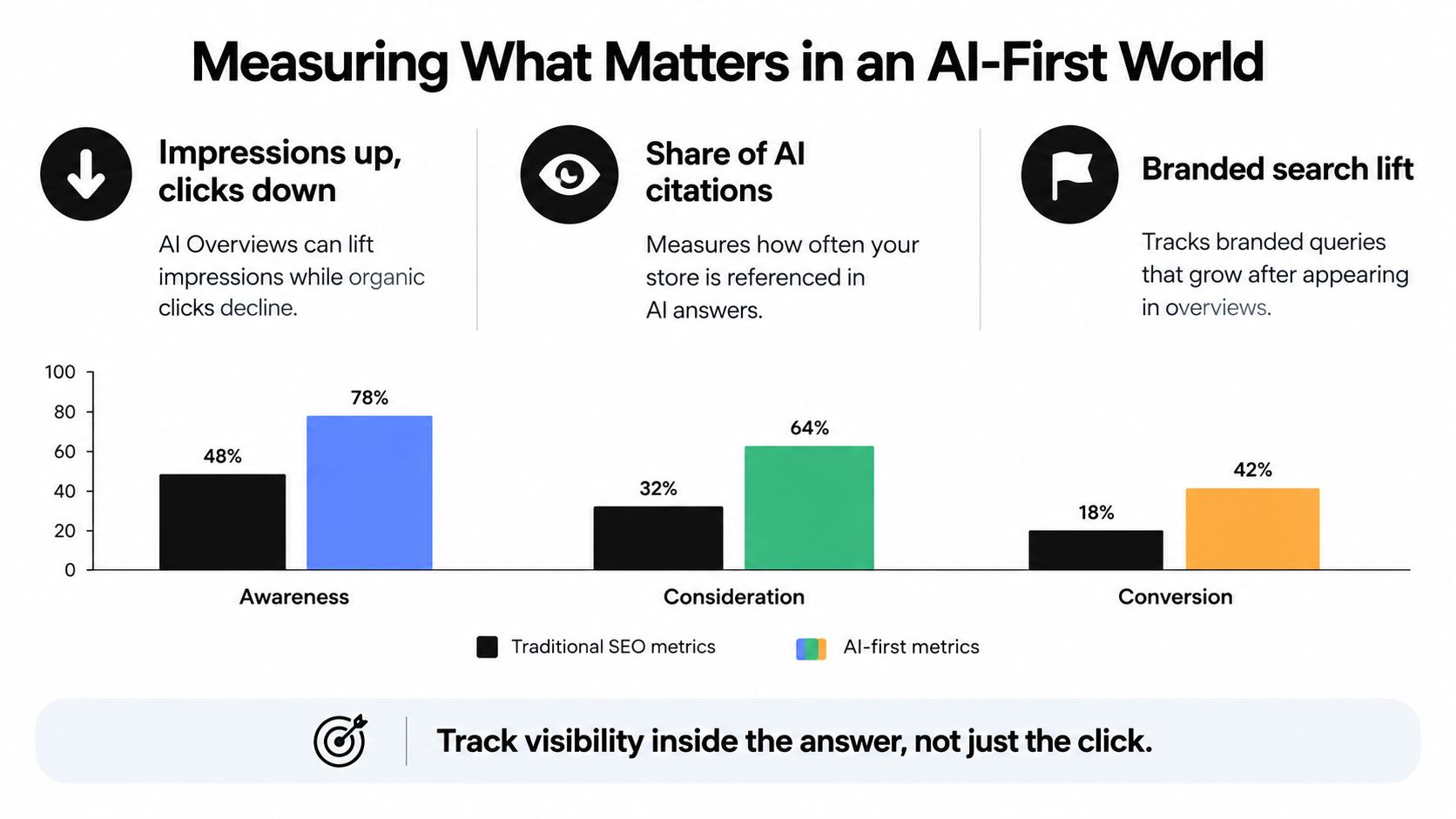
Ahrefs reported that top-ranking pages had a 34.5% lower average CTR when an AI Overview appeared. The reported CTR analysis explains why a fall in organic clicks doesn't automatically mean the content strategy failed. Google may answer part of the query directly, while the shopper remembers the cited brand, searches for it later, or returns through another channel.
Use a three-layer measurement model
Awareness measures whether the store is present. Track AI Overview appearances for a defined query set, cited URLs, brand mentions where observable, and citation share by topic or intent. Manual SERP snapshots can supplement rank tracking because AI coverage changes by query, country, device, and product category.
Consideration measures whether visibility creates demand. Monitor branded queries in Search Console, returning users, direct sessions, product-page engagement, and interactions with comparison tools or buying guides. Compare branded demand against annotated content updates, citation changes, and seasonal effects rather than treating every movement as an AI result.
Conversion measures whether the visibility assists revenue. Use analytics to review assisted conversions, conversions from organic landing pages, revenue from query clusters, and the path from informational content to product selection. A guide may introduce the shopper, while a later branded or direct visit completes the purchase.
A compact dashboard might include:
| Funnel stage | Traditional view | AI-first addition |
|---|---|---|
| Awareness | Impressions and rankings | Cited URLs and query-level Overview presence |
| Consideration | Organic sessions and CTR | Branded searches, returning users, and assisted paths |
| Conversion | Transactions from landing pages | Revenue and assisted conversions by topic cluster |
Interpret declining clicks correctly
Don't respond to lower CTR by making every page shorter or stuffing more keywords into the opening. First ask whether the page is being cited, whether branded searches are changing, and whether the remaining visitors convert at a different rate. A useful cited page should offer something Google can't fully reproduce, such as an interactive selector, complete compatibility evidence, original testing, a transparent comparison, or a direct purchase path.
Track results by intent. Informational questions may produce awareness with fewer immediate visits, while compatibility, product-selection, shipping, and brand-specific queries may lead closer to purchase. Separate those groups in reports so a broad visibility gain doesn't hide weak commercial performance.
Measure the business result, not just the appearance. A citation is an intermediate outcome. The value comes from what happens to brand demand, qualified visits, assisted conversions, and revenue afterward.
Review the dataset regularly and annotate every major content, template, app, and merchandising change. AI Overview coverage can change independently of your work, so controlled updates and consistent query sets provide a more credible picture than isolated screenshots or rank movements.
Yassine Malti builds Shopify apps and custom automations for SEO, AI-assisted content, on-page optimization, and conversational commerce. Visit Yassine Malti to explore Shopify tools or discuss a custom workflow for turning AI Overview visibility into measurable store growth.
Shopify apps by Yassine Malti
Put this into practice
-

TAGit · Product tags
SEO-friendly product tags, generated in bulk · 50 tags/month free
-

Backlinker · Backlinks & guest posts
Guest post backlinks from real Shopify stores · 30 credits/month free
-

ALT SEO · Image alt text
AI alt text for every product image · 100 images/month free